
The best AI books to read in 2027 depend on the question that sent you looking. Which book should you pick up first? If you are trying to make an agent finish a messy real task, a book on neural-network maths can wait. If you want to understand how a model learns, another collection of prompt examples will leave you hungry.
These 21 books do different jobs. Some help you build; some help you decide what is worth building. A few will make you question the claims that arrive with every new model. The authors disagree with one another, which is useful when you are trying to decide what you believe. The first three are books I wrote, so keep that in mind when weighing my recommendations. Start with the section that names the problem you are facing.
Affiliate note: Some linked book titles contain Amazon affiliate links. If you buy through one, I may earn a commission at no extra cost to you. You can read my full disclosure.
How to choose an AI book you will actually finish
Start with the work in front of you. An agent that forgets its instructions calls for a different book than a job interview or a first Python model. You can use this quick match before reading the full list:
- Building agents or RAG apps? Begin with the Harness or Context Engineering Blueprint, depending on whether your headache is multi-step action or the information going into the model.
- Moving into AI product work? Start with the AI Product Manager Blueprint, then read Power and Prediction when you need to rethink a real business decision.
- Learning how models work? Try Grokking Deep Learning if you know Python. Move to Understanding Deep Learning when you want the maths.
- Trying to make sense of the field? Melanie Mitchell’s book gives you a broad starting point. The AI Con gives you sharp questions to ask of product claims.
Books cannot keep an API example current. I use current documentation for commands and books for the slower questions: why a model fails, how a team tests one, and what people mean when they call a system intelligent. If you are new to the subject, my learn AI from scratch guide can help you put a book alongside hands-on practice.
21 best AI books to read in 2027
Each book below has a different starting point. The first three cover systems around AI applications and AI product work; the rest take you through the models themselves, the people who built them, and the arguments about what they can do. Start with the section that sounds like your current problem, then look at the nearby titles if you want to go further.
1. The Harness Engineering Blueprint: best for dependable AI agents
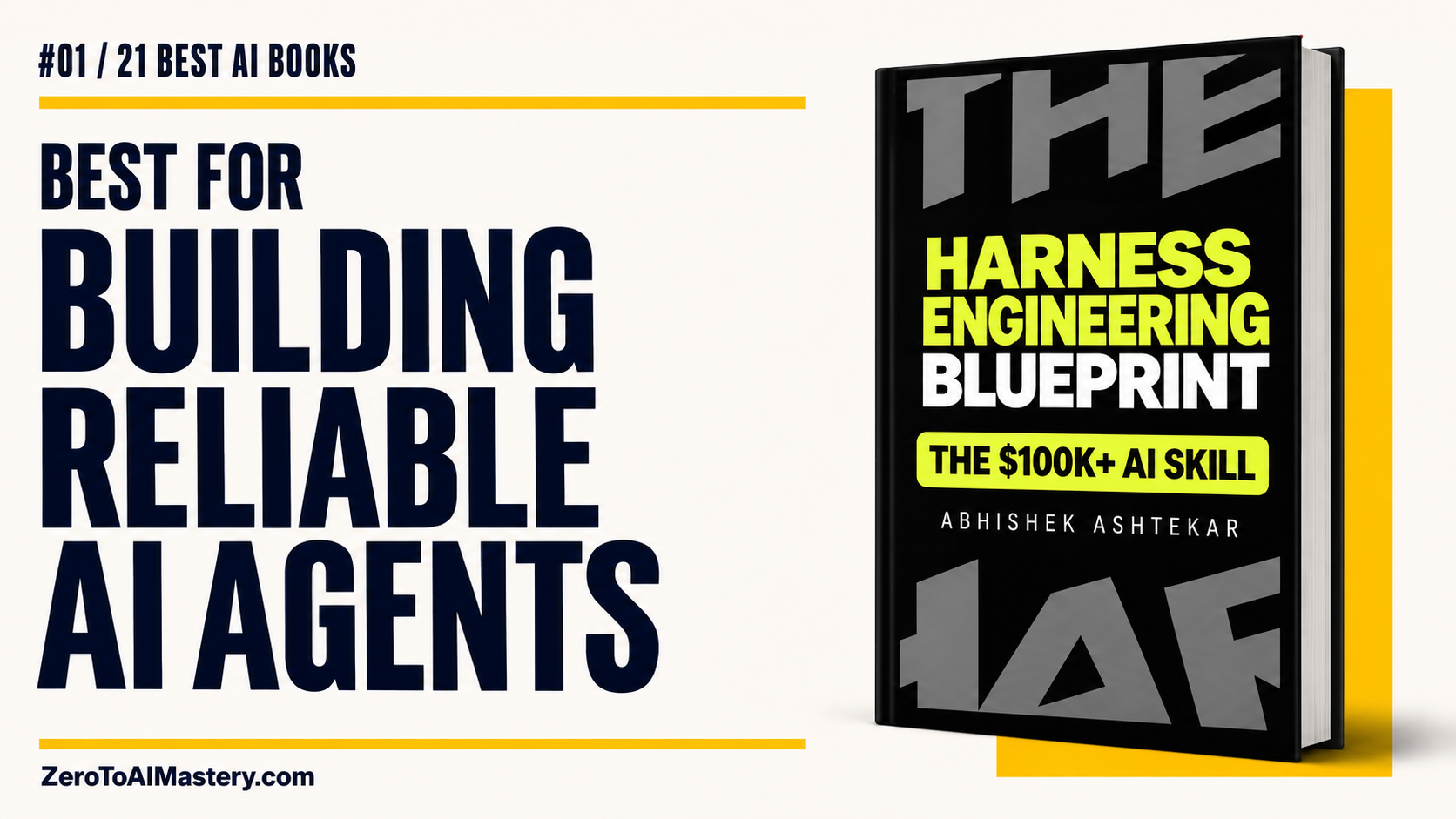
The Harness Engineering Blueprint is the one I would hand to someone whose AI agent works in a demo and falls apart on an ordinary Tuesday. I wrote it around a coding agent building a habit-tracker feature. As the project grows, the agent needs more than a clever prompt: it needs tools it may use, context it can trust, checkpoints, tests, logs, and a way to recover when a step fails.
You do not need a machine-learning degree to follow the book. The interesting part is the system wrapped around the model. When an agent edits the wrong file, you should be able to see what it read, what it decided, and where the workflow let it drift. That is what the chapters on permissions, evaluations, and graph workflows are for. If you build agents for other people to use, this is a practical place to start. My harness engineering introduction covers the central idea in a shorter read.
The agent project lets you watch several parts of a dependable run come together:
- The loop: Follow what the agent sees, decides, and does on each turn. A run log is much easier to debug when you can point to the exact turn that changed direction.
- Tool access: Give the agent enough permission to finish its task, then make it ask before touching anything outside that scope.
- Context and memory: Check which instructions and previous notes travel into the next step. An irrelevant memory can send a good model after the wrong task.
- Checkpoints: Keep a state you can return to before a large edit. Recovery is part of the design, not an apology after a mistake.
- Evaluations: Test the awkward cases: an unavailable tool, a misleading file name, or a request that needs clarification.
You can take those ideas into a small agent of your own. Give it one useful tool, then watch what happens when that tool returns an error. If you can explain its next move and recover without starting over, you have learned more than a polished one-shot demo can show. The book goes deeper into engineering than someone looking only for prompts needs right now.
2. The AI Product Manager Blueprint: best for entering AI product work
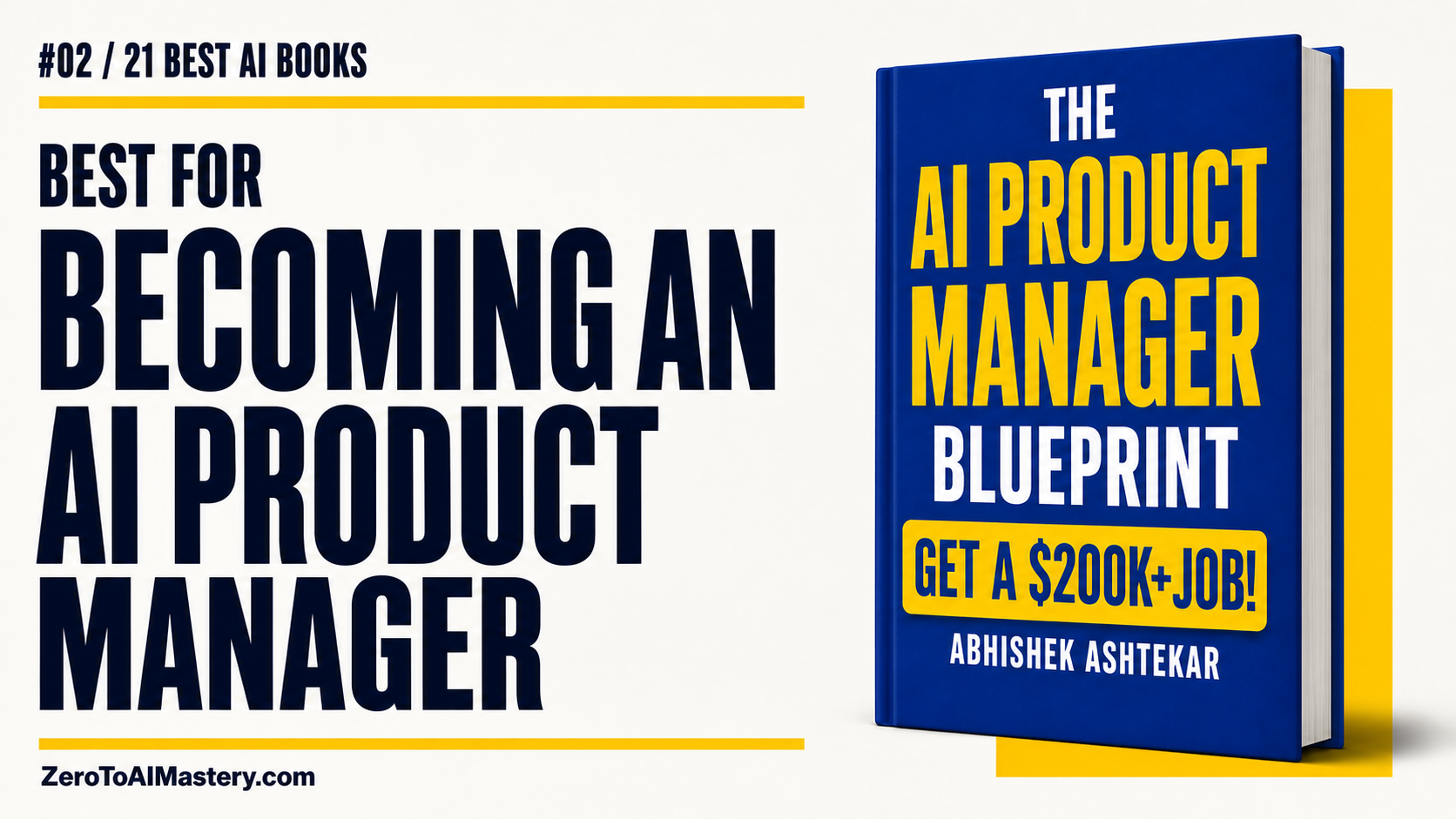
The AI Product Manager Blueprint starts where many career guides skip ahead. What does an AI product manager actually decide all day? I wrote it for readers entering the role without a technical background, so it begins with the job itself before moving into LLMs, RAG, agents, evaluation, and product trade-offs.
The portfolio work matters as much as the terminology. The book walks through five projects, including an AI interview coach and a knowledge assistant built with retrieval. A project like that gives you something more useful to discuss in an interview than a list of tools you have tried. It also covers the resume, interview process, and first 90 days in the job. If you already manage AI products, you may know much of the early material; jump to the portfolio and decision chapters. I compare other routes into the role in my AI product management book guide.
The portfolio chapters help you show the product decisions behind a project. Here are a few choices you should be able to explain:
- Which problem? Name the user and the task before choosing a model. If you cannot describe what someone is trying to do, a feature list will not rescue the idea.
- Which parts need AI? An interview coach might suggest follow-up questions, while a person still judges whether the advice is useful and fair.
- How will you test it? Include bad inputs and wrong answers. A product manager needs to know what happens when the attractive demo fails.
- What would you change? Show how feedback altered the first version. That is easier to discuss in an interview than a finished screenshot.
- Where does it stop? Tell the reader when a person takes over or when the system should admit that it does not know.
You can build a modest project without an engineering team. Your explanation of the choices matters more than pretending the prototype is ready for millions of users. If you already manage AI products, skim the career basics and spend your time on the project and evaluation chapters.
3. The Context Engineering Blueprint: best for RAG and useful model context
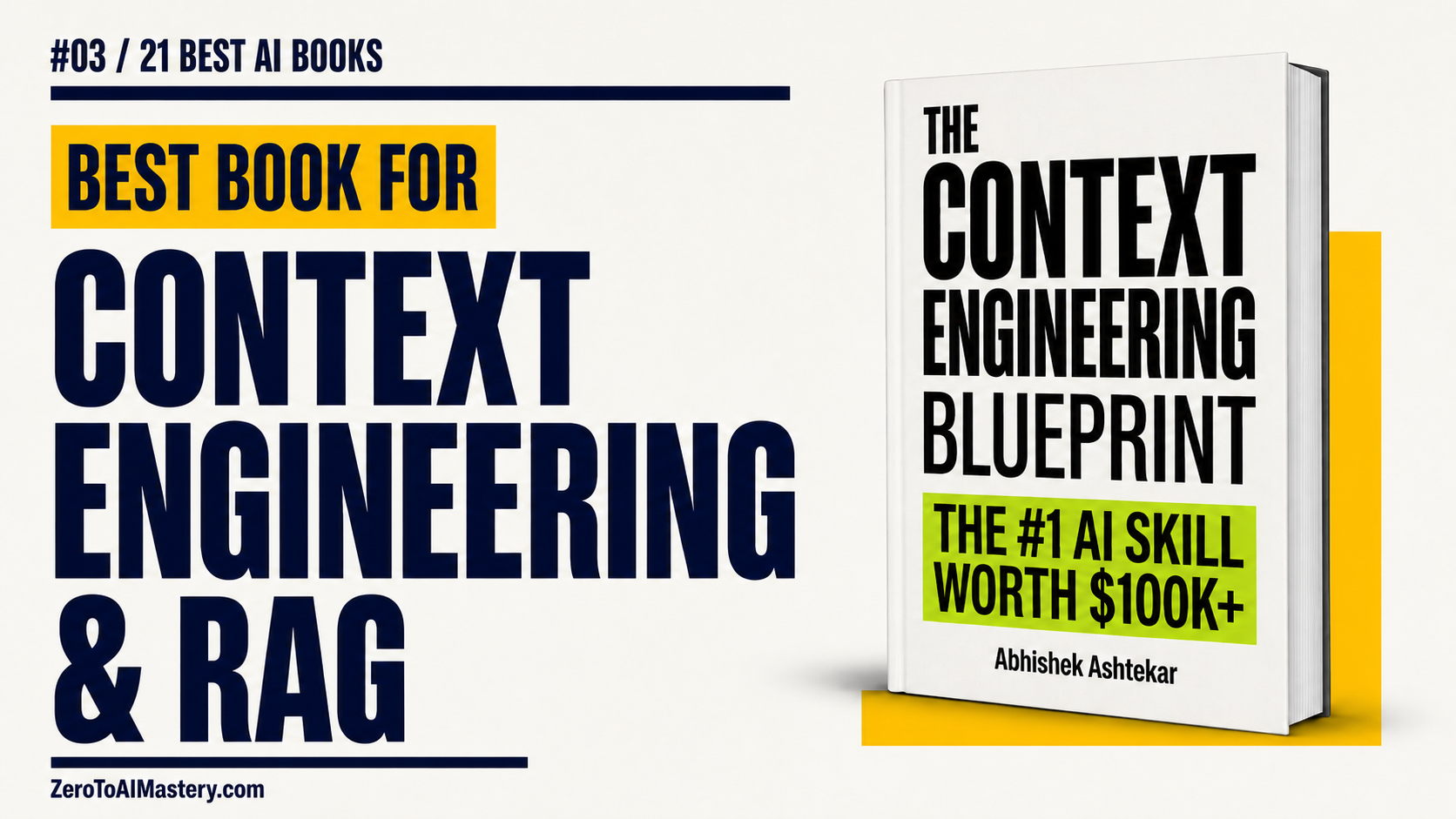
The Context Engineering Blueprint is for the moment your prompt stops being the whole application. Once your assistant must search documents, remember a conversation, or call a tool, the question becomes: which information should the model see right now? I wrote the book to make that design problem concrete through a customer-support assistant.
The chapters move through context windows, embeddings, chunking, retrieval, reranking, memory, and evaluation. Imagine a customer asking about a refund. The assistant needs the right policy page and the relevant order details; giving it the entire company drive is neither helpful nor safe. You can test each retrieval choice against the answer it produces. Start here if you are building a RAG application and keep getting confident answers from the wrong document. My context engineering learning guide provides a shorter route through the basics.
The customer-support example becomes more useful when you test the points where information can go wrong:
- Chunking: Split a policy document without tearing a rule away from its exception.
- Retrieval: Check whether search found the right passage before blaming the model for a bad answer.
- Reranking: Move a relevant source ahead of a passage that merely shares a keyword.
- Memory: Keep the customer’s useful context without carrying unrelated details into every reply.
- Evaluation: Ask questions with answers in different documents, then include a few that the documents cannot answer at all.
Change one piece at a time and see which passage the assistant uses. If the retrieved text is wrong, a fancier prompt will not fix the underlying search. If you are only talking to a model in a chat window, some of this application design will feel early. Come back when your own data or tools enter the picture.
4. The AI Con: best for questioning confident claims
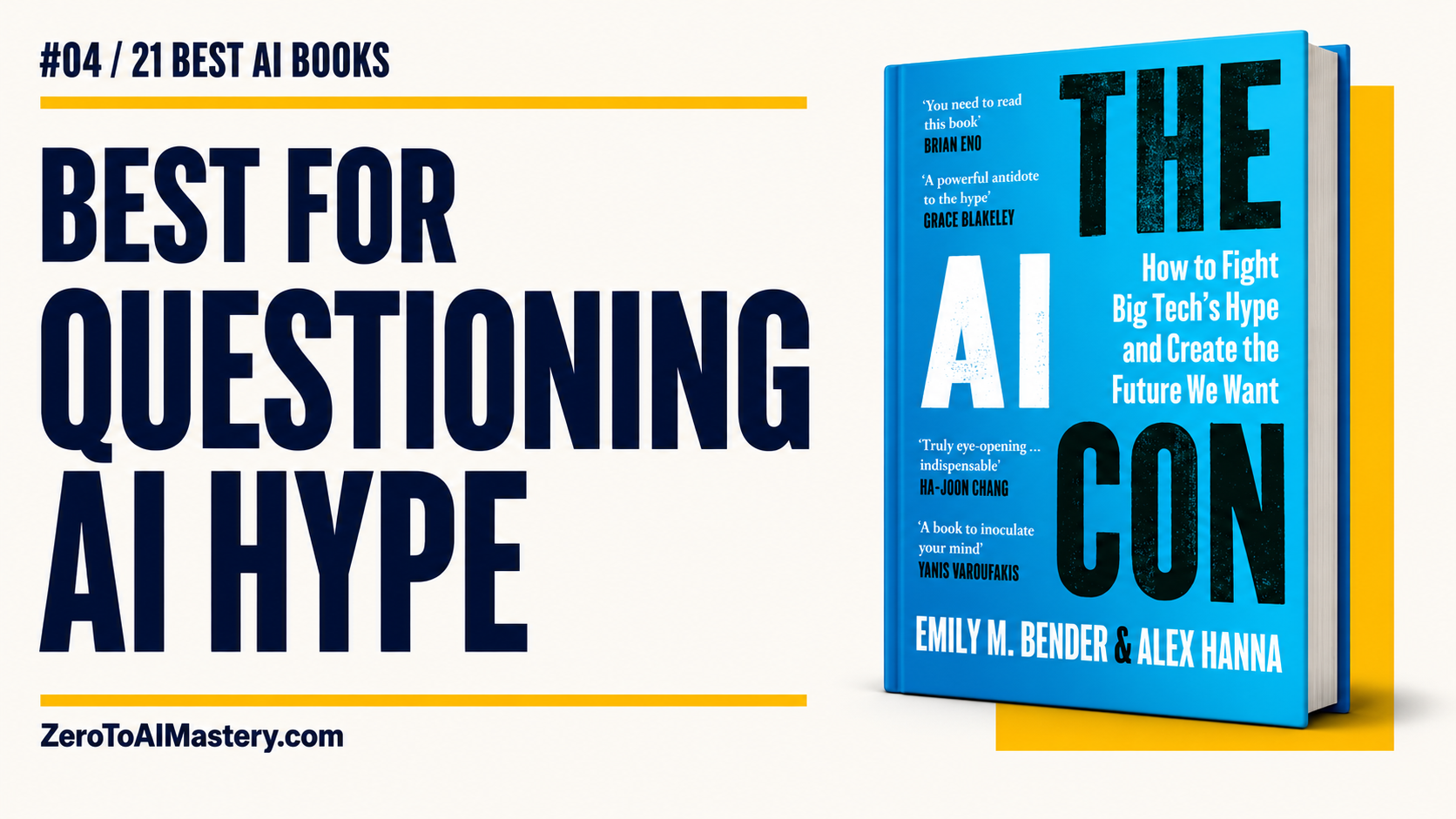
The AI Con is Emily M. Bender and Alex Hanna’s bracing look at the stories told around AI products. They ask who prepared the data, who checked the output, who does the hidden labour, and which failures disappear from a polished demonstration. You may disagree with their conclusions. Their questions are still useful when a company claims its model can replace a job.
Take a claim you have heard this week and put the book to work on it. If a tool supposedly replaces an analyst, what tasks did the test include? Who chose the examples? What happens on the ugly cases? Bender and Hanna make you slow down before treating a successful demo as a dependable service. This is argumentative writing, not a coding manual, and it reads best beside a builder’s account of what the systems can do.
For a team buying or building AI, the book gives you a useful set of questions to bring into the meeting:
- What work did people do behind the scenes to produce the demo?
- Who chose the test cases, and which cases were left out?
- How often does a human have to correct the result in ordinary use?
- What happens to the person affected when the system gets a consequential answer wrong?
Those questions are specific enough to ask a vendor and simple enough to ask yourself. A book that changes the questions you bring to a product pitch can be worth reading even if you remain unconvinced by its larger argument.
5. A Brief History of Intelligence: best for the brain and AI connection
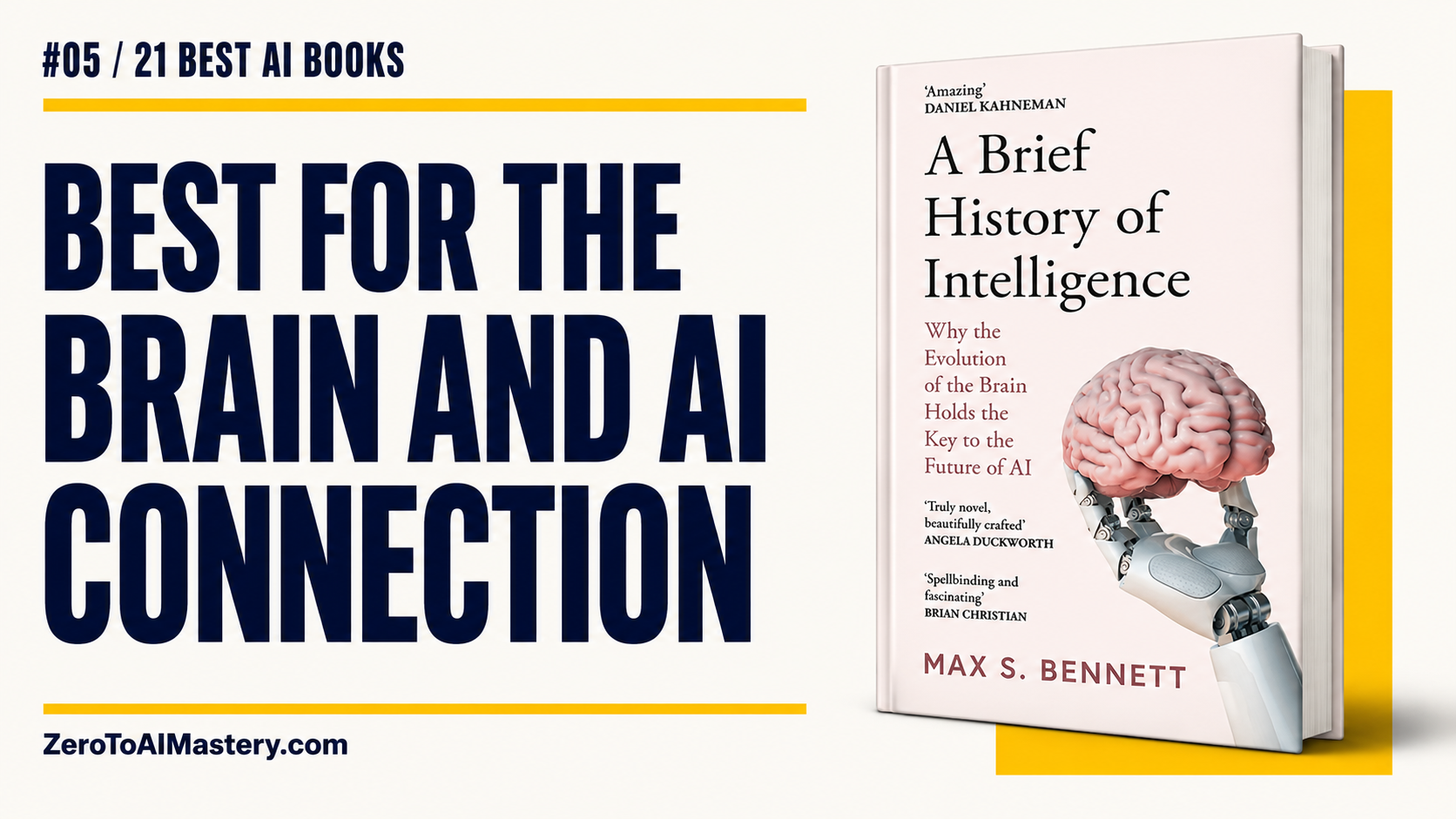
A Brief History of Intelligence follows Max Bennett through the long evolution of animal brains. Movement, memory, and learning enter the story before human language does. That makes the book a refreshing change if your idea of intelligence has narrowed to chatbots and model benchmarks.
Bennett connects neuroscience and machine learning, but he does not offer a recipe for building a human mind in software. Read the connections as arguments to test. A useful question to carry through a chapter is whether a modern AI system solves the same problem as an animal brain or only produces a similar-looking result. You need curiosity about biology, not code. I would give this to someone who wants a narrative and a wider view of intelligence before picking a technical specialty.
One way into the book is to forget about chatbots for a chapter. Think about a creature that has to move toward food, avoid danger, and remember where it found shelter. Those problems demand ways of using information that are easy to overlook when the conversation starts with language. Bennett’s evolutionary route makes you notice them. It also gives you a better reason to be careful with comparisons between brains and models: similar tasks do not imply the same machinery.
If you enjoyed a book that explains biology through a story and you do not mind pausing to look up a term, Bennett is likely to hold your attention. A reader wanting a step-by-step guide to building an AI app should start somewhere else on this list. The connection to AI is an invitation to think, not a replacement for a technical course.
6. The Little Learner: best first technical book on neural networks
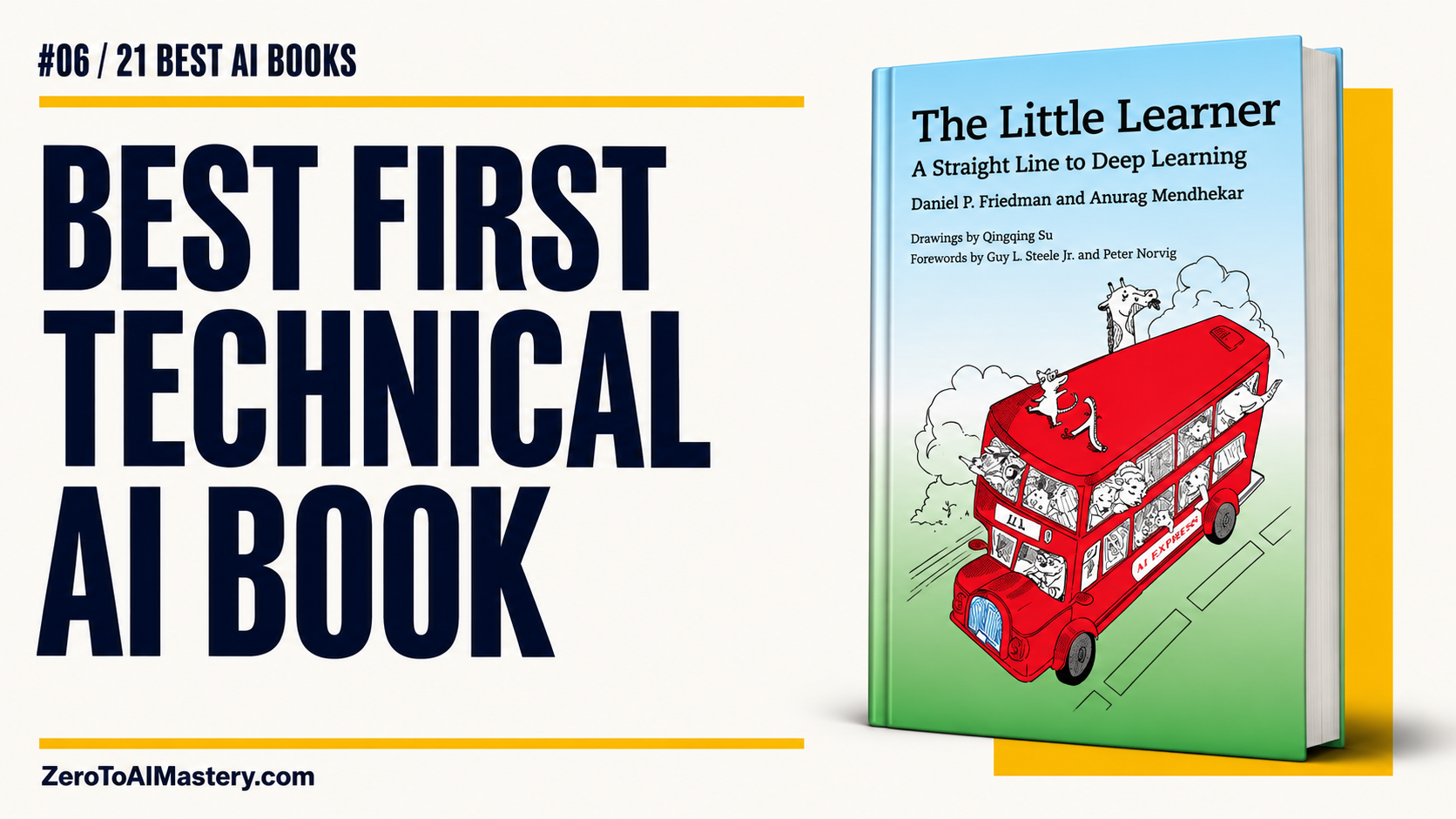
The Little Learner lets you watch a neural network grow from tiny operations. Daniel P. Friedman and his co-authors use short questions and examples to build up tensors, gradients, neurons, and layers. You can trace what changes at each step instead of taking a finished framework on faith.
The code uses a small subset of Scheme, so Python-only readers will need a little patience. The sample pages from MIT Press let you try the question-and-answer style before committing to the book. If you already know how to program and want to understand the mechanics, take one exercise at a time. Stop before each worked answer and predict what the next operation should do. When your prediction is wrong, that is the page to reread.
It helps to treat each exercise as a small piece of code you can account for line by line. Ask what data comes in, what value changes, and why the next operation needs that value. If you can answer those questions without looking at the printed explanation, you are ready to move on. A common beginner mistake is to nod along at the word “gradient” and keep reading before you can say what it changes. Friedman and his co-authors give you enough small examples to slow down at exactly that point.
If Scheme stops you entirely, do not force it. Andrew Trask’s Python-based book later in this list reaches similar mechanics through a language you may already know. The learning goal matters more than making yourself finish a book whose syntax keeps getting in the way.
7. Understanding Deep Learning: best for the theory
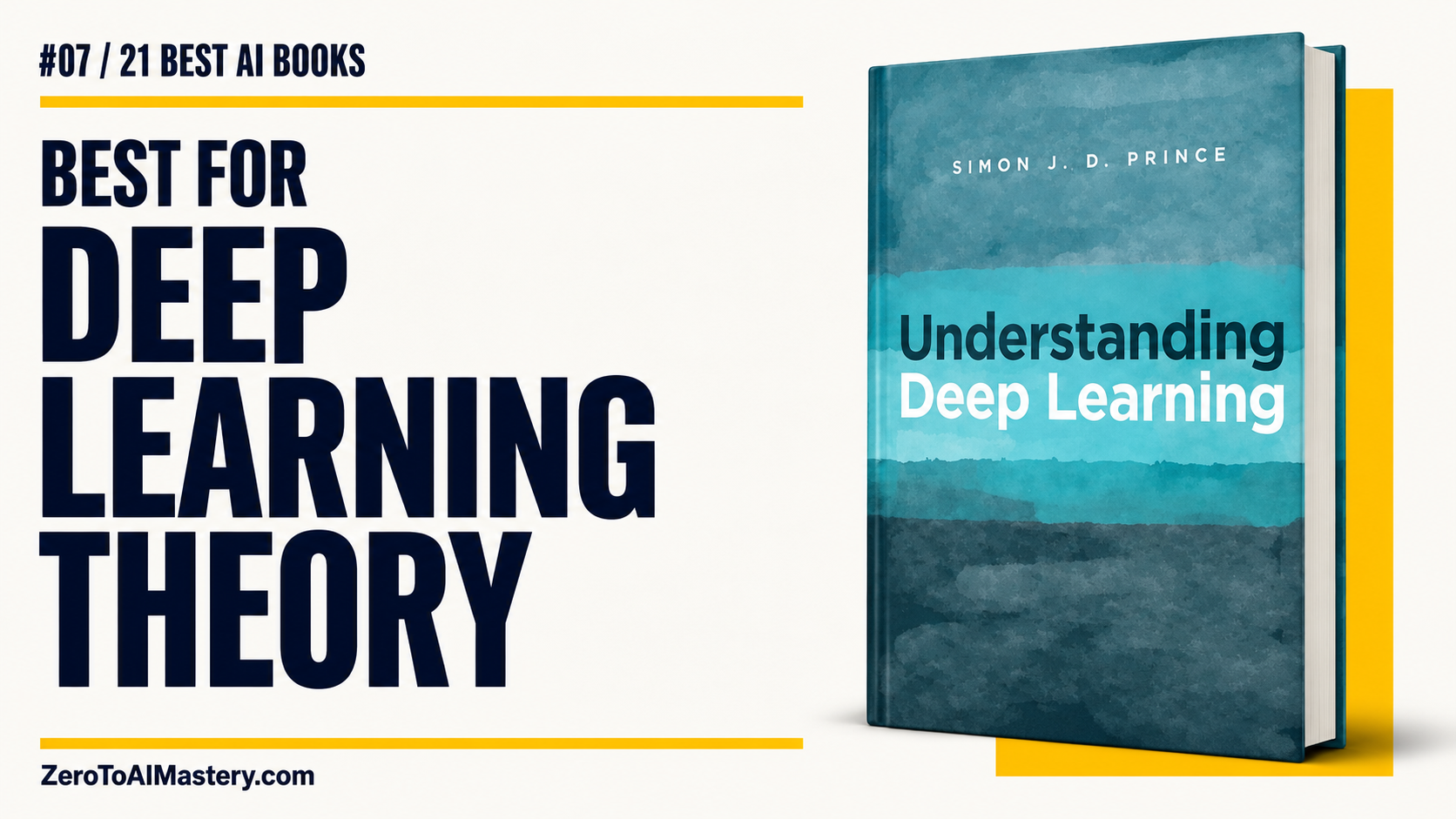
Understanding Deep Learning is where I would go after a small model has made me curious about the mathematics behind it. Simon J. D. Prince explains neural networks with diagrams and equations, then moves into topics such as transformers and diffusion models. He does not ask you to accept a picture as a substitute for the maths, or vice versa.
You can try the open-access edition with a notebook or small experiment open. If a chapter explains overfitting, change one training condition and watch the validation result. If it explains attention, draw the information flow from memory before looking back at the diagram. That work makes the formal treatment stick. You will need some applied maths and patience; this is a tough first AI book for someone who has never coded.
You can use Prince’s diagrams as a check on your understanding. For one chapter, close the book and try this:
- Draw the model or training step from memory.
- Label what enters each part and what comes out.
- Run a tiny example and compare the result with your prediction.
- Return to the equation at the point where your picture and the result disagree.
That is slower than turning pages, but a formal book rewards slower reading. You do not have to work from cover to cover either. If optimization is the thing you keep meeting in code, open that chapter and keep a real experiment beside it. The earlier chapters will still be there when you need them.
8. Deep Learning with Python, Third Edition: best for coding full models
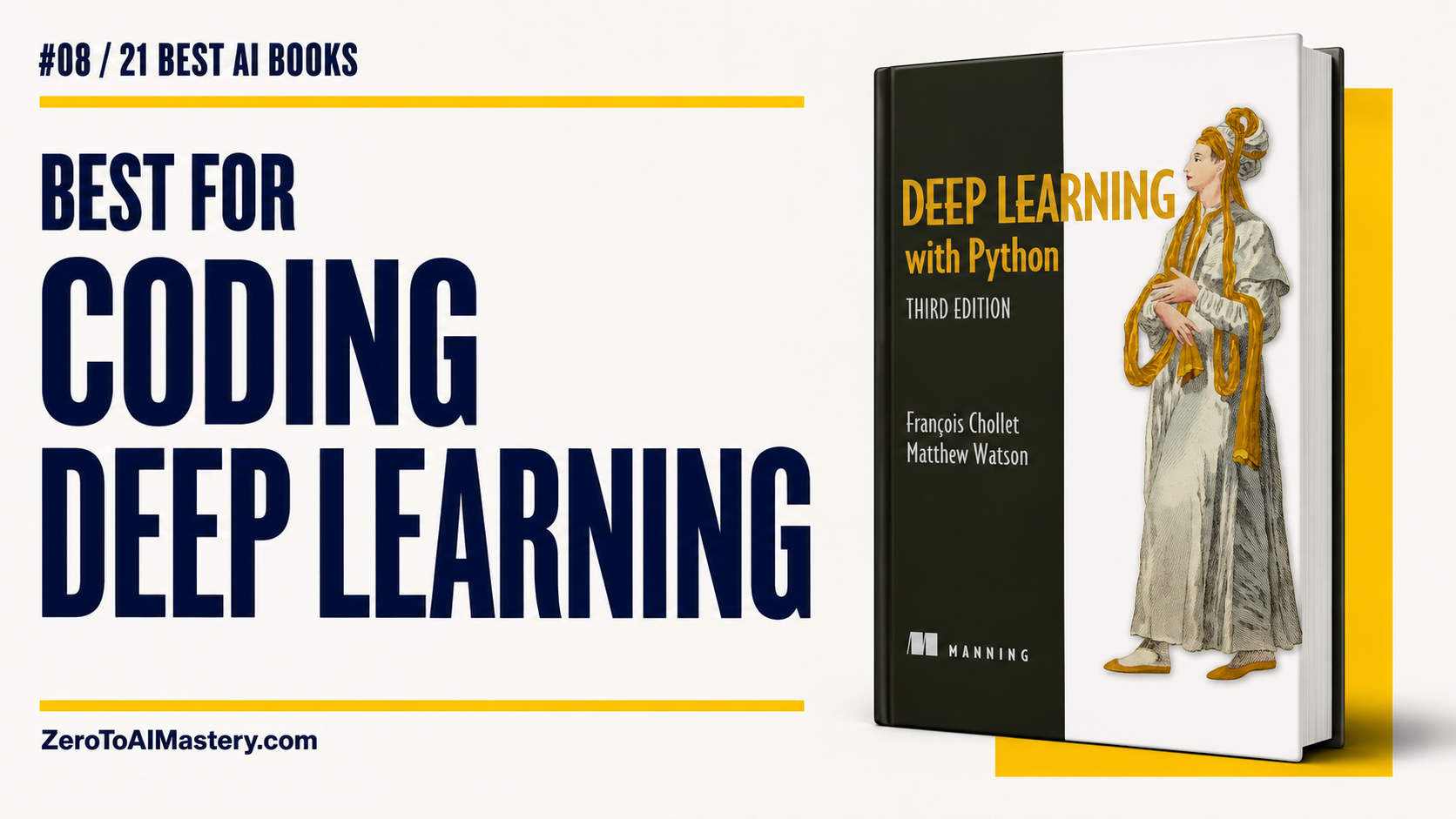
Deep Learning with Python, Third Edition suits a Python reader who is ready to build full models rather than only inspect tiny examples. François Chollet and Matthew Watson use Keras 3 and work with PyTorch and JAX as they cover deep learning, text, images, and generative models. Keep your environment open: this book makes more sense with code running beside it.
Choose a project from Manning’s contents that matches your current level and keep a short experiment log. Write down a baseline, change one part of the data or model, and record what you expected before you run it. A good training metric can still hide weak results on new data; the habit of checking that gap is more valuable than copying every example. Framework commands age, so check current documentation when an installation step fails. If your immediate goal is to call an existing model from an app, you can leave model training for later.
A larger project also teaches you to separate a model problem from a data problem. If validation results are poor, look at your examples before you add more layers. Are the labels reliable? Did the training set contain cases like the ones you care about? A book with full projects gives you room to ask those questions. It can also tempt you to copy a working notebook and move on. Change one choice and explain the result in your own words before starting the next chapter.
You do not need a powerful machine for every early lesson. Start with the small examples you can run comfortably, then scale the project when you know what you are testing. That keeps the focus on learning rather than spending an afternoon wrestling with hardware or a package version.
9. How to AI: best for using AI in ordinary work
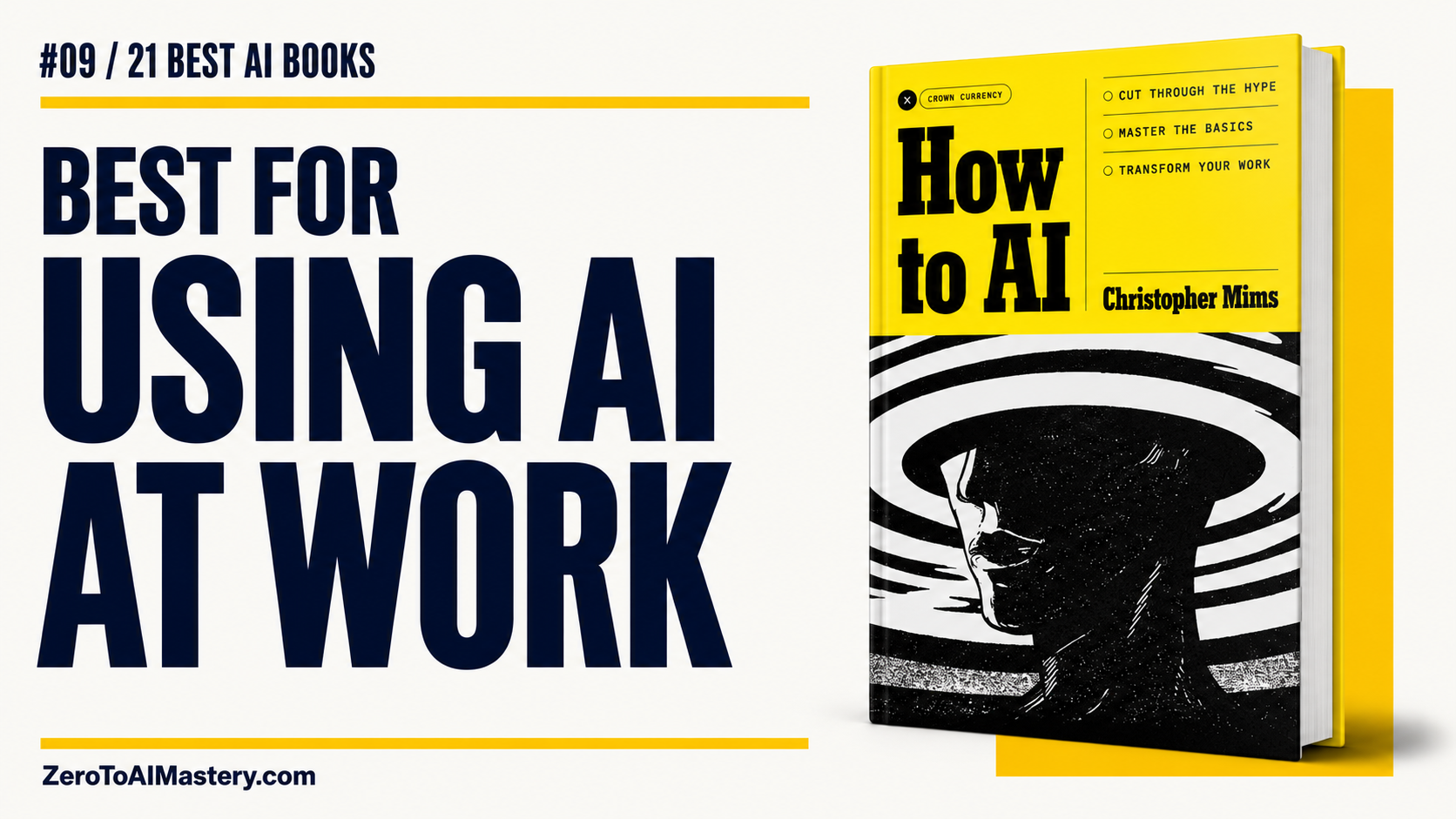
How to AI is Christopher Mims’s guide for the person who uses AI at work but has no wish to train a model. It is about finding tasks worth trying, checking what a tool gives back, and noticing when the checking takes longer than doing the job yourself. That is a more useful starting point than collecting prompts.
Try one weekly task while you read. Give a tool your meeting notes or a customer reply draft, then time the entire job, including the corrections. If it saves ten minutes but creates a mistake you would miss in a hurry, you have learned something about where it belongs in your workflow. Tool names and screens change; that test still works. Builders may find the book introductory. Managers, writers, and students who want a calm first experiment will find more to use here.
For example, suppose you write the same weekly update for your team. An AI tool may turn rough notes into a draft quickly, but it may also invent a decision that nobody made. Mims’s practical approach pushes you to count the checking time as part of the job. If the tool speeds up the first draft and slows down approval, the workflow needs another look.
I would start with a low-stakes task whose result you can inspect easily. Keep the original notes, the tool’s output, and your edited version. After two or three runs, you will have evidence about whether the tool belongs in that task. The answer may be “yes, but only for the outline,” which is a useful answer.
10. Artificial Intelligence: A Guide for Thinking Humans: best broad introduction
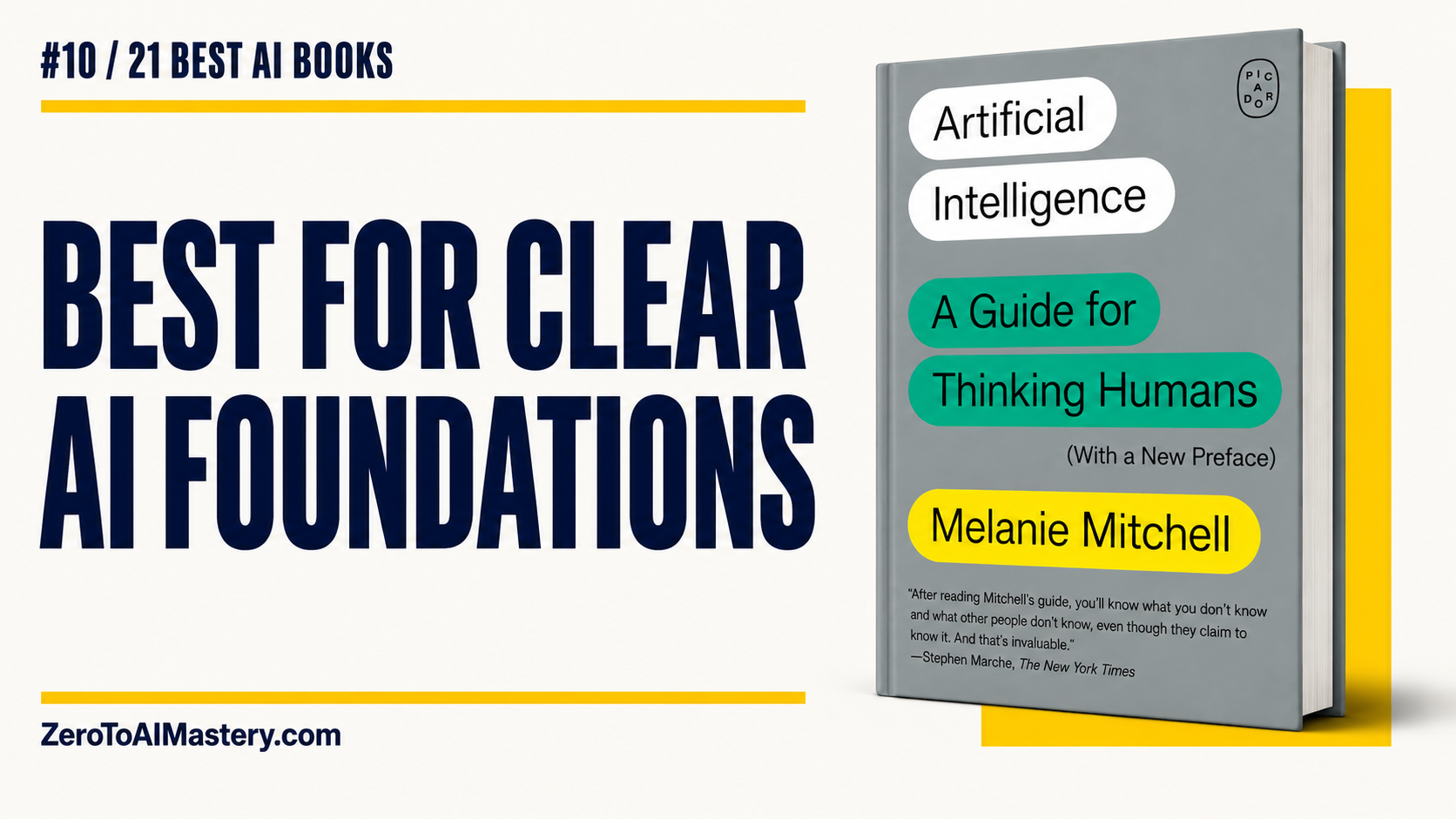
Artificial Intelligence: A Guide for Thinking Humans is the broad introduction I recommend when someone asks for one book before choosing a specialty. Melanie Mitchell explains where AI came from, what learning systems can do, and why a striking benchmark result does not settle a larger question about understanding.
Her examples include an earlier era of AI; the newer edition’s preface brings her view up to the generative-AI era. Use the book to sharpen the questions you bring to current model rankings. After a case study, write two lines: what did the system do, and what might someone wrongly assume it could do next? That distinction helps you appreciate a real advance without stretching it into a claim the evidence cannot carry. Mitchell writes clearly for people who do not code.
Mitchell is also good company when people use one word, “intelligence,” to mean several different things. A system that recognizes an image, a system that writes a paragraph, and a person learning from an unusual mistake may all perform something we call intelligent. The tests are different. Before you accept a claim about a model “understanding,” ask which of those abilities the evidence actually measured.
This makes the book useful to people outside engineering. If you approve a tool for work or explain AI to someone else, you need language that is more exact than either excitement or dismissal. Mitchell gives you that language without asking you to become a researcher first.
11. Rebooting AI: best for commonsense reasoning problems
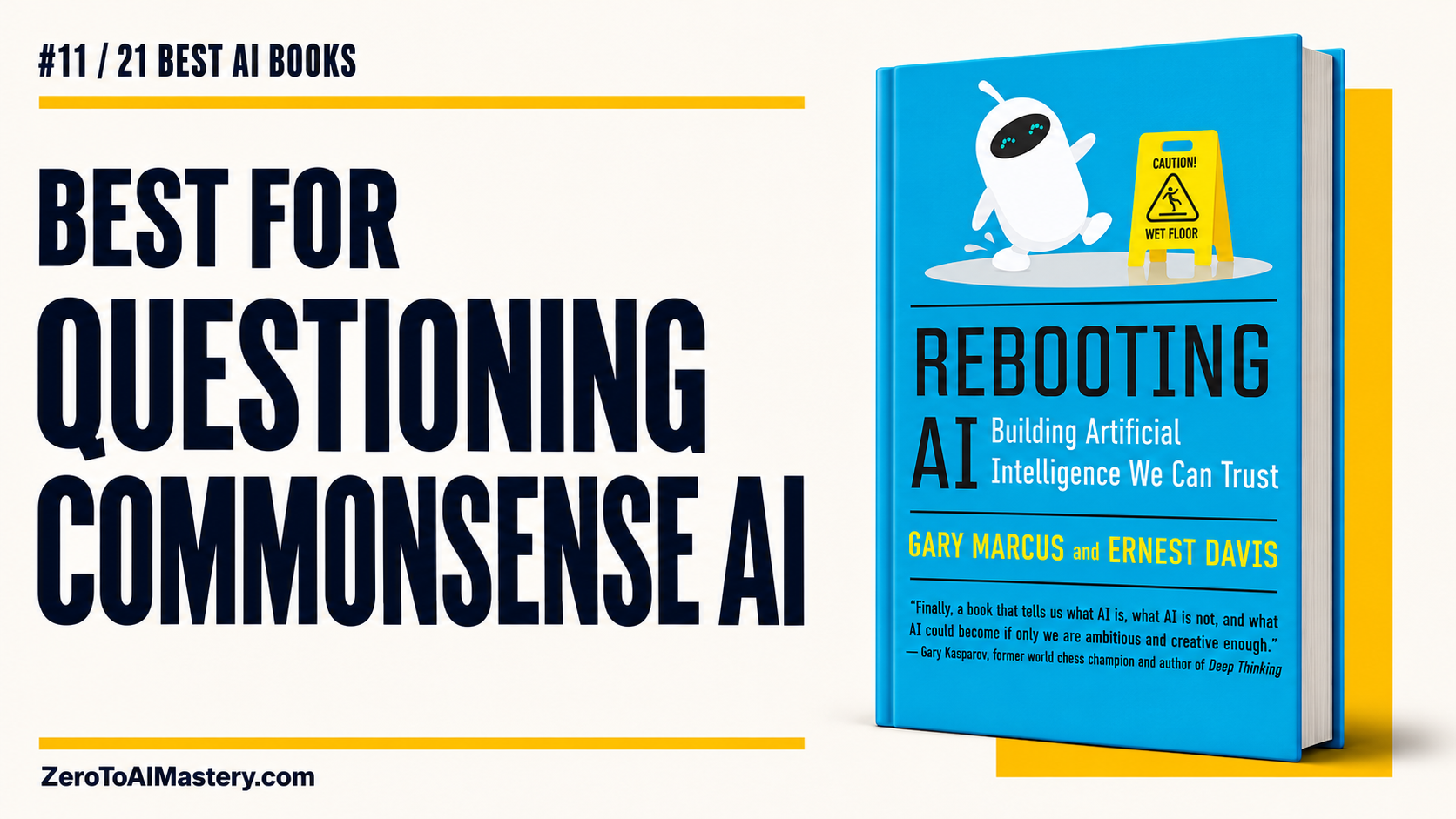
Rebooting AI takes a stubborn problem seriously: a model can succeed at a narrow task and still miss something obvious about the world. Gary Marcus and Ernest Davis argue for stronger ways to represent knowledge and reason through ordinary situations.
The examples predate today’s chatbots, and you should test the argument against systems you can use now. When one produces a fluent but wrong answer, ask what went missing. Did it lack a fact, misunderstand the request, or follow an objective that rewarded the wrong response? Marcus and Davis will not walk you through Python code. They will make you look closely at what people mean by commonsense reasoning. If you only want to build an application this week, choose a hands-on book first. If you keep wondering why impressive systems make elementary mistakes, this is a good one to argue with.
One small exercise is to give a model a request that depends on a fact most people take for granted. Ask it to make a plan, then change one physical or social detail that should force the plan to change. Does it revise the reasoning, or does it keep the old answer and dress it in new words? Use that result to test Marcus and Davis’s argument rather than treating the older examples as the last word.
The book’s strongest use is to make a failure interesting. Instead of collecting screenshots of a chatbot saying something silly, you can ask what kind of knowledge or reasoning the answer would have needed. That is a better starting point for anyone trying to improve a system.
12. The Master Algorithm: best map of machine learning traditions
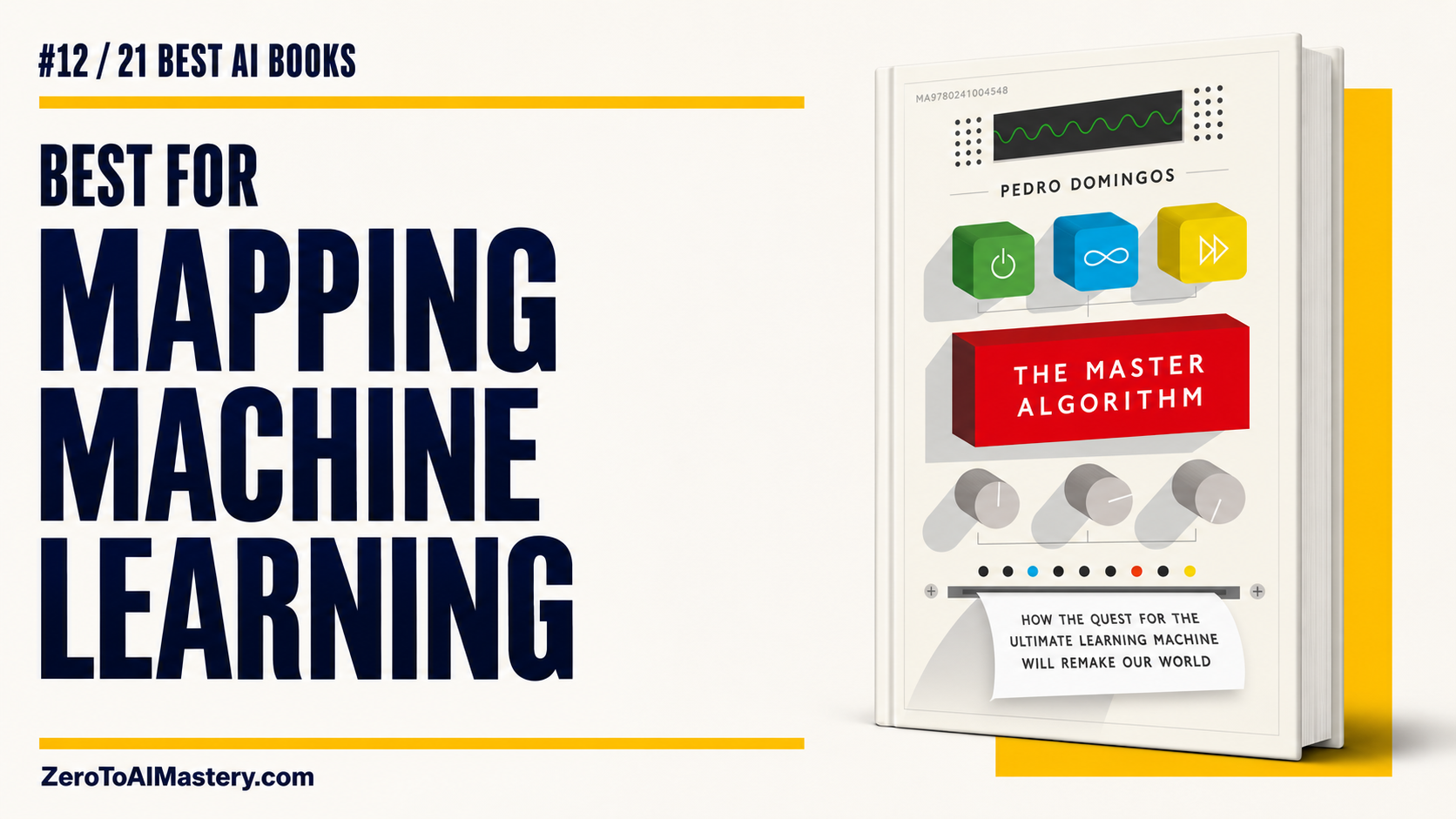
The Master Algorithm takes you back before large language models swallowed every conversation about machine learning. Pedro Domingos introduces several traditions of learning, the people behind them, and the different assumptions each approach makes about data and knowledge.
Do not read the idea of one master algorithm as a settled destination. It is Domingos’s big argument, and the book is more interesting when you test it. A recommendation engine, a diagnostic tool, and an image classifier all make predictions, but they do not create the same kind of evidence. Write down what each learning tradition needs to work well and where it breaks. Some of the examples and forecasts have aged; the map of the field has not lost its use. This is a conceptual book, not a Python workbook.
The schools of learning are easiest to remember if you give each one a problem. Imagine you have to sort spam, recommend a film, and detect an unusual payment. Which parts of the available data would each approach use, and what would it need to assume? Domingos’s history can help you avoid treating one currently popular method as the only possible answer.
The book is also a reminder that a model’s success depends on the question you asked it to answer. Two systems can receive the same label, “AI,” while relying on very different evidence. If you work on product decisions, this wider map helps you ask engineers what kind of failure to expect before you launch a feature. It is a good companion to a practical machine-learning course, not a replacement for one.
13. The Book of Why: best for causal reasoning
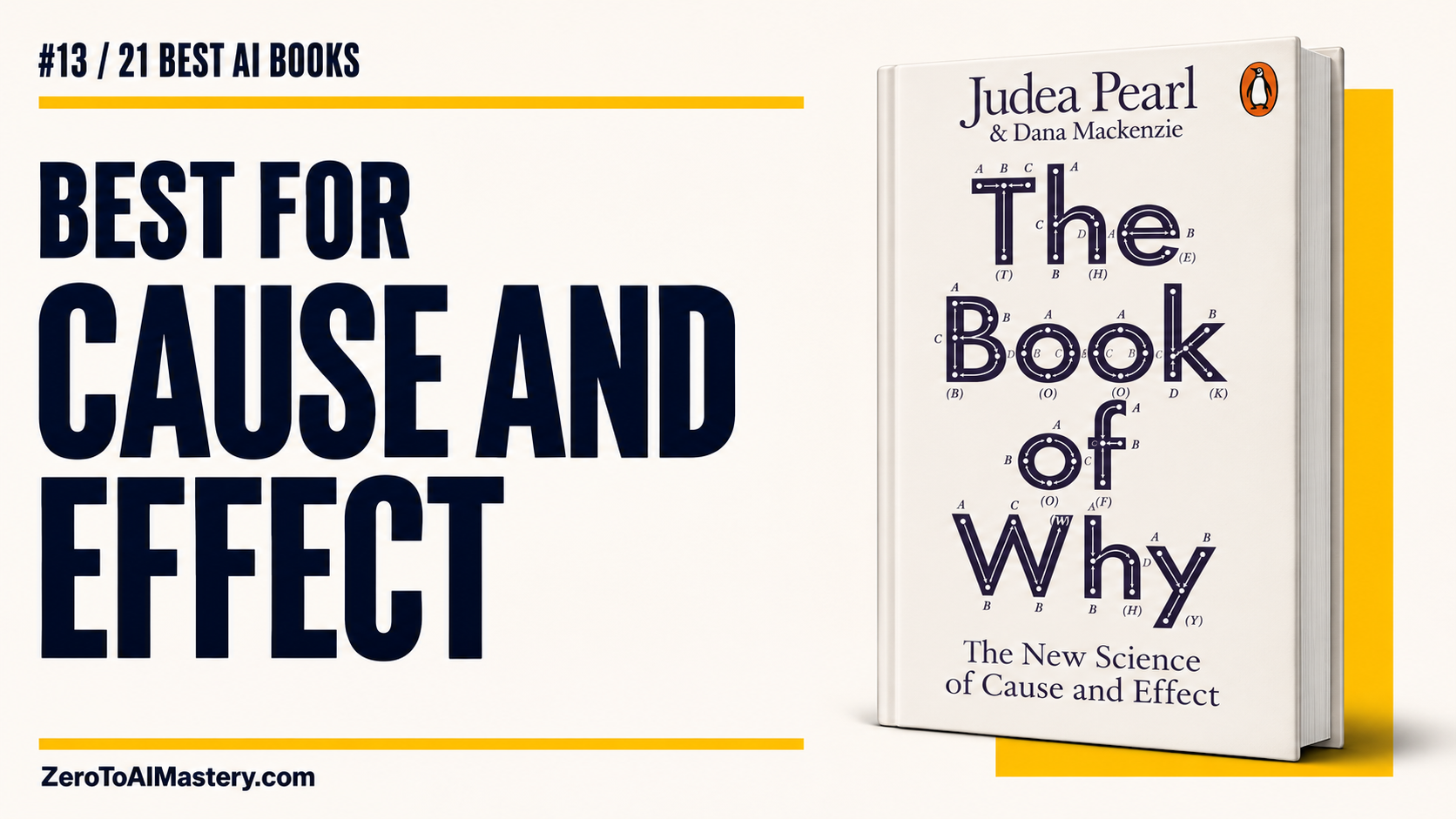
The Book of Why tackles a mistake that turns up in AI projects all the time: a prediction is treated as an explanation. Judea Pearl and Dana Mackenzie ask what it takes to say that one thing caused another, rather than merely appearing beside it in the data.
Suppose a school offers tutoring to students with low scores. Their later scores rise. Did tutoring cause the change? You need to know who received help and what else changed before answering. The book gives you diagrams and questions for reasoning through cases like that. It will not teach you to train a language model, but it can save a team from acting on the wrong conclusion once it has a model. Expect some slow pages if statistics is new to you. I would read one example at a time and draw the causal diagram myself.
Consider a more familiar example: you notice that people who use an AI writing tool finish reports faster. Did the tool make them faster, or were the faster writers more likely to try it? The answer changes what you should do next. Pearl’s framework gives you a way to state the missing question instead of arguing from two numbers that happen to move together.
If you are a product manager, the distinction matters whenever you claim a feature improved an outcome. If you are a model builder, it matters when you recommend an intervention based on a prediction. You do not need to master every diagram at once. Take one small example, draw what you think causes what, and check whether the data you have could distinguish your story from another plausible one.
14. The Coming Wave: best for technology and institutions
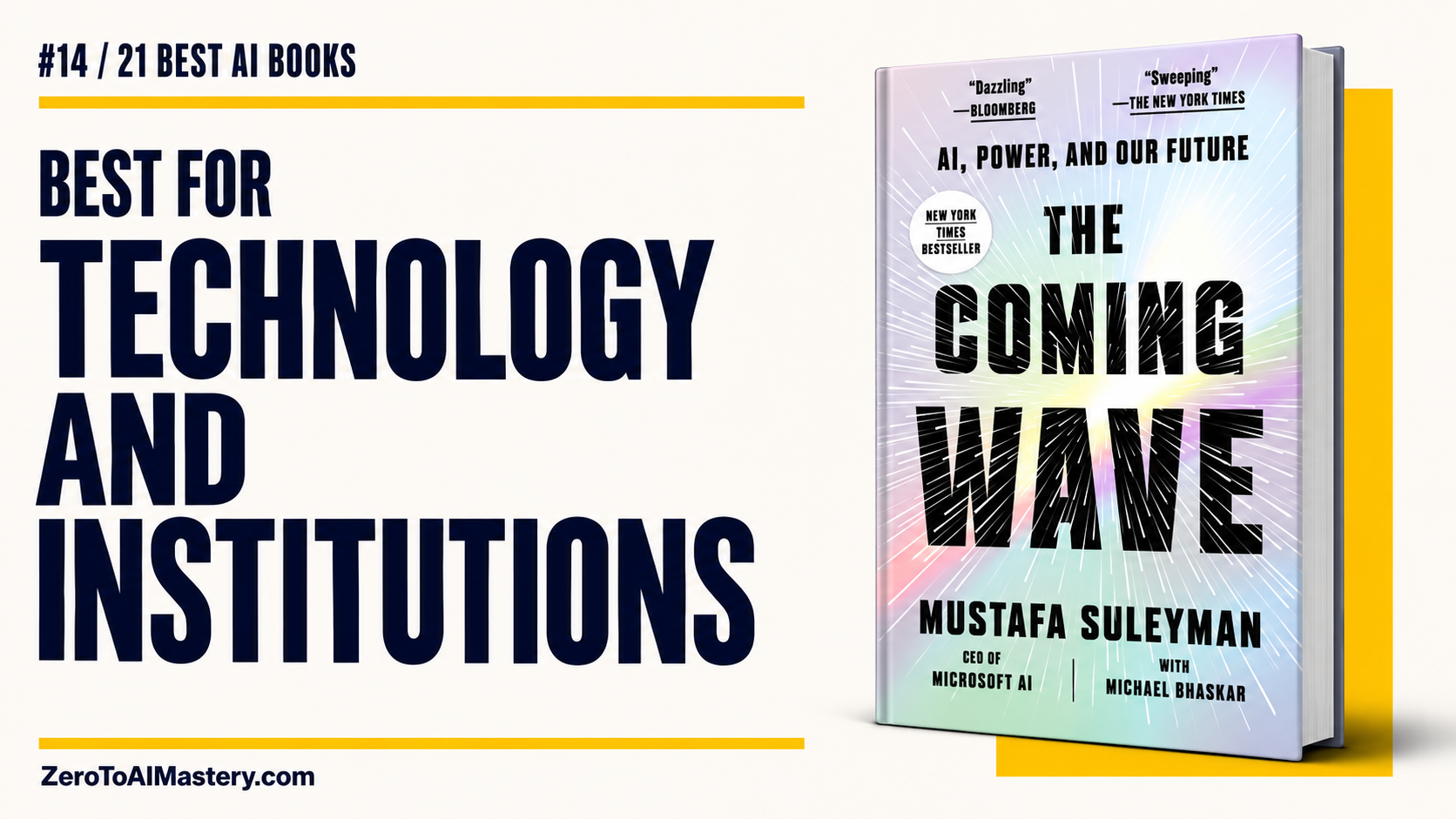
The Coming Wave widens the frame from models to institutions. Mustafa Suleyman and Michael Bhaskar look at AI alongside other powerful technologies and ask how a society might contain harms when useful tools spread quickly.
Suleyman has built AI companies, and that position shapes the book. Keep it in view while you read. The chapters are most useful when you trace a tool past the person who built it: who buys it, who sets the rules, and who absorbs an error? A workplace assistant might look like a small feature to its maker and a consequential decision system to the employee it evaluates. You do not need to agree with every policy proposal to see why that chain matters. This is the book for a reader thinking about public choices and organizational responsibility, not an engineer choosing a model API.
The argument is easier to test when you follow one tool through its whole route into use. For a workplace assistant, ask who supplies the data, who decides which tasks it handles, and who can challenge an answer that affects a person. Those are concrete questions an organization has to answer even when the model itself changes next month.
If governance books usually leave you cold, the industry-insider viewpoint may still keep you reading. Suleyman has reason to care about both the usefulness and the risks of these systems. That tension makes the book worth discussing with someone who sees the same technology from a different job. Do not use it as a substitute for local rules or current policy; use it to notice where those rules need an owner.
15. Supremacy: best for the race to build chatbots
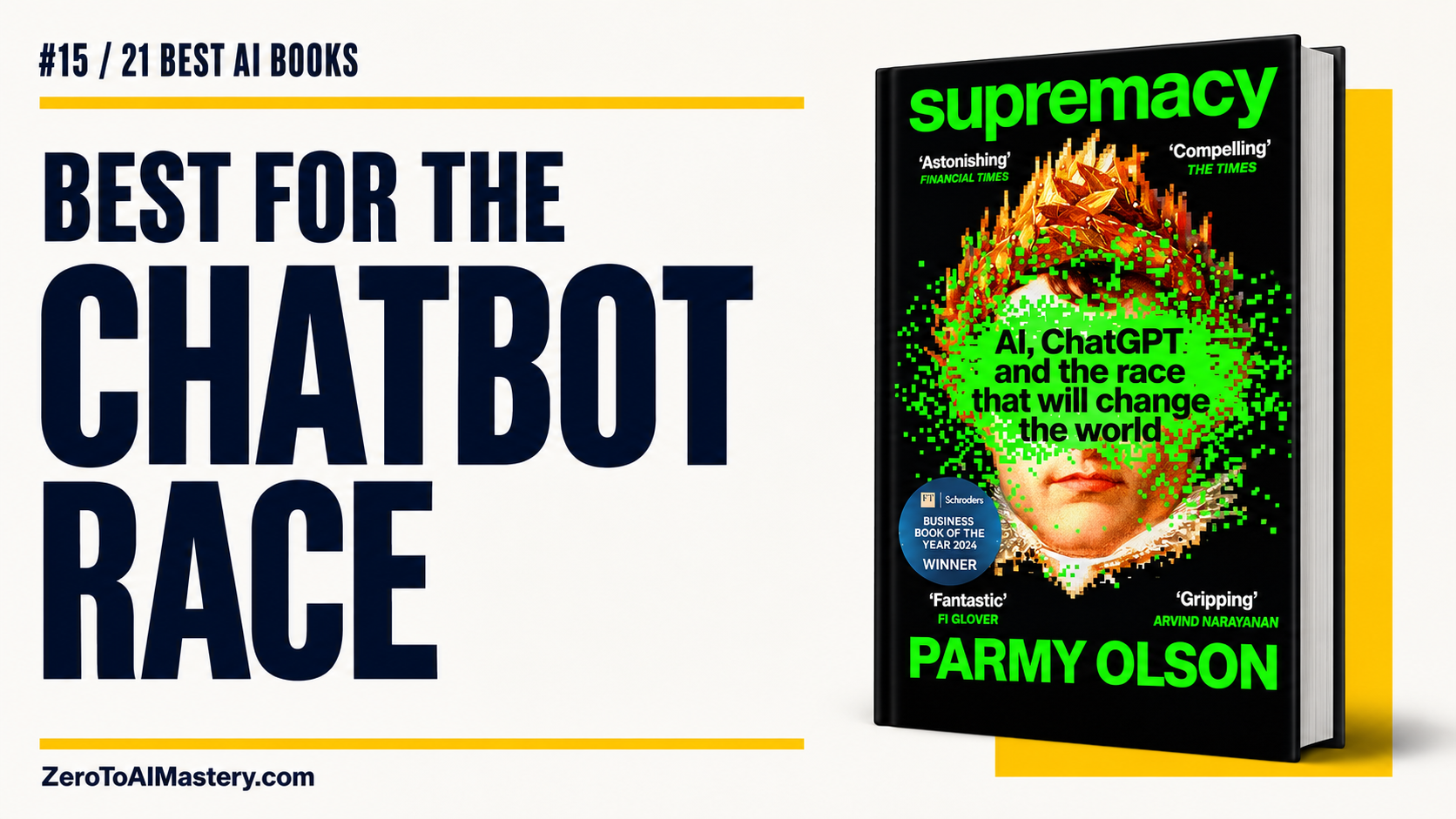
Supremacy puts people and organizations back into the story of modern chatbots. Parmy Olson reports on OpenAI, DeepMind, the researchers around them, and the pressure to turn discoveries into products. A model release can look inevitable in retrospect; the decisions behind it rarely were.
Mark the moments where research, funding, and a product deadline pull in different directions. That habit helps when you read AI news now. A lab can produce important science and still have commercial reasons to frame a result in the strongest possible way. Olson’s reporting gives you the institutional history behind those announcements. It does not explain transformer mathematics, and it cannot predict who leads the next model cycle. Read a technical account alongside it if you want both sides of the story.
Olson is especially helpful when a launch story has been flattened into “the technology arrived.” Researchers choose which problem to pursue. Executives choose when to release a system. Investors choose what they will fund. Those choices affect what the public gets to see and how quickly it arrives. Keeping those people in the frame makes a model announcement easier to read critically.
If you lead a team adopting AI, this book offers a useful pause before repeating a company’s claim in your own pitch. Ask what was a research result, what was a product decision, and what was marketing. You may still use the product. You will be better prepared to explain what you know about it and what you have not tested.
16. The Singularity Is Nearer: best for testing bold forecasts
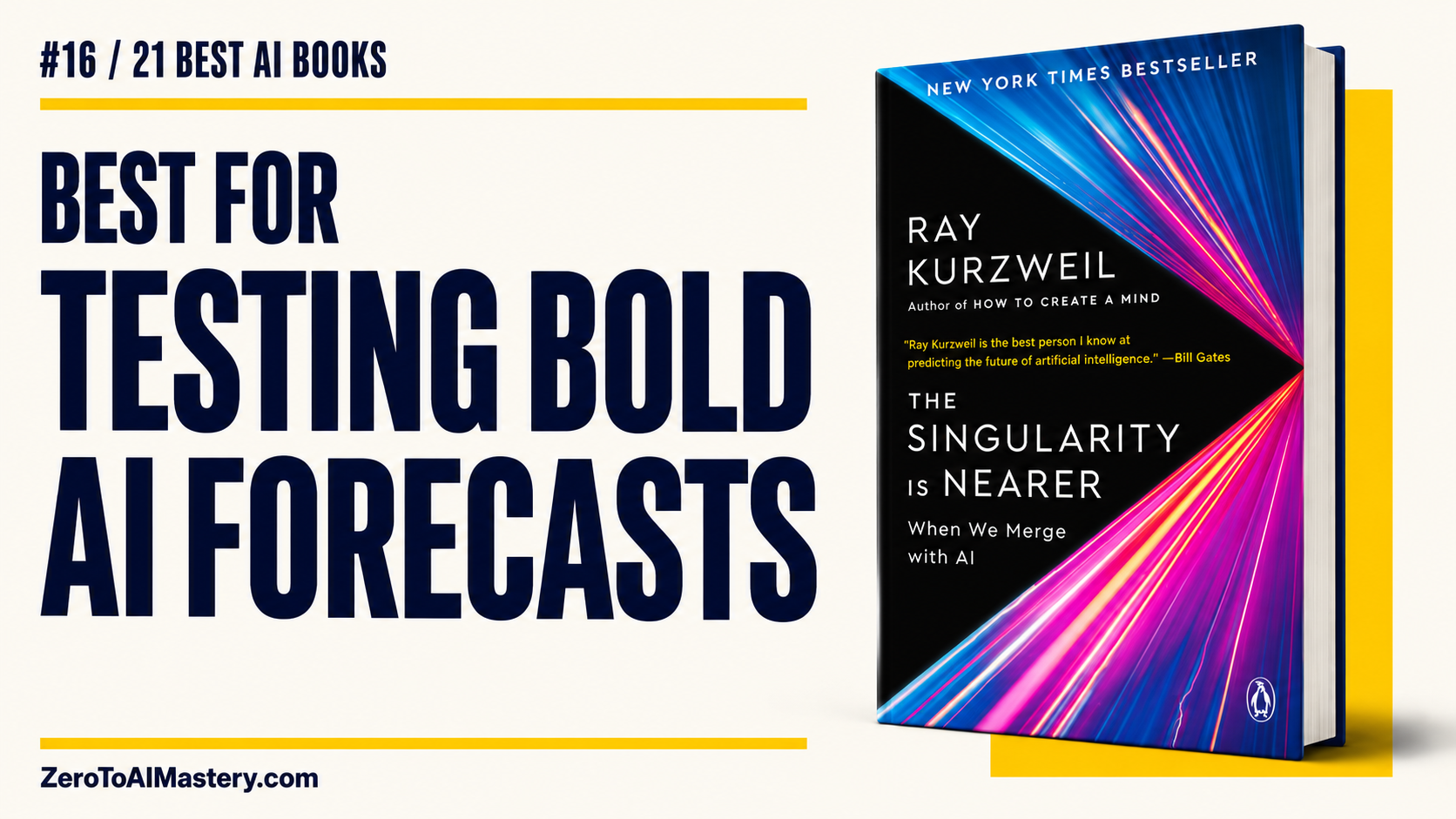
The Singularity Is Nearer is Ray Kurzweil’s case for rapid technological progress, told with the confidence that has made his forecasts famous. It moves well beyond current AI tools into the changes he expects in intelligence and human life.
Keep a pen nearby. Choose three predictions that have a date attached. Write down the evidence Kurzweil offers and what would have to happen for the prediction to fail. Then put those notes beside a skeptical account, perhaps Erik Larson’s book later in this list. You can enjoy an ambitious argument without treating it as a timetable. If you need a model-building tutorial, skip this for now. If you want to understand why some people expect AI progress to accelerate so dramatically, reading the argument in Kurzweil’s own words is better than debating a headline about it.
Forecasting is hard even when the trend looks obvious. A useful way to read Kurzweil is to separate several kinds of claim:
- Measured trend: What happened in computing or another field, over what period?
- Projection: What does he expect to keep happening, and for how long?
- Consequence: How does he connect that projected trend to a change in society or human life?
The first line may have strong evidence while the last requires assumptions about adoption, cost, and human choices. Mark those steps in the margin. That turns a sweeping book into a set of claims you can revisit as evidence arrives, instead of a prophecy you must accept or reject whole.
17. Power and Prediction: best for AI business decisions
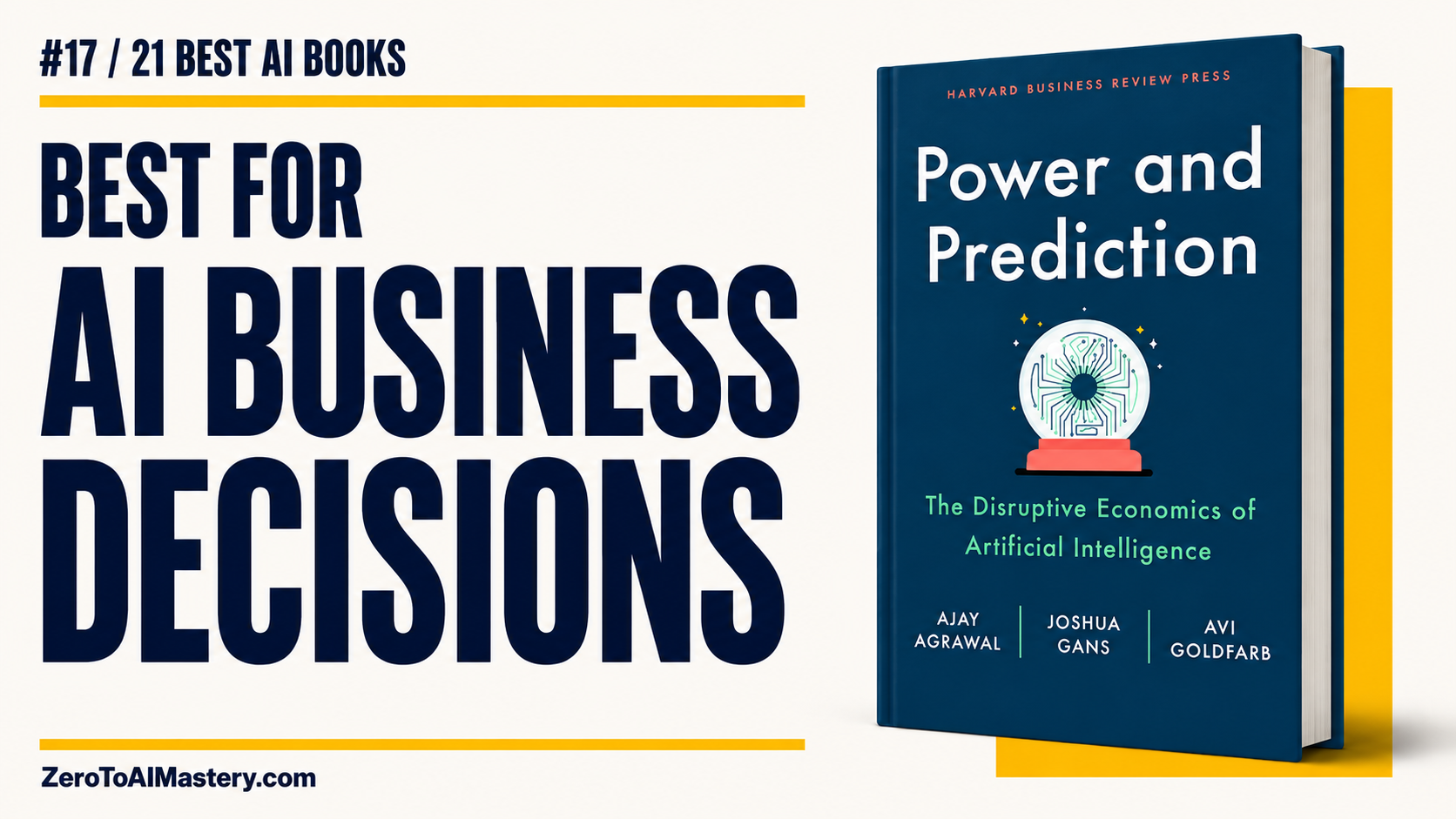
Power and Prediction asks a question that product teams often leave too late: which decision will a better prediction improve? Ajay Agrawal, Joshua Gans, and Avi Goldfarb separate prediction from the judgment and action that follow it. Cheaper prediction helps only if the rest of the workflow can use it.
Picture a support queue. A model predicts which tickets are urgent; a person or policy still decides what happens next. If nobody can act sooner, a more accurate score may change very little. The authors examine the decisions that surround a model. Take a process you know and write down its prediction, judgment, and owner. You may find the bottleneck somewhere other than the algorithm. This is an economics book, so readers seeking training code should look elsewhere. Product managers and founders can use it before spending months on an AI feature.
Take a process at work and write three lines before you propose an AI feature:
- Prediction: What does the model estimate?
- Judgment: Who decides what that estimate means in this case?
- Action: Who can change the outcome, and how soon?
If the final line is blank, a better model score is unlikely to fix the process on its own. You might need to change who receives an alert, or how quickly that person can respond. The book earns its place when it stops a team from treating prediction quality as the whole product.
18. Genius Makers: best for deep learning history
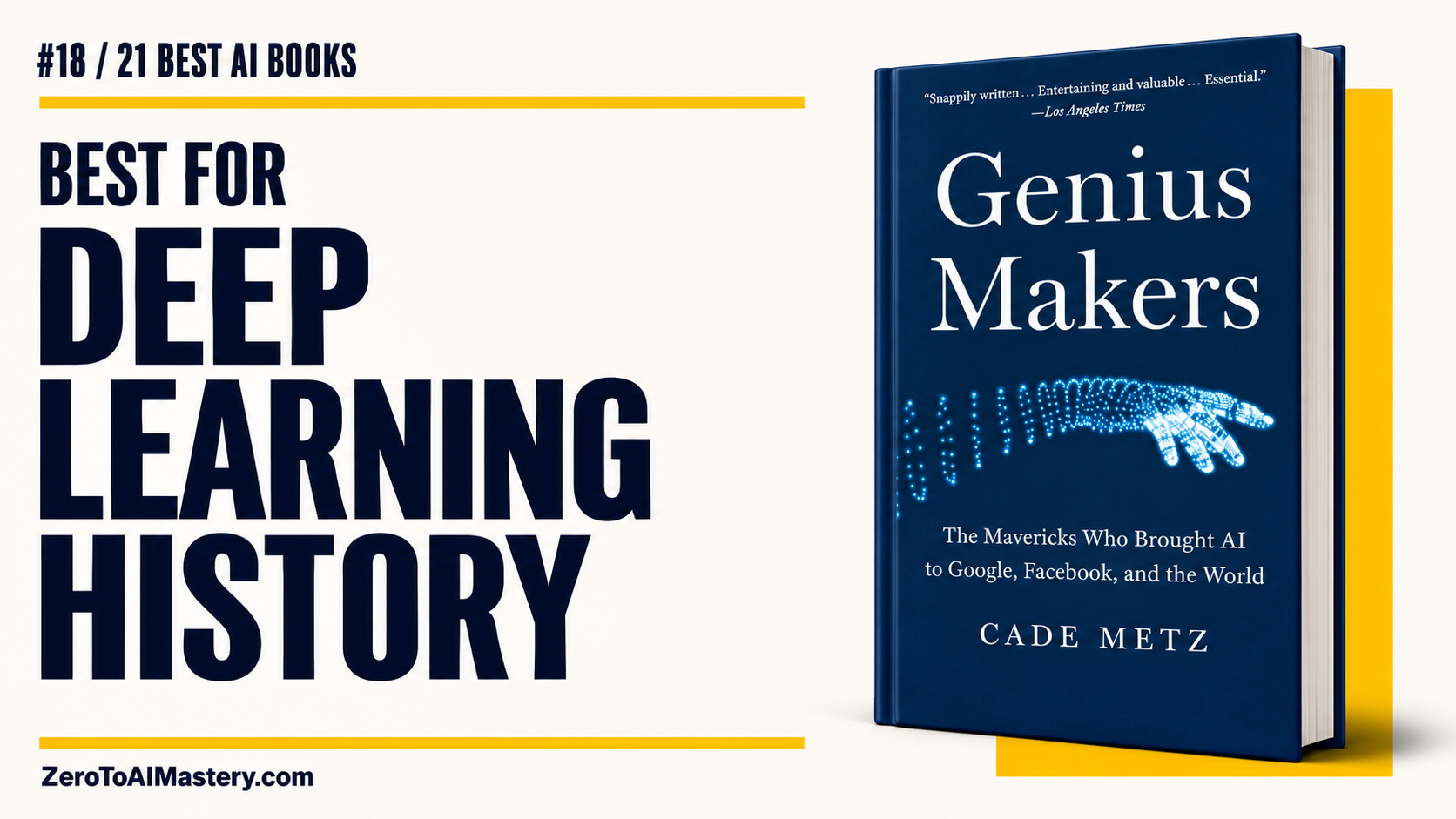
Genius Makers tells the human history of deep learning. Cade Metz follows researchers, labs, and companies through the years when neural networks moved from a disputed bet to the center of an industry. If a textbook leaves you wondering who pushed an idea forward and who resisted it, Metz gives those people a place in the story.
Follow one breakthrough back through the earlier work and the organization that paid for it. That is more revealing than a tale of a lone genius having a sudden insight. The book ends before the latest generative-AI wave, so it is history, not a guide to today’s market. Its value is the long view of how ideas become infrastructure and then businesses. I would read it between technical books, when you want to remember that equations do not fund experiments or decide what gets released.
You can use Metz’s reporting to trace a familiar model technique back to the people who made it practical. Ask what earlier work they needed, what resources their lab supplied, and what other researchers believed at the time. That exercise makes a breakthrough look less like magic and more like a long, contested sequence of choices.
It is also a useful counterweight to a reading diet made only of current product news. Today’s tools did not appear because a release note said they did. People spent years arguing over what was worth trying, often without knowing which idea would pay off. You do not need to memorize every name in the book to understand that part of the history.
19. The Myth of Artificial Intelligence: best skeptical case about general intelligence
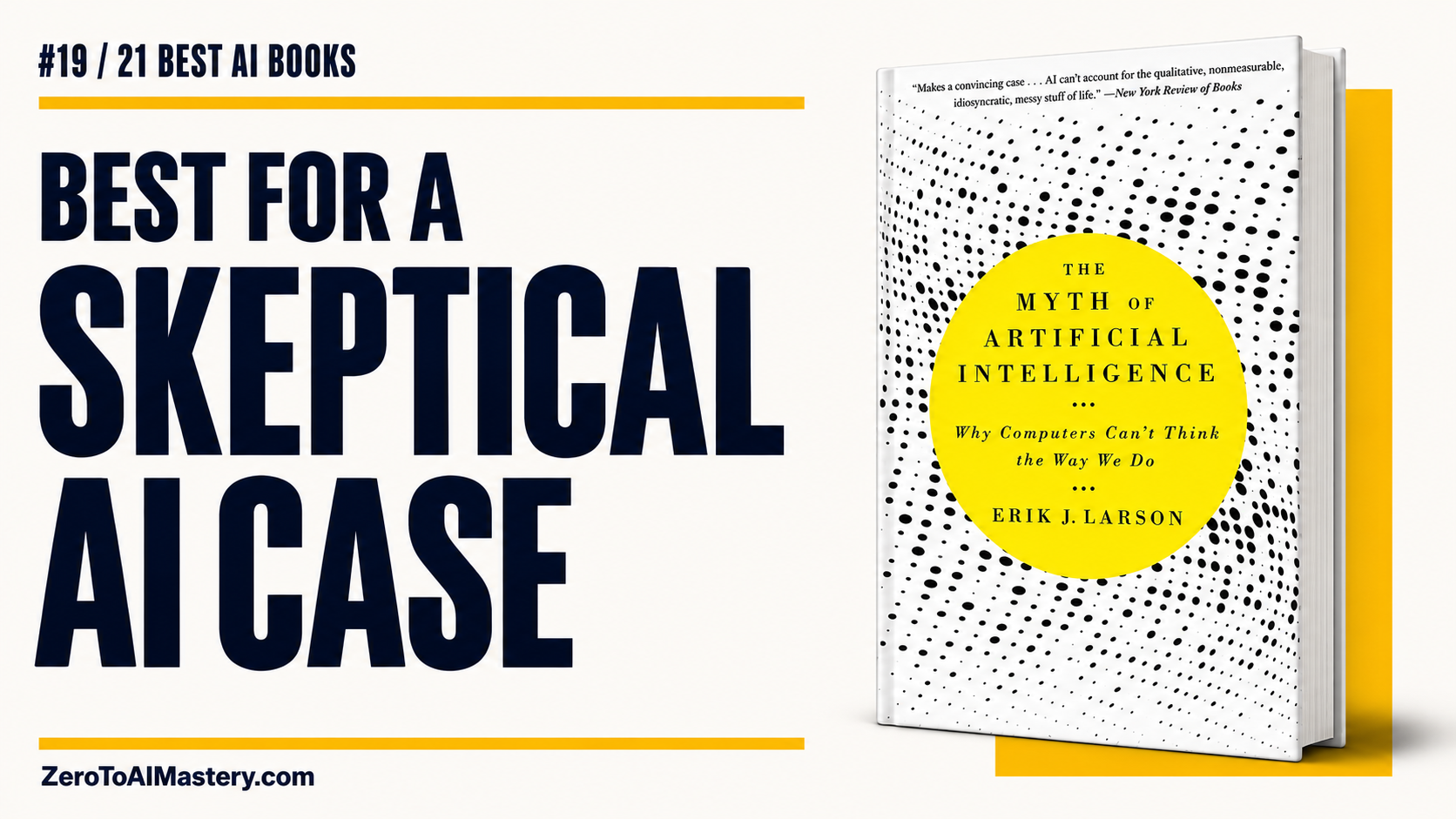
The Myth of Artificial Intelligence is Erik J. Larson’s skeptical argument about humanlike general intelligence. He thinks success on narrow tasks does not show that today’s methods are on a straight road to a thinking machine. The chapters spend time on inference, language, and the kind of reasoning people use in ordinary life.
Bring a concrete example to it. A system answers a question well; what would it need to know to handle a changed version of the same situation? Larson makes you notice the assumptions hidden between those two tests. He has a strong position, and you may reject his conclusion. That is fine. Read him beside Kurzweil and pay attention to how each author defines intelligence before deciding who has the better forecast. This is philosophy and argument, not a programming course.
Larson’s central challenge becomes clearer if you try to describe a task that needs more than a well-formed answer. A person asked to help a friend move house knows that a fragile lamp needs care, that a borrowed van has limited space, and that “after work” might mean different times for different people. A system can produce a sensible plan, yet one small change in the situation may expose what it never understood.
That example does not prove Larson right about the future of AI. It gives you something precise to test. Compare it with a capable current system, change the constraints, and see whether it updates the plan for the right reasons. The book is most useful when it sharpens that kind of inquiry rather than settling the debate for you.
20. Machine Learning Design Patterns: best for recurring engineering problems
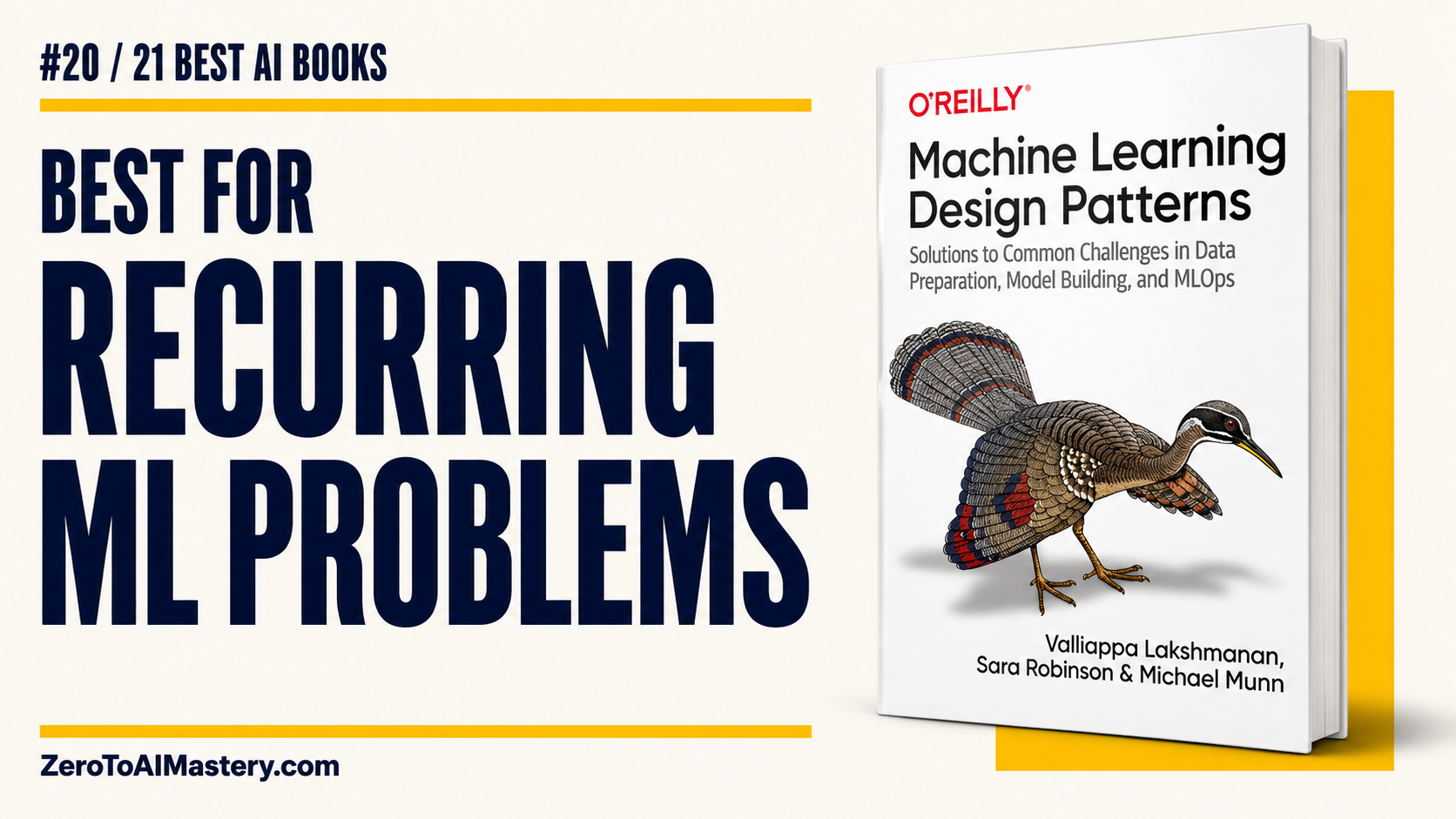
Machine Learning Design Patterns is a reference for problems you meet after the first model works. Valliappa Lakshmanan, Sara Robinson, and Michael Munn collect recurring design choices around data representation, training, reproducibility, and operations. Each pattern describes a problem, a possible solution, and the cost that comes with it.
Open the contents when a project gives a chapter a purpose. If a data change makes a model behave differently, look at the patterns for representation and repeatable experiments. Write down the trade-off before adding machinery to your system. A solution that makes a large production pipeline reliable can make a small project harder to maintain. The framework examples will age, but that way of framing a design problem stays useful. You should already know the basic training and validation workflow before coming here.
Do not try to apply the whole catalog to a new project. Start with a fault you can reproduce. A pattern helps when it makes you choose between two real options, such as accepting a slower training run in exchange for experiments you can repeat. If you cannot say what problem it solves, leave the extra machinery out for now.
Who should keep this book nearby?
An engineer who has trained a few models and now has to keep one working with changing data will get much more from it than a total beginner. Keep it within reach during design reviews, especially when the conversation slides from “we need a more accurate model” to questions about data, deployment, and monitoring.
21. Grokking Deep Learning: best for building intuition with Python
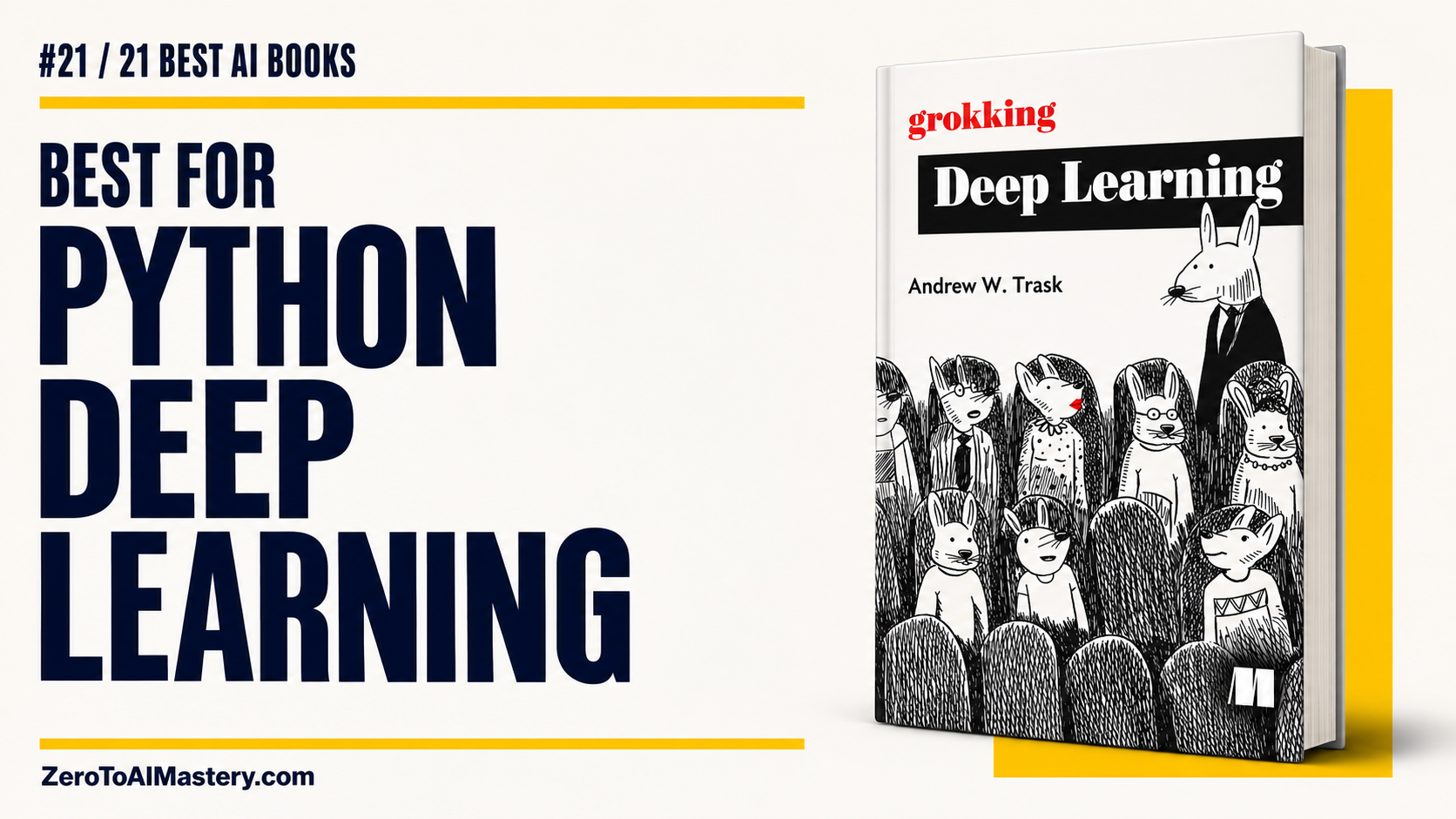
Grokking Deep Learning is Andrew Trask’s invitation to build a neural network with Python and NumPy before a high-level library hides the arithmetic. You can change a small piece of code, watch the error move, and connect that result to the calculation on the page.
The sample chapters let you test Trask’s style. Try a simple classifier and change its learning rate; predict what will happen before you run the code. If you can explain the result in terms of the training loop, you have learned something that carries into larger frameworks. The book predates today’s transformer workflows, so do not expect a guide to current generative models. Its job is to make gradients and learning less mysterious. If The Little Learner appeals to you but Scheme does not, begin here instead. Once the mechanics make sense, move to Chollet and Watson for larger projects.
It is tempting to let a library handle everything once you have seen a neural network work. Trask makes a good case for delaying that convenience just long enough to understand what the library does for you. When a training run behaves strangely later, the memory of changing a weight yourself can help you ask a better debugging question.
Start small enough that you can explain every array in the notebook. If the code feels mechanical at first, draw the data flow on paper and run it again. The payoff is not a modern production model. It is the confidence to look inside a training loop instead of treating it as a sealed box.
Which AI book should you read first?
If you have never read about AI, start with Melanie Mitchell for the broad picture or Christopher Mims if you want to use tools at work this week. If you know basic Python and want to understand learning, start with Andrew Trask. For a specific job, choose the book that sits closest to it: agents, AI product management, or RAG. The point is to get a useful answer, not to finish 21 spines.
After a chapter, do one small thing. Change a training parameter. Sketch the decision behind a product feature. Build a tiny document set and see which passage your assistant retrieves. If the book gives you a question you can test, it has already earned its place on your desk.
Three reading paths
- I build AI apps: Read The Context Engineering Blueprint, then The Harness Engineering Blueprint. Come to Machine Learning Design Patterns when a real production problem appears.
- I want to understand models: Choose Grokking Deep Learning or The Little Learner for the mechanics, then Deep Learning with Python, Third Edition. Keep Understanding Deep Learning nearby when the maths becomes your next gap. My AI and machine-learning books guide has more options for that route.
- I make product decisions: Start with The AI Product Manager Blueprint if the role is new to you. Follow with Power and Prediction, then challenge your assumptions with The AI Con or Melanie Mitchell.
You can stop after the first book if it answers the question you brought. If it does not, choose the next one for the gap you can now name.
Conclusion
The best AI books to read in 2027 are the ones that help you make a decision or solve a problem you can name. A beginner who wants the broad picture will get more from Melanie Mitchell than from a dense book of equations. Someone building a RAG assistant should begin with context and retrieval. A product manager needs to identify the decision an AI feature improves before choosing a model. Those differences matter more than the publication year on the cover.
I would choose one book, read enough to try an idea, and keep notes on the result. If the book discusses a tool, check its current documentation before following a command. If it makes a forecast, write down what evidence could prove it wrong. If it teaches a method, use the method on a small example you can inspect. That is how a reading list becomes useful work rather than a pile of bookmarks.
You may already know some of these titles or want a different angle. My earlier AI books article takes you through another set of choices. For this list, start with the gap you feel most clearly and let that choice lead you to the next book.
Frequently asked questions about AI books
What is the best AI book for a complete beginner?
Artificial Intelligence: A Guide for Thinking Humans gives you an approachable view of the field without asking you to code. If your goal is using AI in ordinary work, Christopher Mims’s How to AI is more immediately useful.
Which book should I read to build AI agents?
Start with The Harness Engineering Blueprint and build a small agent beside it. Pay attention to what happens after an error: tool permissions, checkpoints, tests, and logs matter as much as a successful prompt.
Which book explains RAG and context engineering?
The Context Engineering Blueprint follows the information your application gives a model, from chunking and retrieval to memory and evaluation. Keep a small set of documents nearby so you can test the choices.
Do I need maths before reading these books?
No. The books on history, criticism, and product work need curiosity more than calculus. Grokking Deep Learning asks for basic Python. Simon Prince’s Understanding Deep Learning is easier once you know some applied maths.
Are older AI books still useful?
Yes, when you read them for their ideas rather than current API commands. The Master Algorithm maps approaches to learning; Genius Makers explains how deep learning became influential. Use current documentation for software steps.
Which AI book should an aspiring product manager read first?
Start with The AI Product Manager Blueprint if you are learning the role and need a project to discuss in interviews. If you already work in product management, Power and Prediction will help you identify the decision an AI feature should improve. Pick a real product problem and use the book to question one choice you would make.
Should I read all 21?
No. Pick the book that matches a problem you have now. Try one idea from it before choosing the next. You will learn more from one book you use than from a stack you feel obliged to finish.
Final Thoughts
If you have been circling AI books for weeks, unsure which one is “right,” give yourself a smaller decision. Write down one thing you want to explain or do a month from now. “I want my RAG assistant to find the correct policy” gives you a starting point. “I should learn AI” leaves you staring at the whole shelf. You do not need to become an expert before you open the first chapter, and you do not need to follow a prescribed order through 21 books.
When a chapter gives you an idea, test it while it is fresh. Change a parameter in a tiny model. Ask an agent to recover from a tool error. Sketch the decision behind an AI feature you wish existed. A small test will tell you what you understood and what still feels fuzzy. You can go back to that page, ask a better question, or choose another book that explains the missing piece from a different angle.
Some of these books will challenge one another. Let them. You are allowed to enjoy a builder’s optimism and still demand evidence for a claim. You can appreciate a critic’s warning and still make something useful. Pick the book that helps you with the problem in front of you tonight. Read a chapter, try one idea, and see what question you have tomorrow.