
Picking an AI book sounds easy until you stand in front of the shelf. One book begins with linear algebra. Another expects you to know Python. A third jumps straight into retrieval, fine-tuning, and model evaluation. All three might be good, but only one might be useful for the problem you have today.
That is why this guide does not rank books by popularity alone. These are the best AI and ML books for people who want to understand the subject, write working code, and eventually build systems that survive outside a notebook. The list begins with foundations, moves through practical machine learning and large language models, and ends with application engineering and production systems.
You do not need to read all ten books from the first page to the last. A beginner may start with a short overview, use a mathematics book when a concept feels unclear, and spend most of the year working through one practical machine learning book. An experienced software engineer might skip that route and begin with LLM internals or production design. The right sequence depends on the gap you are trying to close.
Here is the short answer. If you want one broad machine learning book with code, choose Hands-On Machine Learning with Scikit-Learn, Keras & TensorFlow. If you want to understand language models from the inside, choose Build a Large Language Model (From Scratch). If you already build models and need to make them reliable in production, choose Designing Machine Learning Systems. The other seven books fill important spaces between those goals.
| Book | Best for | Start here if you want to |
|---|---|---|
| Build a Large Language Model (From Scratch) | LLM internals | Build a small language model yourself |
| AI Engineering | Foundation model applications | Design useful AI products with evaluation and retrieval |
| Hands-On Large Language Models | Visual LLM learning | Understand embeddings, transformers, and semantic search |
| Hands-On Machine Learning | Practical machine learning | Learn algorithms by writing Python code |
| Designing Machine Learning Systems | Production ML | Design data, deployment, and monitoring systems |
| The Hundred-Page Machine Learning Book | Fast technical overview | See the whole ML map before going deeper |
| Practical Statistics for Data Scientists | Applied statistics | Make better decisions with data and experiments |
| Essential Math for AI | Mathematical intuition | Understand the math behind models without losing the use case |
| LLM Engineer’s Handbook | LLMOps | Move an LLM project from development to production |
| Generative Deep Learning | Generative model families | Understand how models create text, images, and other content |
The rest of the guide explains what each book teaches, who should read it, and how to turn the material into a project. It also gives you a twelve-week plan, so the list becomes a route rather than another collection of titles saved for later.
How to Use These AI and Machine Learning Books
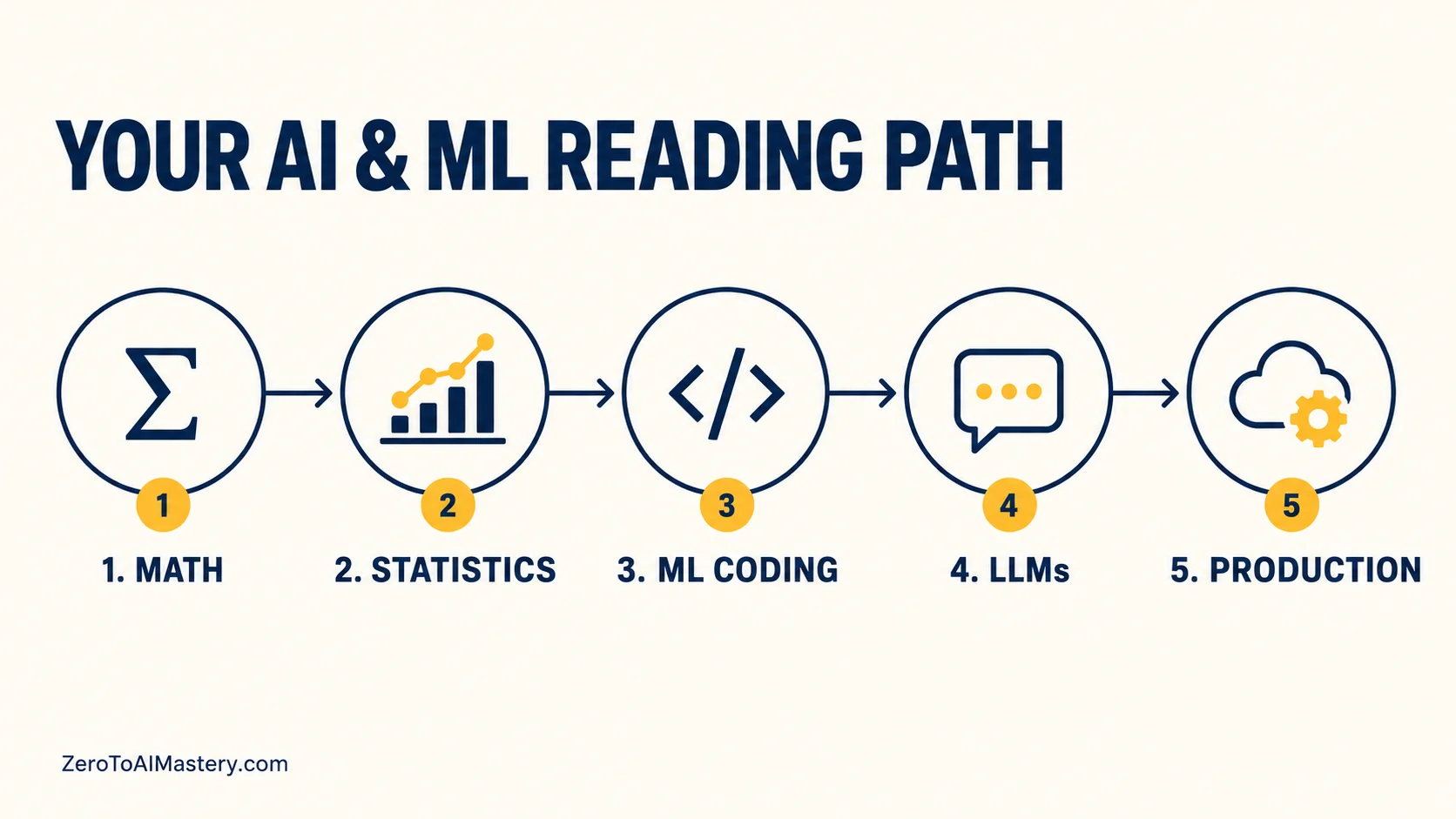
Start with your current gap
The fastest way to waste a good technical book is to choose it because the subject looks advanced. Someone who cannot explain a training set, validation set, and test set does not need an LLMOps handbook yet. Someone who already deploys machine learning services probably does not need three months of introductory definitions. Begin with the question that stops your work today.
If formulas make model explanations hard to follow, start with Essential Math for AI. If you understand the formulas but struggle to connect them to decisions, use Practical Statistics for Data Scientists. If both are familiar and you need practice, move to Hands-On Machine Learning. This order keeps the theory attached to a reason.
People who are completely new can pair this list with the site’s guide on how to learn AI from scratch. That guide covers the wider roadmap. This article handles one part of that roadmap: choosing books that build a connected set of technical skills.
Write one sentence before you begin a book: “I am reading this because I cannot yet…” Finish the sentence with a specific ability. For example, “I cannot yet explain why a model fails after the data changes,” or “I cannot yet build a transformer block without a library hiding the details.” That sentence gives you a test for whether the book is helping.
Read in layers instead of reading everything
Technical books rarely need a single reading method. On the first pass, read the introduction, table of contents, chapter summaries, and one representative chapter. Mark the concepts you recognize, the concepts you partly understand, and the concepts that are new. This pass gives you the shape of the subject before individual details begin competing for attention.
On the second pass, study the chapters tied to your current project. Run the code, change one assumption, and record what changed. If the book explains regularization, compare two settings on the same dataset. If it explains retrieval, change the chunk size or retrieval depth and inspect the answers. A small controlled change teaches more than copying a complete notebook that works on the first run.
Use the third pass only for reference. Return when a real problem gives the chapter a purpose. This is especially useful for large books such as Hands-On Machine Learning and for system-design books that cover many failure modes. Treating every chapter as equally urgent often turns reading into a test of endurance.
Build a small artifact after each major idea
A technical idea becomes useful when you can explain it, implement a small version, and recognize when it breaks. After each major section, produce one artifact. It can be a notebook, a diagram, a short design document, an evaluation table, or a monitoring checklist. The artifact does not need to become a portfolio project. It needs to prove that you can use the idea without the page open beside you.
Keep the artifact narrow. After a chapter on embeddings, build a search tool for twenty documents, not an enterprise knowledge platform. After a chapter on distribution shift, write a one-page plan for detecting a change in input data. After a chapter on attention, implement one attention head and inspect its tensor shapes. Small work exposes confusion quickly.
This approach also makes the books easier to combine. One project can begin as a scikit-learn baseline, gain a statistical evaluation plan, add an LLM interface, and finish with production monitoring. The books then stop feeling like ten separate courses. They become ten views of the same engineering work.
1. Build a Large Language Model (From Scratch): Best for Understanding LLMs From the Inside
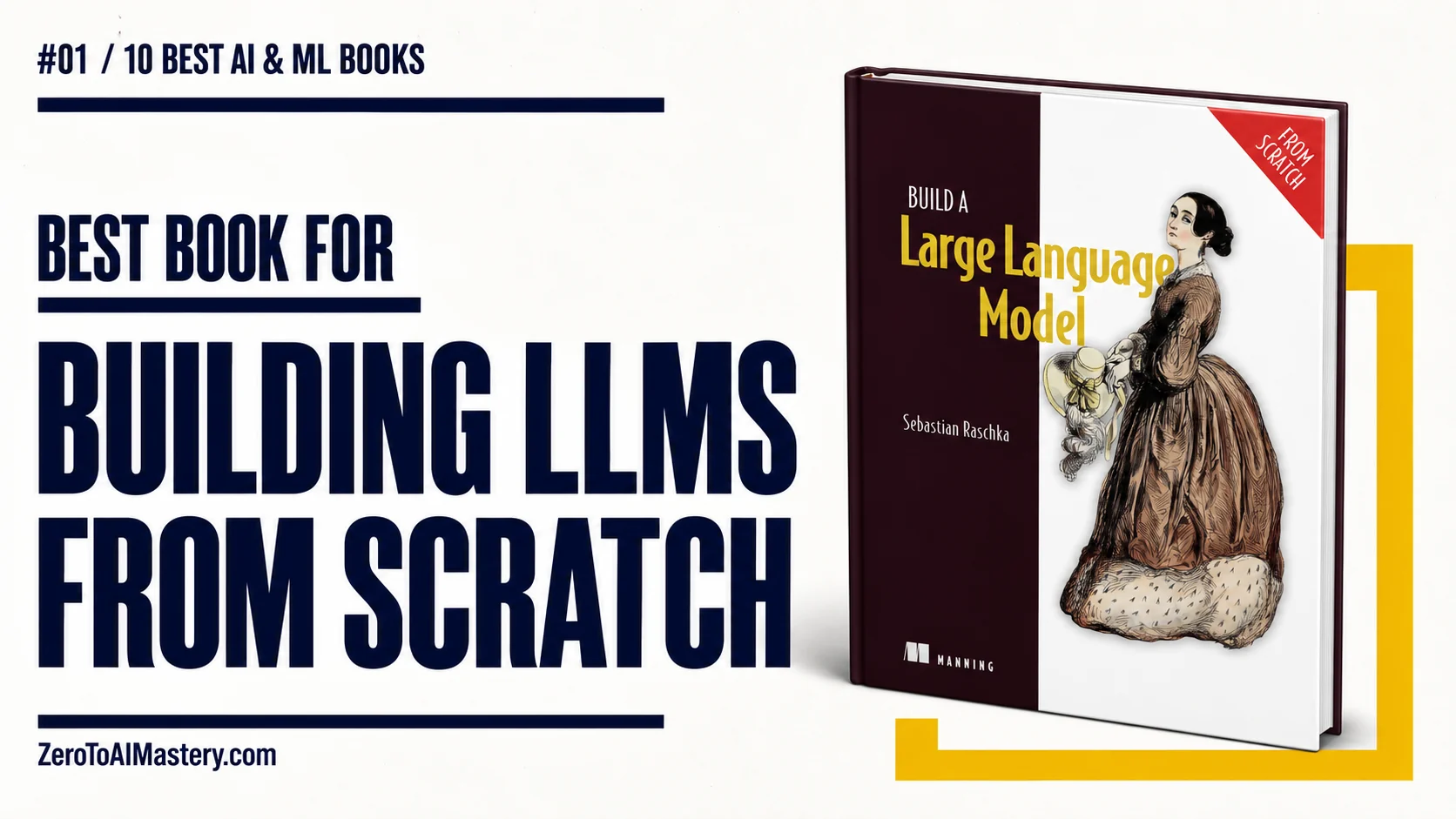
Sebastian Raschka’s Build a Large Language Model (From Scratch) is the strongest choice here for anyone who wants to see what sits below an LLM API. It follows the construction of a GPT-style language model through tokenization, embeddings, attention, transformer blocks, pretraining, text generation, and fine-tuning. The value comes from watching those pieces connect in code.
What the book teaches
- Tokenization and data preparation: The book begins with the path from raw text to model input. You learn why text must be split into tokens, how tokens become vectors, and how batches are prepared for next-token prediction. These steps can look like plumbing when a library handles them. Building them makes later model behavior easier to reason about.
- Attention mechanics: The attention chapters are the center of the book. Instead of treating attention as a slogan about what a model “focuses on,” the text follows the queries, keys, values, masks, and matrix operations that produce an output. You see why causal masking matters for language generation and how multi-head attention lets different learned projections operate in parallel.
- Training and fine-tuning: The later material joins those parts into a transformer, trains it, loads pretrained weights, and adapts the model for classification or instruction following. The result is not a frontier-scale system. That limitation is useful. A smaller model lets you inspect the training loop, loss, output, and failure modes without hiding them behind a remote service.
Who should read it
This is a good book for Python programmers who know the basic idea of neural networks and want a concrete route into LLM internals. You should be comfortable reading tensor code and debugging shapes. You do not need to be a research scientist, but a basic understanding of gradients and model training will keep the early chapters from becoming slow.
It also suits application engineers who use language model APIs and feel that too much happens behind one function call. You may never train a large model for work. Understanding the smaller version still helps you reason about context windows, token costs, fine-tuning data, sampling, and why generated text varies.
Complete beginners can read it, but the path will be easier after a practical machine learning or deep learning introduction. If the training loop and tensor operations feel unfamiliar, pause and use Hands-On Machine Learning for the required foundation. Returning later is more efficient than forcing every chapter on the first attempt.
How to use it
Build the model in stages and keep each stage runnable. First, create a tokenizer and data loader that can show the exact input and target sequences. Next, implement attention and write down the shape of every tensor. Then add the transformer block, train on a small public-domain text, and save sample outputs at regular intervals.
Do not judge the exercise by the quality of the generated prose. Judge it by whether you can explain why the loss changes, what the context length controls, and how a sampling setting changes the output. Break one part on purpose. Remove the causal mask, change the learning rate sharply, or use a tiny context window. Observing the failure gives the architecture a physical feel that a diagram cannot provide.
Finish by writing a short note called “What an LLM API hides.” List tokenization, batching, forward passes, sampling, checkpoints, and adaptation. That note will make later books on AI engineering easier because you will know which problems belong to the model and which belong to the application around it.
2. AI Engineering: Best for Building Applications With Foundation Models
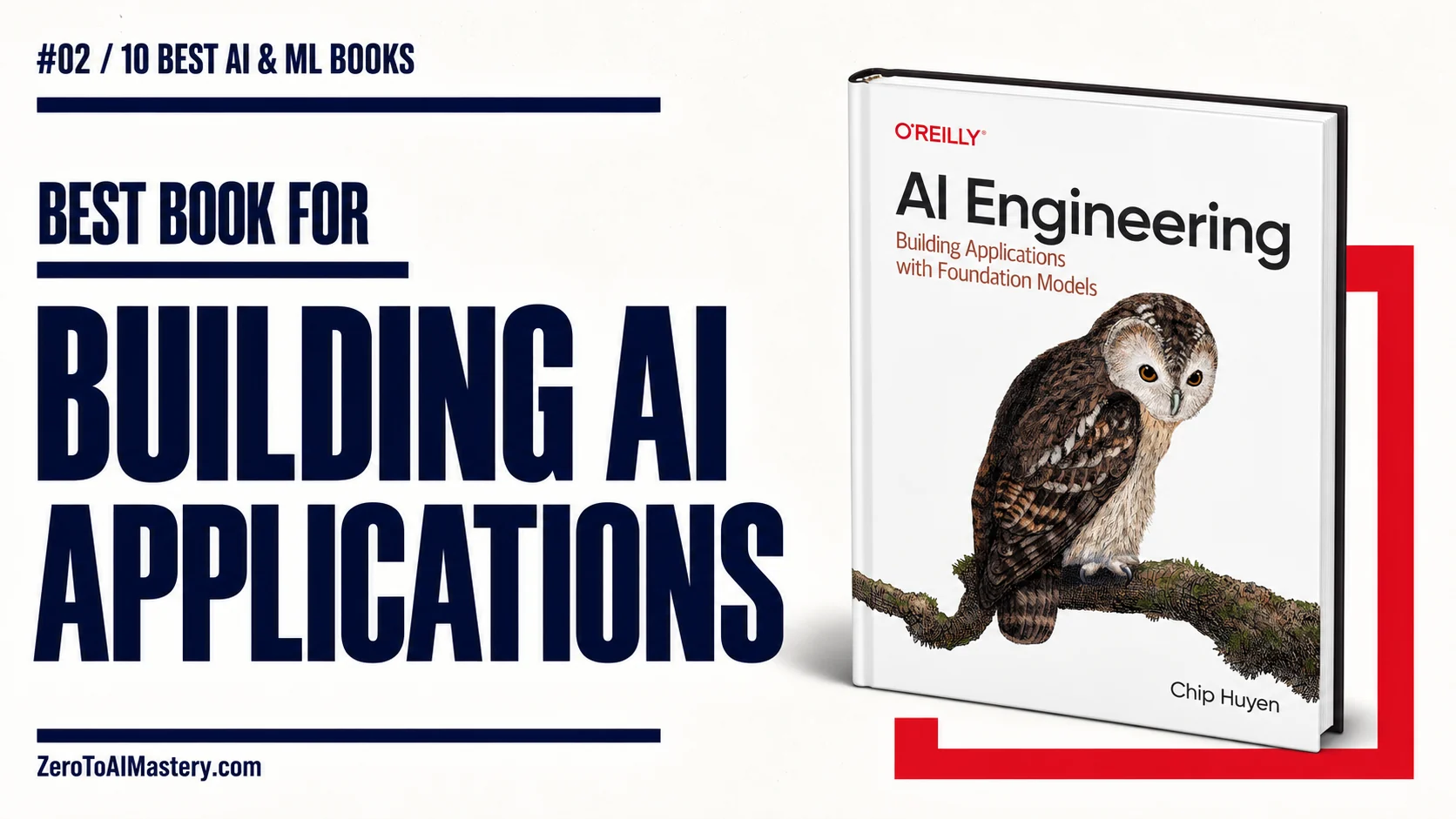
Chip Huyen’s AI Engineering: Building Applications with Foundation Models begins where many machine learning books end. The base model already exists. Your job is to select it, shape the context, evaluate the result, improve the system, and make the application reliable enough for real users.
What the book teaches
- Application-level model decisions: The book treats a foundation model as one component inside a larger product. That changes the questions. Instead of asking only how to train a model, you ask which model fits the task, how to measure output quality, how to collect useful feedback, and whether retrieval, prompt changes, or fine-tuning is the right improvement.
- Evaluation that reflects real use: Evaluation receives the attention it deserves. A convincing demo can fail when users ask unexpected questions, the source documents change, or a model update alters the output. The book helps you think about task-specific evaluation sets, human judgment, automated checks, latency, cost, and the tradeoffs between them. Those are practical decisions, not a single universal score.
- Prompts, retrieval, agents, and fine-tuning: It also connects prompt engineering, retrieval-augmented generation, agents, fine-tuning, and data work. These topics are often taught as separate tricks. Here they are choices inside an application workflow. You learn to identify the failure first, then choose the least complicated intervention that addresses it.
Who should read it
This is one of the best books for AI engineers who build products with existing models. It is useful for software engineers, machine learning engineers, technical product leaders, and founders who need a shared way to discuss model behavior and product reliability. It assumes more interest in system decisions than in deriving every model equation.
Read it after you have built at least one small model-powered application. Without that experience, some evaluation and deployment problems may feel abstract. The project can be simple: a document question-answering tool, a classifier, or a structured extraction pipeline. You only need enough experience to have seen outputs that look right at first and fail under closer testing.
People planning an AI engineering career can pair this book with the practical steps in how to become an AI engineer. The career guide explains the broader skill path. This book gives depth to the application layer of that path.
How to use it
Choose one application and keep it unchanged while you work through the main ideas. Create an initial version with one model and a small set of real inputs. Save every input and output. Before changing the prompt or model, turn the failures into an evaluation set with clear labels or scoring rules.
Then test improvements one at a time. Add retrieval and measure whether grounded answers improve. Change the prompt and record which cases become better or worse. Try a second model and compare quality, latency, and operational complexity. This simple experiment log will teach you more than rebuilding a new demo for every chapter.
End with a one-page system card. Include the task, intended users, data sources, evaluation set, known failure modes, fallback behavior, monitoring signals, and the condition that would trigger a model change. That document turns the book’s ideas into an engineering habit. It also prevents a team from treating prompt edits as the only tool available.
3. Hands-On Large Language Models: Best for Visual and Practical LLM Learning
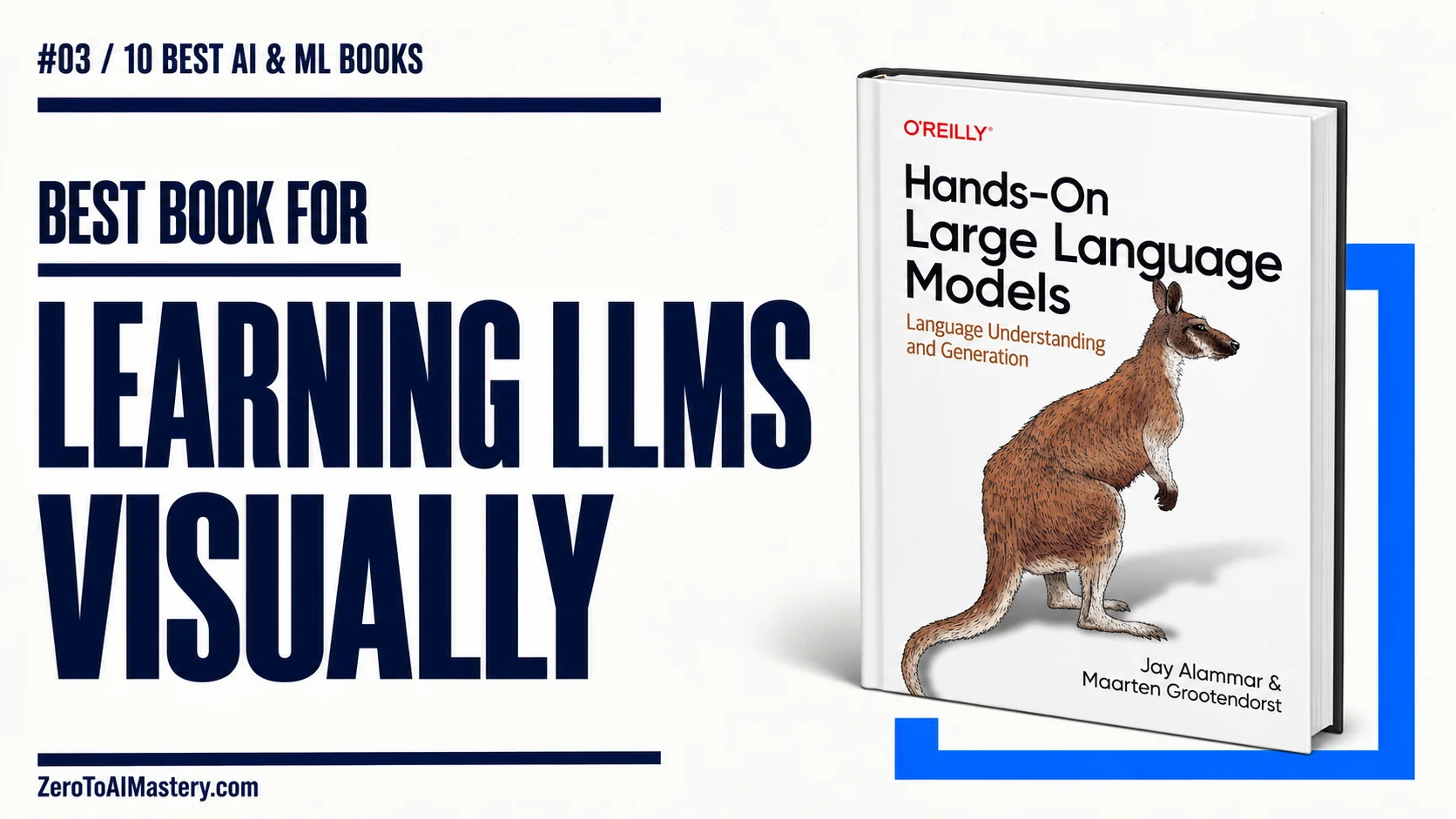
Jay Alammar and Maarten Grootendorst’s Hands-On Large Language Models is a practical bridge between LLM concepts and the tasks people build with them. Its visual explanations help with ideas that are hard to hold in your head from equations alone, while the examples move into embeddings, classification, clustering, semantic search, text generation, and fine-tuning.
What the book teaches
- Transformer fundamentals: The early chapters build a mental model of language models and transformers. Visual explanations show how tokens become representations and how information moves through the architecture. The goal is not to replace the mathematics. It is to give the mathematics a map, so later details have a place to land.
- Embeddings and representation models: The book then spends substantial time on representation models. Embeddings matter because many useful language applications do not require free-form generation. Search, clustering, topic discovery, classification, and recommendation can begin with a good representation of meaning. Learning these tasks reduces the temptation to use a chat model for every problem.
- Generation, retrieval, and adaptation: Generative models, prompting, retrieval, and adaptation come later. Because the book covers both representation and generation, it helps you compare approaches. A support-ticket routing problem may need embeddings and a classifier. A research assistant may need retrieval plus generation. A narrow style transformation might benefit from fine-tuning. The model choice follows the task.
Who should read it
This book fits readers who understand Python and basic machine learning but find LLM material scattered across papers, notebooks, and product documentation. It is especially helpful for visual learners who want a concrete picture before reading lower-level implementation details.
It is also a sensible first LLM-specific book for data scientists. Many examples connect familiar tasks such as classification and clustering with modern embedding models. That continuity makes the jump into language models smaller than starting with a pure architecture text.
Choose this before Build a Large Language Model (From Scratch) if you want to use language models before constructing one. Reverse the order if your main goal is to understand the transformer from the inside. Reading both is reasonable because they answer different questions: one asks how to work with modern language models, and the other asks how the core model is built.
How to use it
Create one small corpus that you can reuse across chapters. It could contain your notes, public technical documentation, product reviews, or support questions. Generate embeddings, visualize clusters, build semantic search, and test a simple classifier on the same material. Reusing the data makes the methods easier to compare.
For semantic search, write ten questions and decide which documents should appear before running the model. That small relevance set stops you from judging results by intuition alone. Change the embedding model or chunking method and see which queries improve. If a change helps six questions and hurts four, inspect why instead of reporting one average number.
When you reach generation, add answers on top of the search system. Keep retrieved passages visible beside each answer. Mark unsupported claims, missed evidence, and cases where the right passage was never retrieved. This separates retrieval failures from generation failures, an important habit for anyone studying context engineering.
4. Hands-On Machine Learning with Scikit-Learn, Keras & TensorFlow: Best for Learning ML by Coding
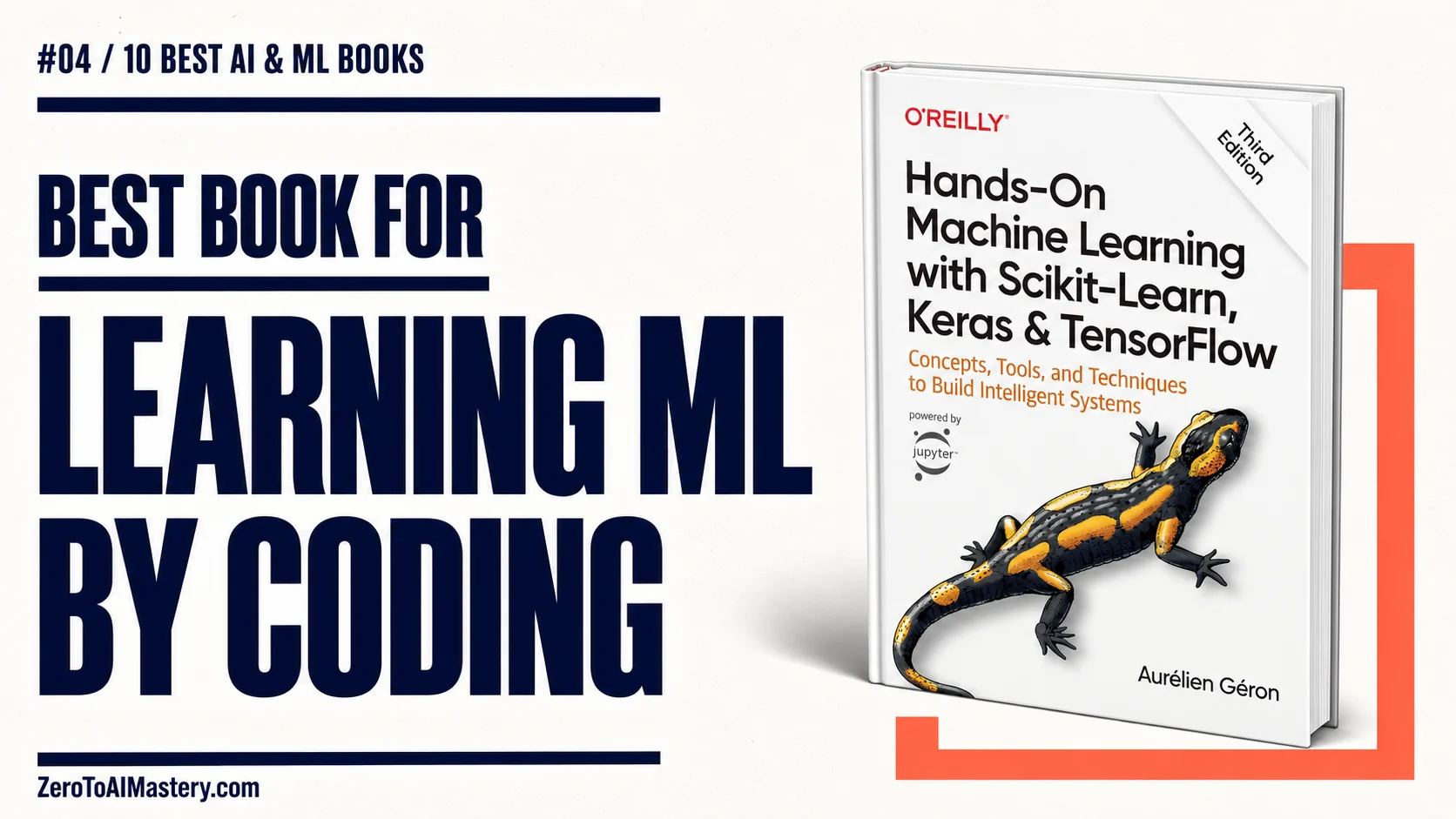
Aurélien Géron’s Hands-On Machine Learning with Scikit-Learn, Keras & TensorFlow is the broad practical anchor of this list. It covers the complete path from preparing data and training classical machine learning models to building neural networks and working with modern deep learning ideas. The examples make the concepts tangible through Python.
What the book teaches
- The end-to-end machine learning workflow: The first part builds the workflow that every later topic depends on. You frame a problem, inspect data, create training and test sets, prepare features, select a model, tune it, and evaluate it. Regression, classification, decision trees, ensembles, support vector machines, clustering, and dimensionality reduction appear as tools inside that workflow.
- Data quality and evaluation: That structure matters more than memorizing algorithms. A beginner often believes model selection is the main task. In practice, data quality, leakage, evaluation design, and error analysis can decide whether the result means anything. The book repeatedly brings the reader back to the whole pipeline.
- Deep learning foundations: The deep learning material moves through neural network basics, training techniques, computer vision, sequence models, transformers, generative models, and reinforcement learning. No single section can make you an expert in every field. The breadth gives you enough context to choose where deeper study should begin.
Who should read it
This is the best single choice on the list for a programmer starting serious machine learning study. You should know basic Python. Familiarity with NumPy and pandas will help, but you can learn missing pieces while working through the examples. A modest mathematics background is enough to begin if you are willing to stop and review unfamiliar terms.
It also works as a reference for people who learned machine learning through disconnected tutorials. The book puts preprocessing, training, evaluation, and deployment concerns into one sequence. That can reveal gaps that individual project videos leave behind.
If your goal is the career path described in how to become a machine learning engineer, this book can support the technical core. It cannot replace projects, software engineering, databases, or deployment practice, but it gives those activities a sound model-building base.
How to use it
Do not copy every notebook exactly. Choose one tabular dataset and keep it for the classical machine learning chapters. Build a baseline with a simple model, write down the metric, and record every change to preprocessing or model settings. The history matters because it shows which improvement helped.
For each algorithm, answer four questions in plain language: What kind of pattern can this model learn? What assumptions does it make? Which setting controls complexity? How will failure appear in the metric or errors? If you cannot answer one, return to the explanation before adding more code.
Use a different project for deep learning, such as a small image or text classification task. Keep the dataset manageable. Compare a simple baseline with the neural approach and explain whether the extra complexity earned its place. That comparison teaches engineering judgment, which is more valuable than completing every exercise.
5. Designing Machine Learning Systems: Best for Production ML
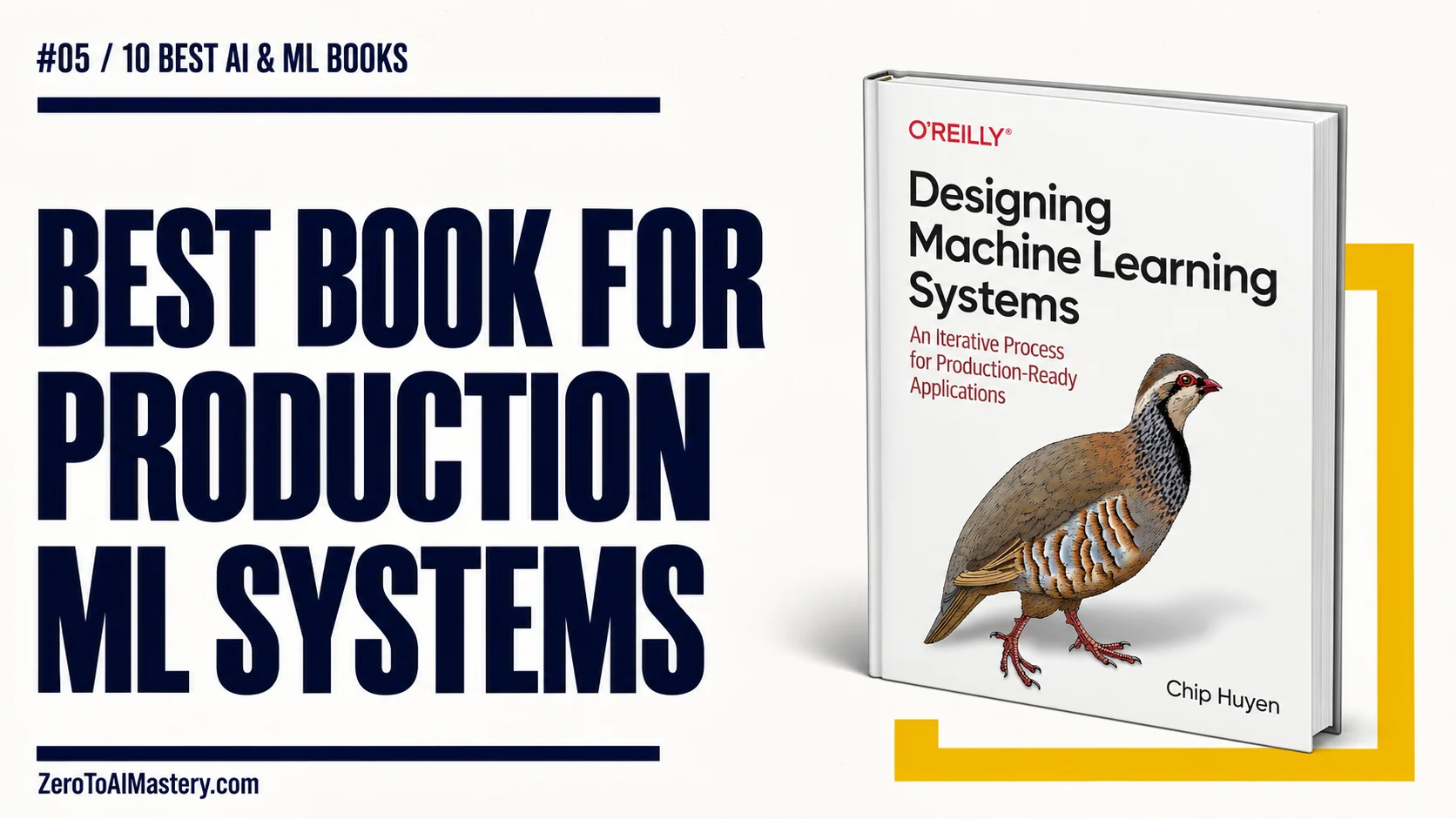
Chip Huyen’s Designing Machine Learning Systems focuses on the distance between a model that works during development and a machine learning system that keeps working for users. It covers data engineering, training data, feature work, deployment, monitoring, continual learning, infrastructure, and the organizational decisions around them.
What the book teaches
- The complete production system: The central lesson is that the model is only part of the system. Data must arrive, transformations must stay consistent, predictions must be served, outcomes must be observed, and changes must be detected. A model can keep returning valid numbers while its real-world usefulness declines. Production design must make that decline visible.
- Distribution shift and monitoring: The sections on distribution shift are especially useful. The data seen after deployment may differ from the training data because user behavior, business rules, devices, markets, or the world itself changed. Monitoring input distributions, prediction patterns, and delayed outcomes helps a team decide whether a model needs investigation or retraining.
- Feedback loops and data lineage: The book also explains why feedback loops and data lineage matter. Predictions can change the behavior that creates future data. Labels may arrive late or contain hidden rules. A dataset without a record of how it was produced is difficult to trust. These concerns rarely appear in clean tutorial datasets, but they dominate mature machine learning work.
Who should read it
Read this after you have trained and evaluated several models. You do not need years of industry experience, but you should know what a training pipeline and prediction service do. The book becomes much more vivid once you have felt the gap between a notebook and a maintained application.
It suits machine learning engineers, data scientists moving toward production ownership, platform engineers, and technical leads. Software engineers can also use it to understand why machine learning systems need different monitoring and data practices from ordinary request-response services.
This book and AI Engineering overlap at the system boundary but have different centers. Designing Machine Learning Systems provides a broad production framework for machine learning. AI Engineering concentrates on applications built with foundation models. Read the former for durable production principles and the latter for the current foundation-model application layer.
How to use it
Take a model you already built and draw the full system around it. Include where raw data originates, how features are created, where model versions live, how predictions reach users, when labels arrive, and who responds to an alert. Any blank box is a useful reading question.
Next, define three kinds of monitoring. Add a service measure such as latency or error rate, a data measure such as a feature distribution, and an outcome measure tied to the task. Write what action each alert should trigger. An alert without an owner or response is only noise.
Finally, write a failure review before the failure happens. Imagine the model performs well at launch and degrades three months later. List five possible causes and the evidence that would distinguish them. This exercise turns broad concepts such as drift and feedback loops into a diagnostic plan you can reuse.
6. The Hundred-Page Machine Learning Book: Best for a Fast Technical Overview
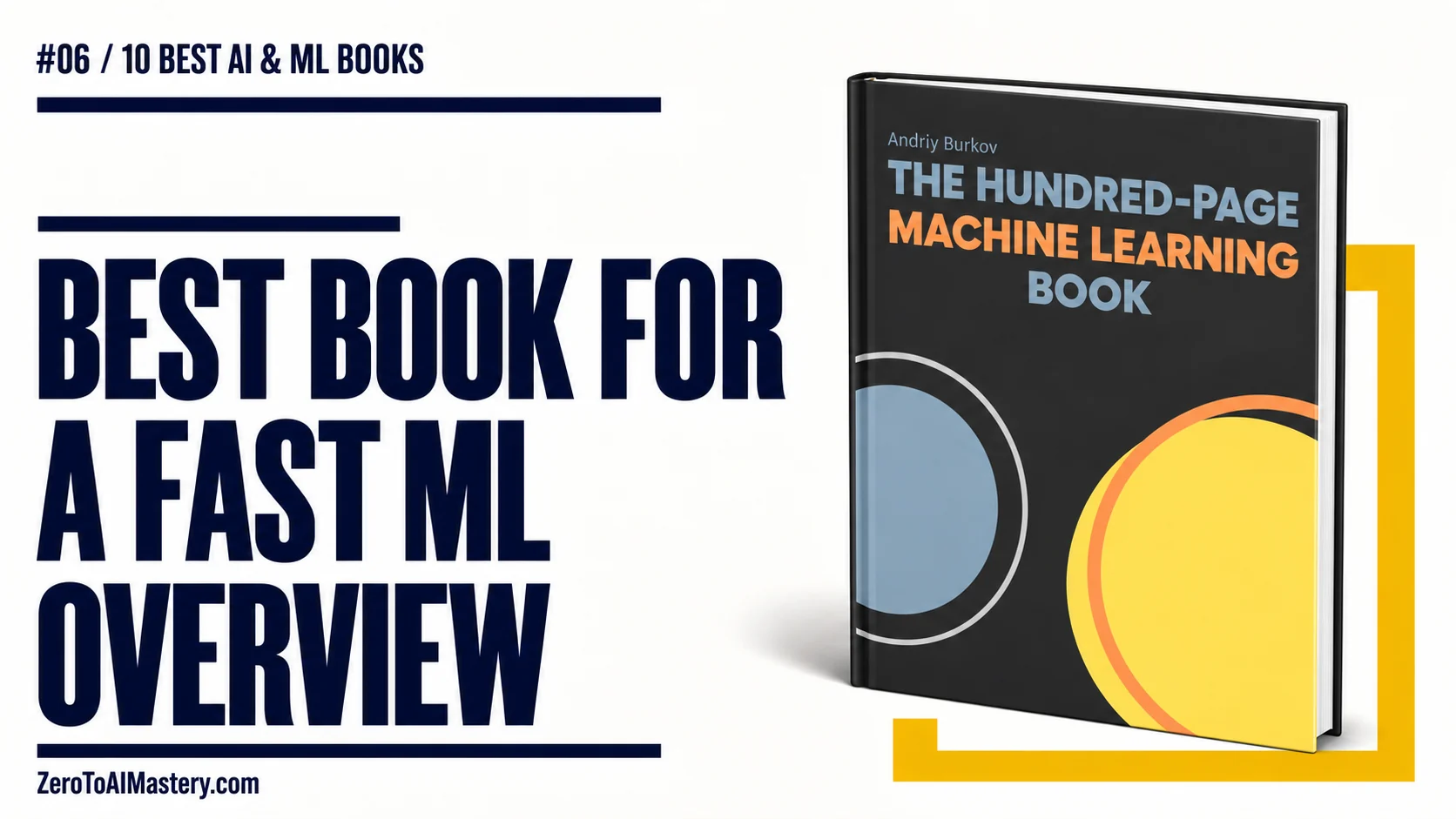
Andriy Burkov’s The Hundred-Page Machine Learning Book compresses the main machine learning map into a small volume. It covers supervised and unsupervised learning, common algorithms, neural networks, feature work, evaluation, and practical concerns with little detour. The result is dense rather than shallow.
What the book teaches
- The machine learning map: The book gives you the vocabulary and relationships needed to understand a much larger field. You see how learning problems are framed, how models find patterns, how optimization changes parameters, and how regularization controls complexity. You also meet the main algorithm families without spending several chapters on each one.
- How algorithm families differ: Its short form forces the explanations to focus on the central mechanism. A support vector machine, decision tree, ensemble, clustering method, and neural network are not presented as isolated brands. Each is a way to represent patterns under particular assumptions. That perspective makes it easier to compare methods later.
- Model evaluation: The evaluation material is equally important. A model is not useful merely because it fits training data. You need a suitable metric, a careful validation method, and an understanding of what kind of error matters. The book introduces these decisions early enough to shape how you read the algorithm chapters.
Who should read it
This is a strong first-pass book for programmers, analysts, product leaders, or students who want the outline before choosing a deeper source. It works well when you have heard many terms but cannot yet explain how they connect. A short, structured overview can remove that fog.
The title can create the wrong expectation. One hundred pages does not mean effortless or nontechnical. Several pages may require slow reading, notes, and outside examples. The compression assumes that the reader will pause. If you try to finish it in one sitting, important distinctions will blur.
Experienced practitioners can use it as a reset. Reading a compact account can expose areas that daily work has allowed to become vague. It is also useful before an interview or before reading a system-design book, because it refreshes the shared language without becoming a complete course.
How to use it
Read the book once without attempting to master every equation. After each chapter, write a five-sentence summary that includes the problem, the main method, one assumption, one failure mode, and one question. This creates a compact map in your own words.
On the second pass, choose three topics that matter for your next project. For example, you might choose gradient boosting, model evaluation, and clustering. Use a deeper book or documentation to implement each topic, then return to the concise explanation. You will often find that the short version becomes clearer after the code.
Create a one-page decision tree at the end. Begin with the type of target and data you have, then branch toward a baseline method and evaluation approach. The diagram will be imperfect, and that is acceptable. Its purpose is to expose where your decisions still rely on memorized labels rather than understanding.
7. Practical Statistics for Data Scientists: Best for Useful Statistical Thinking
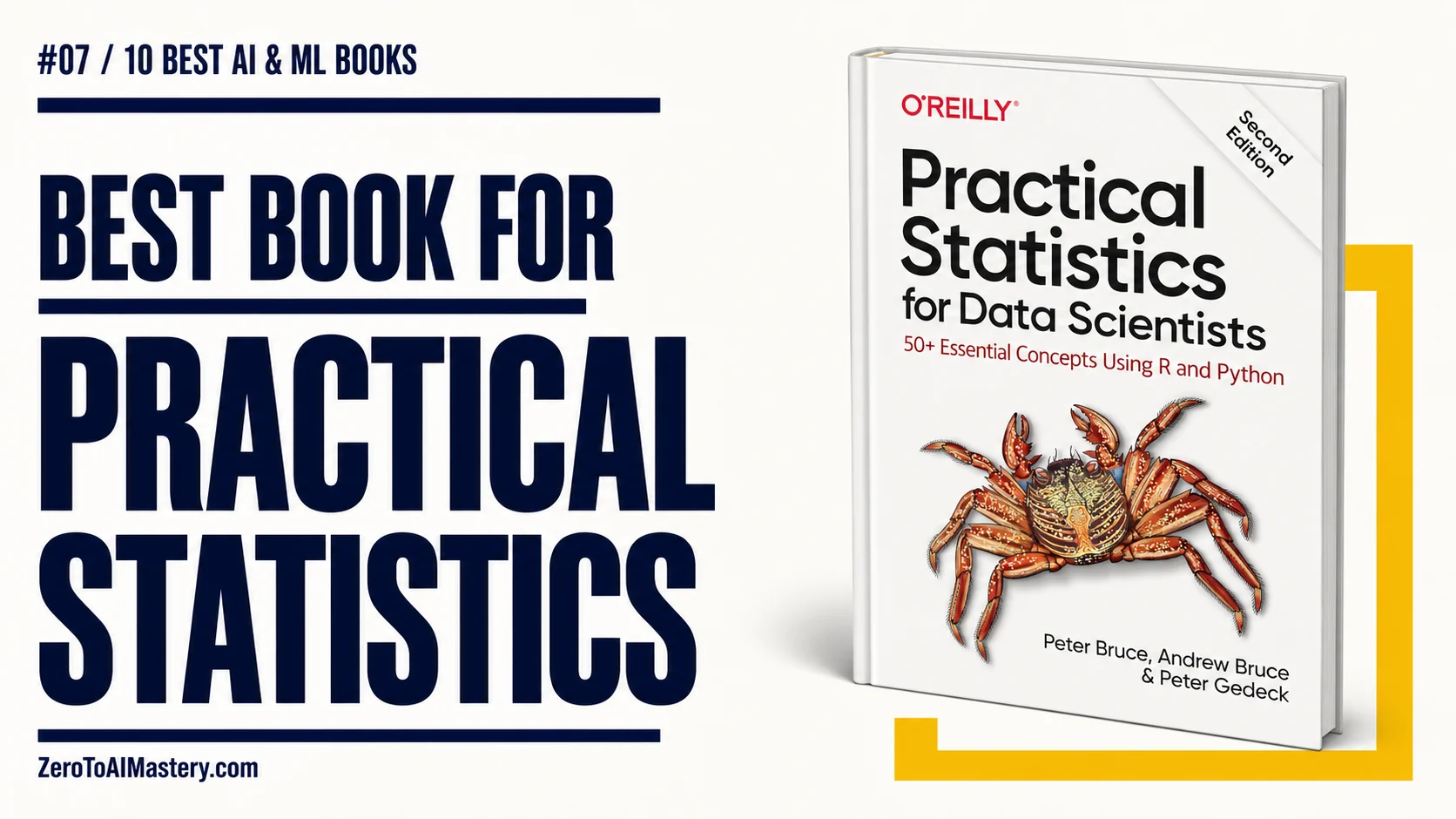
Peter Bruce, Andrew Bruce, and Peter Gedeck wrote Practical Statistics for Data Scientists for readers who need statistics to solve data problems. It covers exploratory data analysis, sampling, experiments, significance testing, regression, classification, statistical machine learning, and unsupervised learning with examples in R and Python.
What the book teaches
- Understanding real-world data: The book starts with the behavior of data rather than a long march through proofs. Distributions, estimates of location and variability, sampling, and bias become tools for deciding what a dataset can support. This foundation helps you notice when an average hides an important subgroup or when a sample does not represent the population you care about.
- Experiments and significance testing: The chapters on experiments and significance testing are useful because model work often includes comparisons. Did a new model improve the task, or did a small sample produce a noisy difference? Is a change in user behavior connected to the model, or did another event happen at the same time? Statistics cannot remove uncertainty, but it gives you a disciplined way to describe it.
- Regression and classification: Regression and classification connect traditional statistical thinking with machine learning. You see how coefficients, residuals, confounding variables, class imbalance, and evaluation measures affect interpretation. The goal is not to defend a border between statistics and machine learning. It is to make better decisions with data.
Who should read it
This book fits data scientists, machine learning engineers, analysts, and software engineers who work with experiments or model evaluation. It is particularly useful for people who can train a model but feel less confident when asked whether the result is reliable.
You do not need advanced mathematical training. Basic algebra and comfort with code are enough for most of the journey. Some topics will require a second reading if probability is new, but the examples keep the discussion attached to real data tasks.
Choose this before a heavy theoretical statistics text if your immediate need is practice. It will not replace a full university sequence for research work. It will help you ask better questions about samples, tests, uncertainty, and model comparisons, which is the right foundation for deeper study.
How to use it
Use one dataset with a clear outcome and a few messy features. Begin with exploratory analysis and write down what you believe before fitting a model. Look for skew, missing values, outliers, and groups that may behave differently. Then test whether the later model agrees with your initial story.
Run a small simulation whenever a probability idea feels abstract. Draw repeated samples from a known distribution and plot the resulting estimates. Change the sample size. Add bias. Watch confidence intervals widen or shrink. A few lines of code can turn sampling theory into something you can see.
For the experiment chapters, design a test for a feature you know well, even if you cannot run it. Define the unit of assignment, the outcome, the minimum useful effect, possible sources of contamination, and the stopping rule. This exercise is valuable because a clean statistical test begins before the data arrives.
8. Essential Math for AI: Best for Building Math Intuition
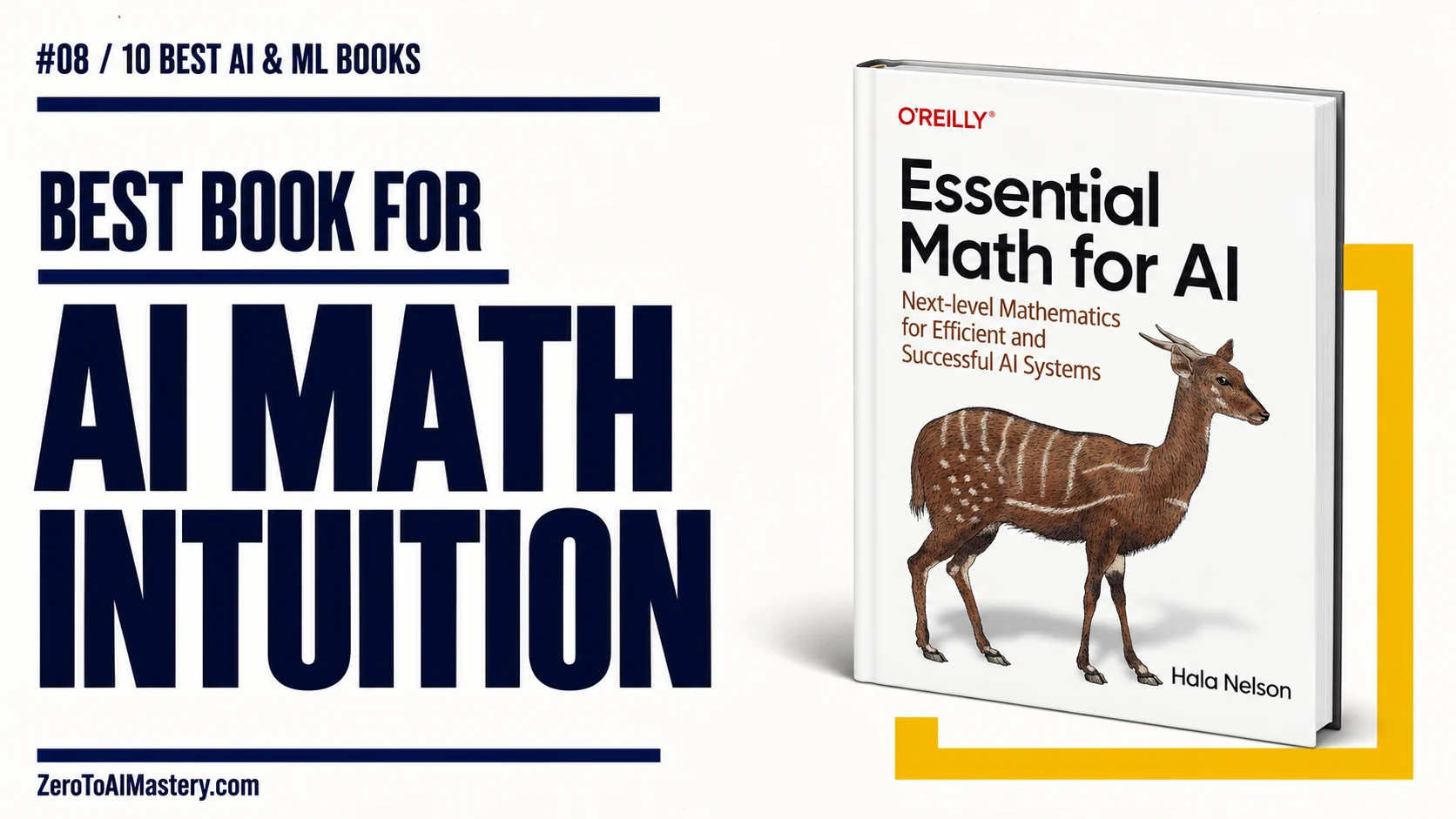
Hala Nelson’s Essential Math for AI connects mathematics with the models and problems that use it. The book draws from linear algebra, calculus, probability, statistics, graph theory, and optimization. Its aim is not to collect formulas. It is to show why these mathematical ideas appear in artificial intelligence.
What the book teaches
- Linear algebra: Linear algebra explains how data and parameters are represented and transformed. Vectors describe examples and embeddings. Matrices combine operations across many values. Eigenvectors, decompositions, and projections appear in dimensionality reduction, optimization, and model analysis. Seeing these connections makes the notation less arbitrary.
- Calculus and optimization: Calculus and optimization explain how a model learns. Derivatives describe local change, gradients point toward parameter updates, and loss functions turn a task into something an optimization method can work on. The book also addresses cases where a clean mathematical optimum does not guarantee a useful system.
- Probability, statistics, and graphs: Probability and statistics give language to uncertainty, while graph concepts help describe relationships and structure. Together, these topics support machine learning, deep learning, probabilistic models, and modern representation methods. The benefit is a connected view rather than a separate mathematics course for every tool.
Who should read it
This book is for readers who can follow machine learning code but feel blocked when explanations become mathematical. It also suits students who studied these subjects earlier and no longer remember why the techniques matter. Application can make old material easier to recover.
It is not the simplest possible introduction to mathematics. Some sections move quickly and reward patient reading. If basic algebra manipulation is difficult, use an introductory source alongside it. The goal is steady understanding, not finishing chapters on a fixed schedule.
Engineers who already know the mathematics can still benefit from the AI connections. Being able to calculate a gradient is different from explaining what the gradient means in a training problem. The book encourages that second kind of understanding.
How to use it
Keep a two-column notebook. In the first column, write the mathematical object: vector, matrix, derivative, probability distribution, graph, or objective function. In the second, write the AI job it performs. Add a tiny example with actual numbers whenever the link feels weak.
Recreate important operations with a small array library before relying on a deep learning framework. Multiply a data matrix by a weight matrix, compute a simple loss, and estimate a gradient. Then compare your result with an automatic differentiation tool. This makes the framework feel like an implementation aid rather than magic.
Do not wait to “finish the math” before building models. Pair each topic with a chapter in Hands-On Machine Learning or Build a Large Language Model. When you meet an unfamiliar operation, return to the relevant mathematics. The project supplies context, and the mathematics supplies explanation.
9. LLM Engineer’s Handbook: Best for Taking LLMs to Production
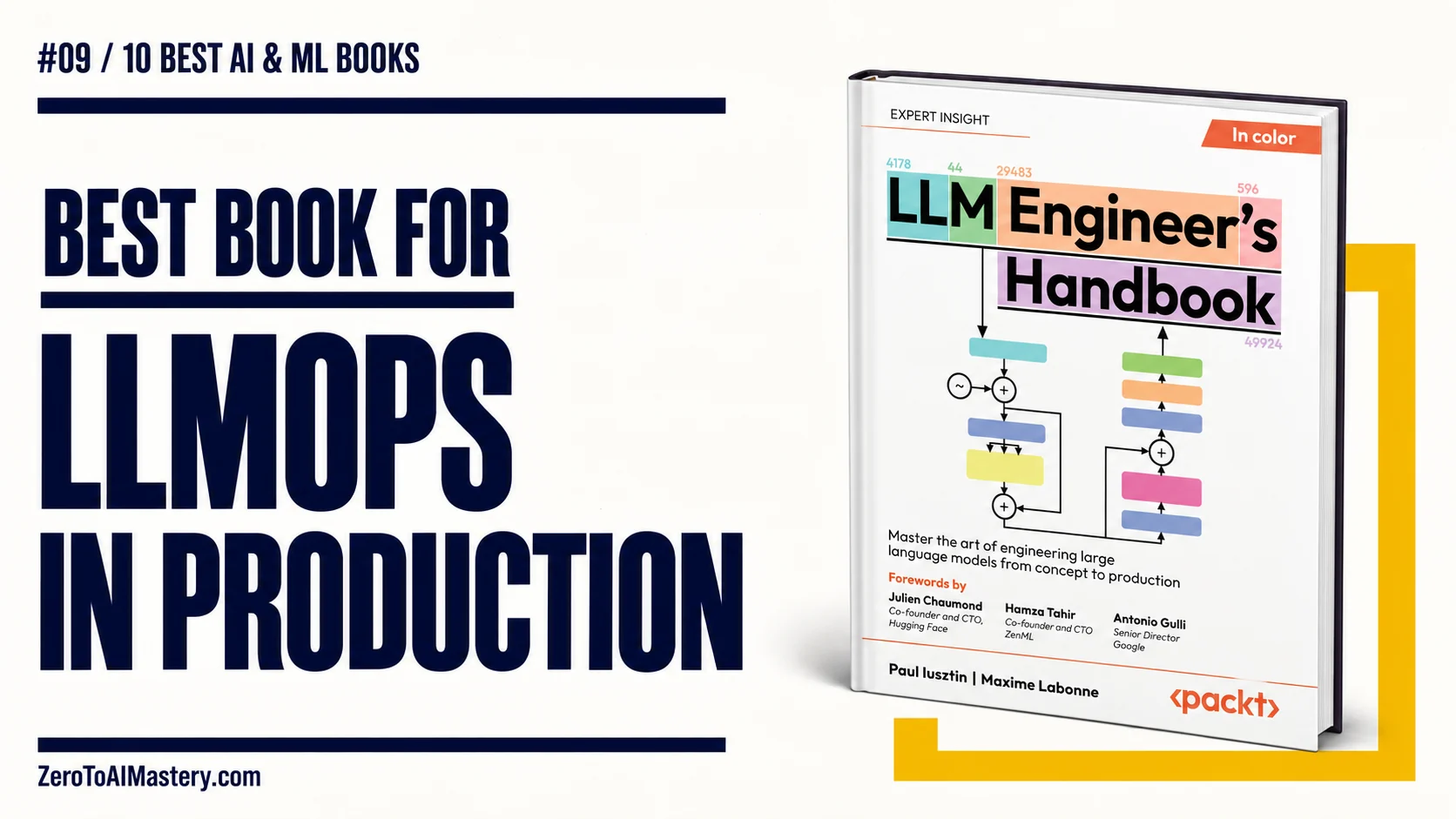
Paul Iusztin and Maxime Labonne’s LLM Engineer’s Handbook presents an end-to-end workflow for building, training, deploying, and monitoring language model applications. It combines data pipelines, fine-tuning, evaluation, retrieval, serving, and LLMOps in one project-oriented path.
What the book teaches
- A repeatable LLM engineering pipeline: The book treats an LLM system as a repeatable engineering pipeline. Data must be collected and versioned, experiments must be tracked, models must be evaluated, and deployment must be reproducible. This is a useful correction to examples that stop after one notebook returns a plausible answer.
- Retrieval compared with fine-tuning: Fine-tuning and retrieval appear as different ways to improve a system. Retrieval adds relevant information at inference time. Fine-tuning changes the model’s behavior through training data. The right choice depends on the failure, available data, update frequency, and operating constraints. A mature workflow tests those assumptions instead of choosing the fashionable method.
- Serving and monitoring: The production material covers serving, monitoring, and orchestration. Language model systems need ordinary service measures such as latency and errors, plus measures tied to retrieval quality, output quality, safety rules, and changing user inputs. The book makes these concerns part of development rather than an afterthought.
Who should read it
This is an intermediate book for engineers who have already built at least one LLM application. You should know Python, basic model use, and the idea of retrieval or fine-tuning. Familiarity with cloud services, containers, and experiment tracking will help, although the project can also teach those pieces.
It is a good match for machine learning engineers moving into LLMOps and software engineers taking ownership of model pipelines. The workflow is more important than any single library. Individual tools will change, but versioning, evaluation, deployment, and monitoring remain necessary.
Readers who want a broader product and model-selection view may start with AI Engineering. Readers who want a concrete end-to-end implementation can move to this handbook next. The two books complement each other when you keep the problem definition and evaluation set consistent.
How to use it
Choose one small application and run it through the complete lifecycle. Version the source data, create a baseline, define an evaluation set, train or adapt the model, deploy an endpoint, and collect monitoring signals. A modest system completed end to end teaches more than an ambitious system that never leaves development.
Record lineage for every result. You should be able to connect an output to a model version, prompt or template, retrieval index, source data, and configuration. When performance changes, this record lets you compare causes. Without it, debugging becomes guesswork.
Add one controlled failure before calling the project complete. Remove an important document, introduce a malformed input, or change the data distribution. Check whether the monitoring and fallback behavior reveal the issue. This resembles the thinking behind harness engineering, where the surrounding system helps capable models operate reliably.
10. Generative Deep Learning: Best for Understanding How Generative Models Work
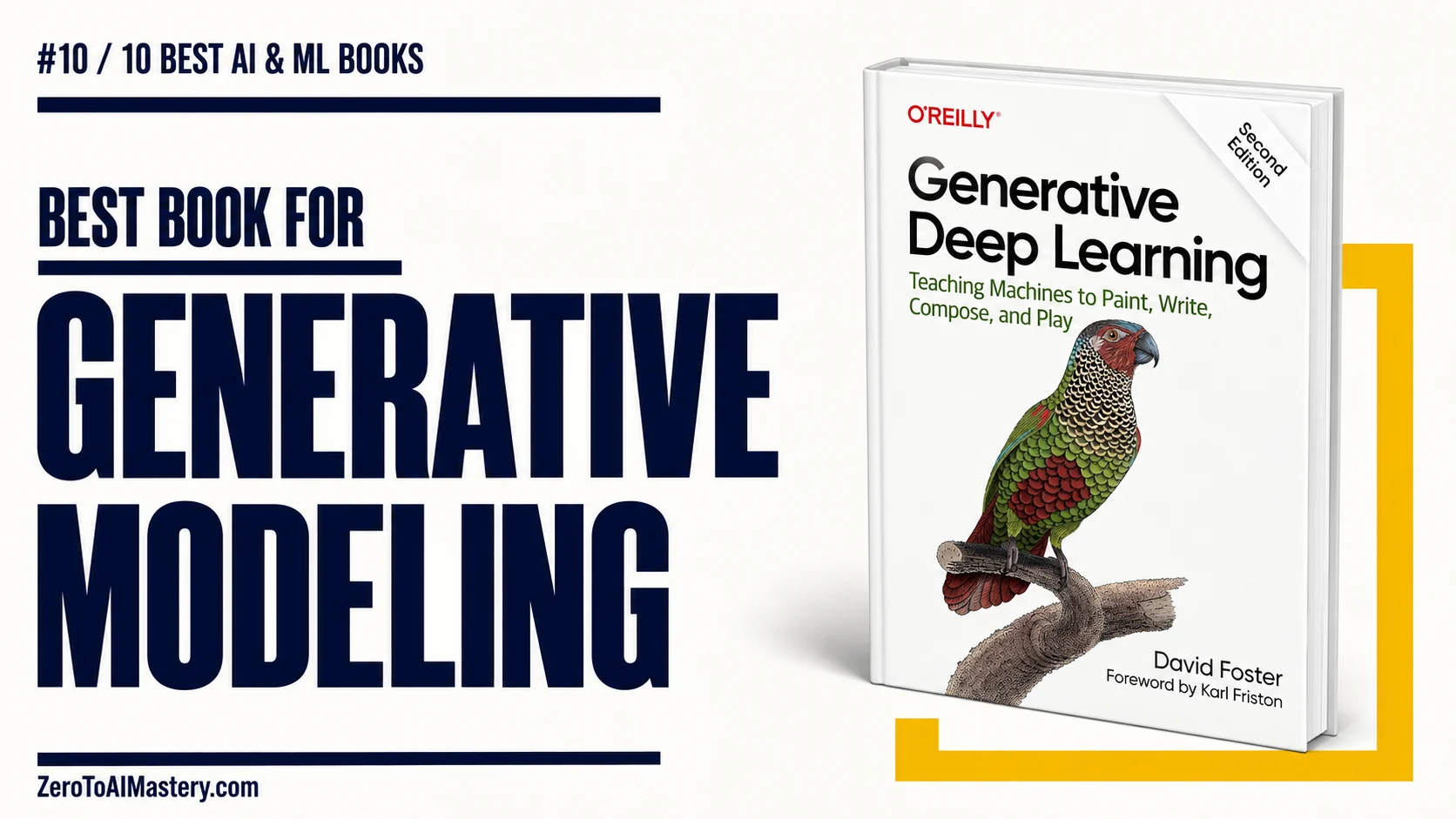
David Foster’s Generative Deep Learning explores how neural networks generate new data. The book covers variational autoencoders, generative adversarial networks, autoregressive models, transformers, diffusion models, and other approaches through explanations and implementations.
What the book teaches
- Major generative model families: The book shows that “generative AI” is not one architecture. An autoregressive model predicts the next element in a sequence. A variational autoencoder learns a structured latent space. A GAN trains a generator against a discriminator. A diffusion model learns to reverse a noise process. Each method defines generation differently.
- Tradeoffs between architectures: Studying these families side by side helps you understand tradeoffs. Some models offer useful latent representations. Some produce sharp samples but can be difficult to train. Some generate sequentially. Some start with noise and refine it. The architecture affects training behavior, sampling speed, controllability, and failure modes.
- Evaluating generative output: The practical examples also show how a generative system is evaluated. A low training loss does not automatically mean diverse, coherent, or useful output. Visual inspection, held-out measures, task-specific checks, and an understanding of the data are all needed. This lesson transfers to text, images, audio, and multimodal systems.
Who should read it
This book suits readers who already understand neural network training and want a wider view of generative methods. Basic Python and deep learning experience are important. If layers, losses, optimizers, and training loops are new, begin with the relevant parts of Hands-On Machine Learning.
It is useful for engineers who know transformers but want to understand the broader field. The recent focus on LLMs can make generative modeling appear synonymous with text generation. This book restores the larger picture and makes ideas such as latent spaces and diffusion easier to compare with autoregressive generation.
Creative technologists can also use it, provided they are willing to study the mechanisms rather than only run finished models. The payoff is control. Understanding the training objective and representation helps you choose an approach for a specific kind of content.
How to use it
Select two model families and train small versions on the same simple dataset. For images, use a compact set that trains quickly. Keep sample outputs at fixed intervals and record the loss curves. Compare what improves, what collapses, and how sampling differs.
For a variational autoencoder, explore the latent space instead of looking only at final samples. Interpolate between two points and inspect how the output changes. For a diffusion model, save intermediate denoising steps. These observations connect the model’s mathematical objective with its visible behavior.
Finish with a comparison note that answers five questions: What does the model learn? How is it trained? How does it generate a sample? What failure is common? When would you choose it? If you can answer those questions without relying on brand names, you have learned the central lesson of the book.
How to Turn These Books Into a 12-Week Learning Plan
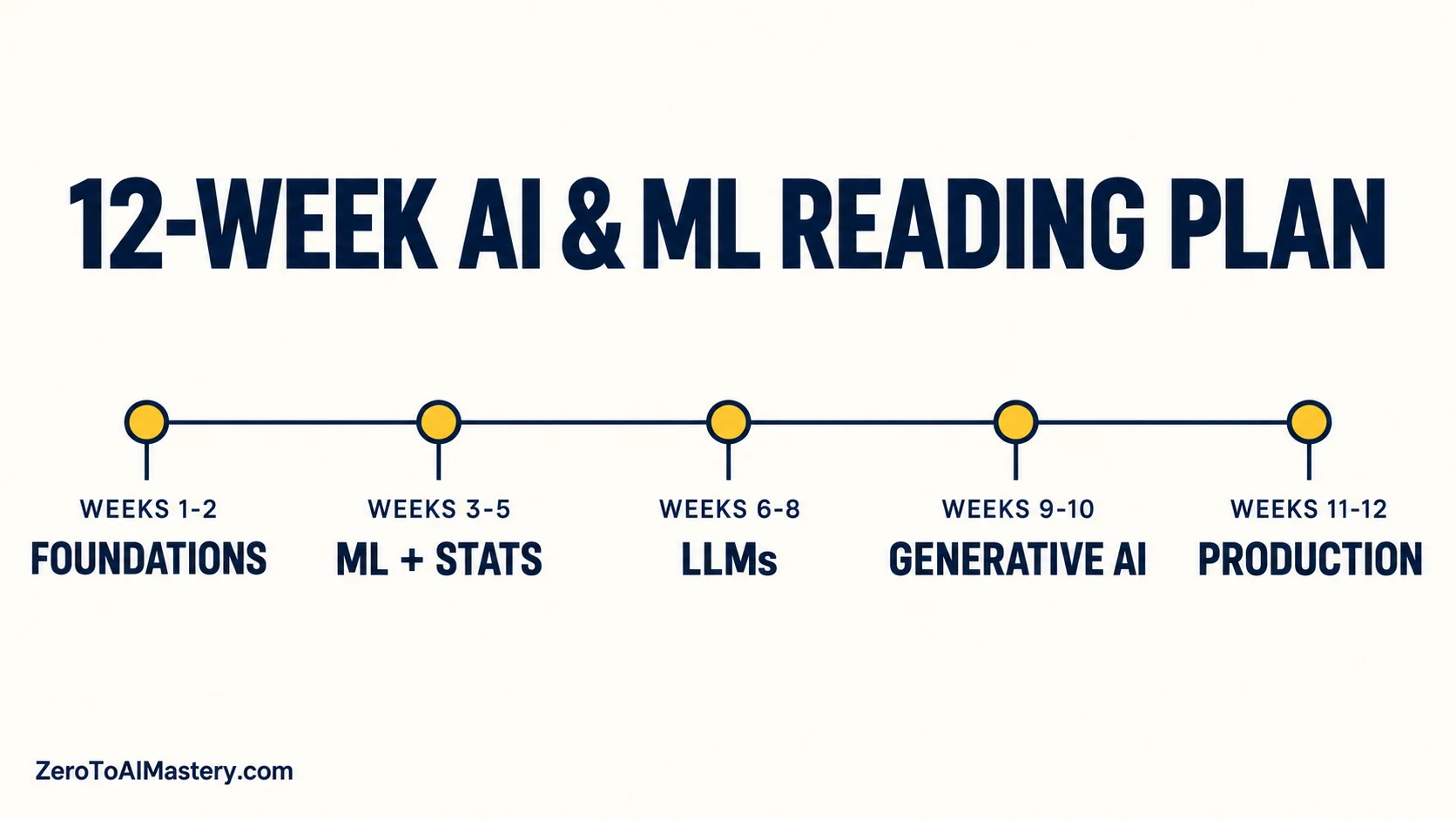
This plan is designed for someone who already knows basic Python and can study six to eight focused hours each week. It does not attempt to finish all ten books. The goal is to build a connected map, complete selected chapters, and produce one small project that gains depth as the weeks pass.
Weeks 1 and 2: Build the map
Read The Hundred-Page Machine Learning Book for the broad overview. Do not stop at every unfamiliar formula. Mark the sections that feel weak and write a short summary of supervised learning, unsupervised learning, evaluation, optimization, and regularization.
Use Essential Math for AI to review the mathematics behind those weak sections. Focus on vectors, matrices, derivatives, probability, and optimization. Create small numerical examples rather than long copied notes. By the end of week two, you should be able to explain how data becomes a matrix, how a loss measures error, and how an optimizer changes parameters.
Choose a simple tabular dataset for the project. Define the target, decide what one useful prediction would mean, and reserve a test set. Build the simplest reasonable baseline. Save the code and a one-page description of the problem.
Weeks 3 to 5: Learn the machine learning workflow
Work through the core classical machine learning chapters in Hands-On Machine Learning. Prioritize the end-to-end project, classification, model training, trees, ensembles, and evaluation. Apply each major idea to your chosen dataset instead of starting a new notebook every time.
Use Practical Statistics for Data Scientists alongside the project. Study exploratory data analysis, sampling, experiments, regression, classification metrics, and class imbalance. Check whether the dataset represents the population named in your problem statement. If it does not, write that limitation down.
At the end of week five, your project should include a baseline, one stronger model, a clear metric, error analysis, and a record of experiments. You should know which improvement helped and which only added complexity.
Weeks 6 to 8: Understand and use language models
Use selected chapters from Build a Large Language Model (From Scratch) to implement tokenization, attention, and a small transformer. The model can train on a tiny text collection. The purpose is to follow the path from tokens to generated output.
At the same time, use Hands-On Large Language Models to build an embedding-based feature. Add semantic search over your project notes or another small document set. Define ten test queries and expected results before tuning the system.
These two tracks answer complementary questions. The small transformer shows what happens inside the model. The embedding project shows how a pretrained model becomes part of a useful application. By the end of week eight, write a diagram that separates model work, data work, retrieval, and application logic.
Weeks 9 and 10: Compare generative approaches
Read the overview and two model-family sections in Generative Deep Learning. Choose one approach beyond the transformer, such as a variational autoencoder or diffusion model. Train a small example or carefully reproduce one exercise while recording intermediate outputs.
Compare that method with autoregressive text generation. Describe the training objective, sampling process, strengths, and common failure for each. Avoid a vague judgment about which method is “better.” The methods solve different forms of generation.
Use this comparison to revise your project design. If the project only needs classification or retrieval, say so. Knowing when generation is unnecessary is part of learning generative AI.
Weeks 11 and 12: Design for production
Read the evaluation and application-design sections of AI Engineering. Turn your project examples into a small evaluation set. Add task quality, latency, and failure categories. Test one improvement at a time and keep the result, including cases that became worse.
Use LLM Engineer’s Handbook for the implementation workflow and Designing Machine Learning Systems for the wider production design. Version the data, model, prompts, and retrieval configuration. Draw the serving path and define monitoring for service health, data changes, and task outcomes.
Finish with a design review. State who the system helps, what it does, which data it uses, how quality is measured, what it cannot handle, and what happens when a component fails. This final document is the bridge from reading to engineering.
Common mistakes to avoid
- Reading several books without building anything. Notes can create a feeling of progress while leaving implementation gaps hidden. Build a small artifact after every major topic.
- Starting with the most advanced title. A production handbook cannot replace a working understanding of training, evaluation, and data. Begin where your current gap begins.
- Copying code without changing it. Change a parameter, dataset, assumption, or component. Then explain the result. Controlled variation is where much of the learning happens.
- Treating every page as equally important. Technical books serve different needs at different times. Read the core path now and keep the rest as reference.
- Using model output as the only evaluation. Decide what success means before looking at a few appealing examples. Keep a fixed set of cases and record failures.
- Chasing tools instead of principles. Libraries and model names will change. Data quality, evaluation, lineage, monitoring, and clear system boundaries will remain useful.
Conclusion
The best AI and ML books do more than explain a collection of algorithms. Together, they should help you move from a problem to data, from data to a model, and from a model to a system that can be tested and maintained.
For a beginner, the most useful path is usually The Hundred-Page Machine Learning Book, selected parts of Essential Math for AI, and sustained project work with Hands-On Machine Learning. That sequence gives you the map, the missing mathematics, and the coding practice.
For LLM work, pair Build a Large Language Model (From Scratch) with Hands-On Large Language Models. The first reveals the machinery. The second shows how to use modern models for representation and generation tasks. Add AI Engineering when the focus shifts from a model demo to a reliable application.
For production work, read Designing Machine Learning Systems and LLM Engineer’s Handbook with a real project beside you. Their ideas become concrete when you can point to your own data pipeline, evaluation set, service, and monitoring plan.
Choose one gap, one book, and one artifact. That small cycle is a better learning system than collecting ten titles and waiting for the perfect time to begin.
Frequently Asked Questions
1. What is the best AI and machine learning book for a complete beginner?
The Hundred-Page Machine Learning Book is a good overview for a beginner who wants to see the field before committing to a large textbook. Pair it with simple Python exercises and selected chapters from Hands-On Machine Learning. If mathematics is the main barrier, use Essential Math for AI as a companion rather than trying to complete it first.
2. Which book should I read first to learn machine learning with Python?
Start with Hands-On Machine Learning with Scikit-Learn, Keras & TensorFlow if you already know basic Python. Work through the end-to-end project and the classical machine learning chapters before moving to deep learning. Use one dataset across several chapters so you learn the workflow, not only separate examples.
3. What are the best books for AI engineers in 2026?
For application engineering, start with AI Engineering. Add Hands-On Large Language Models for embeddings and LLM tasks, then use Designing Machine Learning Systems for broader production design. LLM Engineer’s Handbook is useful when you want a concrete LLMOps workflow.
4. Do I need advanced mathematics before reading AI books?
No. You need enough algebra, probability, and calculus to understand the topic you are studying, but you can learn those parts alongside a project. Essential Math for AI works well as a reference when a model explanation becomes unclear. Waiting to master all mathematics before writing code usually delays useful practice.
5. Do I need to know Python before reading these books?
Python is important for the hands-on titles. Basic variables, functions, loops, data structures, and package use are enough to begin. System-design books can be read without writing every example, but practical experience will make their decisions easier to understand.
6. Which book is best for understanding how LLMs work?
Choose Build a Large Language Model (From Scratch) if you want to construct the main components and follow the training process. Choose Hands-On Large Language Models if you want a visual explanation plus practical tasks such as embeddings, classification, semantic search, and generation. Reading both gives you an internal and an application view.
7. Which book is best for production machine learning?
Designing Machine Learning Systems is the broadest choice for production machine learning. It covers data, deployment, monitoring, distribution shift, continual learning, and system tradeoffs. For LLM-specific production workflows, add LLM Engineer’s Handbook.
8. What is the difference between AI Engineering and Designing Machine Learning Systems?
AI Engineering focuses on applications built with foundation models, including model selection, evaluation, prompting, retrieval, agents, and fine-tuning. Designing Machine Learning Systems covers production machine learning more broadly, with strong attention to data systems, deployment, monitoring, and change over time. The first is more specific to the current foundation-model layer; the second provides a wider production frame.
9. Should I read Build a Large Language Model or Hands-On Large Language Models first?
Read Build a Large Language Model first if architecture and implementation are your main questions. Read Hands-On Large Language Models first if you want to build useful LLM features with pretrained models. You can alternate them by studying an internal concept and then applying a related pretrained model task.
10. Can I learn machine learning from books alone?
Books can give you structure, depth, and a reliable reference, but they cannot replace practice. You need to prepare data, train models, inspect errors, compare approaches, and explain your choices. A small completed project beside each book is enough to turn reading into skill.
11. Are AI books outdated too quickly in 2026?
Tool-specific examples can age, but core ideas remain useful. Tokenization, attention, evaluation, sampling, data quality, distribution shift, monitoring, and experiment design do not disappear when a new model or library arrives. Prefer books that teach those principles and use current documentation for changing APIs.
12. How many AI and machine learning books do I need to read?
One well-chosen book studied with a project can be more useful than ten books read quickly. Begin with the book that addresses your current gap. Add a second only when the project exposes a new gap, such as statistics, LLM internals, or production design.
13. What is the best combination for learning AI mathematics and statistics?
Use Essential Math for AI for linear algebra, calculus, probability, and optimization in an AI context. Use Practical Statistics for Data Scientists for sampling, experiments, regression, classification, and uncertainty in data work. Apply both to the same dataset so the subjects reinforce each other.
14. What order should an aspiring AI engineer follow?
Begin with a broad overview, then study mathematics and statistics as needed. Build practical machine learning projects, learn LLM internals and applications, and finish with evaluation and production systems. The exact order can change, but fundamentals should support the application layer rather than being skipped entirely.
Final Thoughts
A good reading list should make your next decision easier. It should tell you which book fits your present level, what you can build with it, and where to go when you reach the next gap. That is the purpose of this sequence.
If you are beginning, pick one overview and one practical book. If you already build models, choose the book that addresses the part of the system you understand least. If you work with LLMs, study both the model and the machinery around it. Reliable AI comes from those layers working together.
Do not measure progress by pages alone. Measure it by what you can now explain, build, test, and diagnose. Read a chapter, make one small change, record what happened, and carry that lesson into the next project.