


You open an AI job listing and see a salary above $200,000. Then you read the requirements: production experience, difficult technical decisions, and responsibility for work that other people use. The opportunity is real. The route into it needs more thought than a list of course certificates. The highest paying AI jobs reward different strengths, and you need to choose a role before you choose a learning plan.
This guide compares ten career paths with current employer pay evidence. You will see what each person does, which skills to build, and which project can demonstrate those skills. You will also find a course path, a study plan, and a method for comparing job offers. The salary examples refer to United States roles. A U.S. remote position can still require U.S. residence and work authorization.
The title describes roles with the potential to pay above $200,000 in 2026. It does not describe the normal starting salary for each occupation. Some advertised ranges cross that amount; others start above it. The highest numbers often come with staff, principal, or leadership duties. Read the pay evidence together with the exact title and location before you use it as a target.
The examples and learning exercises below are proposed practice projects. They are not claims about projects I completed or results that an employer achieved. Use them to turn study into work that another person can inspect. You can follow one path without buying every course or learning every tool mentioned here. A smaller project that you can explain will help you more than a large collection of copied demonstrations.
How Much Do The Highest Paying AI Jobs Pay In 2026?
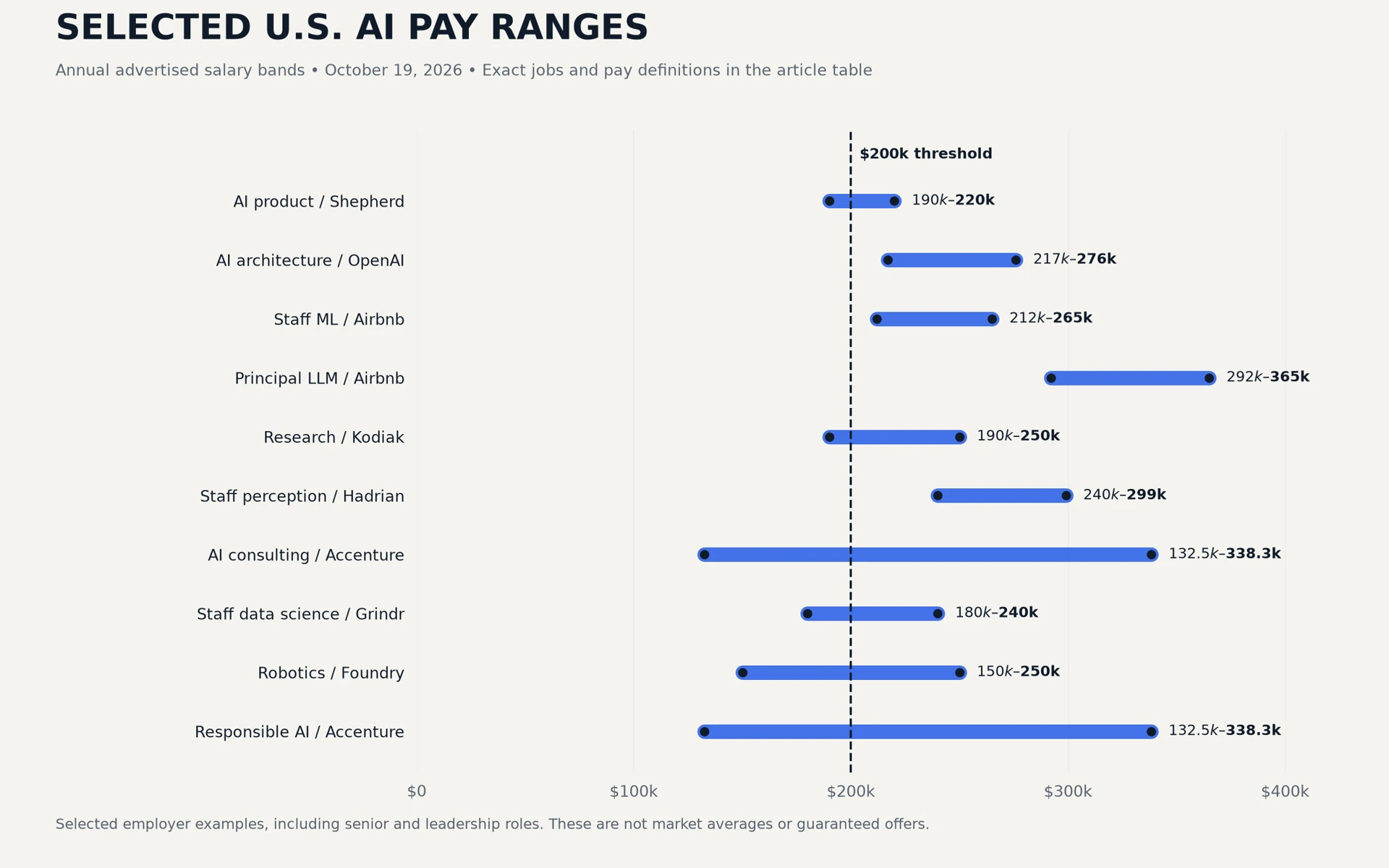
Selected U.S. AI roles can pay above $200,000, but an advertised range is an example from one employer. It is not an occupation-wide average. This guide uses direct employer postings to show that the pay level exists. It uses government wage data to put those examples in a wider context. All salary evidence was checked for this guide on October 19, 2026.
1. Read The Salary Evidence Before You Compare Roles
The table records the employer’s exact job title, location, and published range. The career family helps you connect a title to the work discussed later. Two employers can use different titles for similar duties. An AI consultant may work on implementation, while a governance specialist may manage controls across product teams. Read the job description to confirm the match.
| Career family and employer | Exact advertised title | U.S. location and level | Annual USD range | Pay definition |
|---|---|---|---|---|
| AI Product Manager, Shepherd | AI Product Manager | San Francisco; 4+ product years | $190,000 to $220,000 | Base; equity separate |
| AI Architect, OpenAI | Applied AI Architect, Retail | San Francisco; senior technical scope, Zone A | $217,000 to $276,000 | Base; equity separate |
| Machine Learning Engineer, Airbnb | Staff Machine Learning Engineer, Traffic Intelligence | U.S. remote, eligible states; Staff, 9+ years | $212,000 to $265,000 | Base; equity separate |
| NLP / LLM Engineer, Airbnb | Principal Machine Learning Engineer- LLM Fine-tuning and Optimization | U.S. remote, eligible states; Principal, 10+ ML years and PhD | $292,000 to $365,000 | Base; equity separate |
| AI Research Scientist, Kodiak | World Model Research Scientist- Physical AI | Mountain View; multiple levels, PhD | $190,000 to $250,000 | Base; equity separate |
| Computer Vision Engineer, Hadrian | Robotics Software Engineer, Perception | SF Bay Area; Staff/Principal scope, 10+ years | $240,000 to $299,000 | Advertised salary; equity separate |
| AI Consultant, Accenture | Sourcing and Procurement Senior Enterprise AI Value Strategist | California band; Senior Manager, 8+ relevant years | $132,500 to $338,300 | Advertised annual salary; bonus separate |
| Data Scientist in AI, Grindr | Staff Data Scientist | SF/Palo Alto; Staff, 7+ years | $180,000 to $240,000 | Base; equity separate |
| Robotics Engineer, Foundry Robotics | Robotics Research Engineer | Emeryville; in person, experienced deployment work | $150,000 to $250,000 | Base; equity separate |
| AI Ethics / Governance Specialist, Accenture | Responsible AI Engineering Senior Manager | California band; Senior Manager, 10+ engineering years | $132,500 to $338,300 | Advertised annual salary; bonus separate |
The chart uses the endpoints from the same postings. Its line at $200,000 helps you see which ranges cross the threshold. The length of a range does not tell you the likelihood of receiving its upper end. These employers and job levels form a selected set of examples. They do not form a representative salary survey, and the order is not a ranking of market averages.
2. Separate Salary From Total Compensation
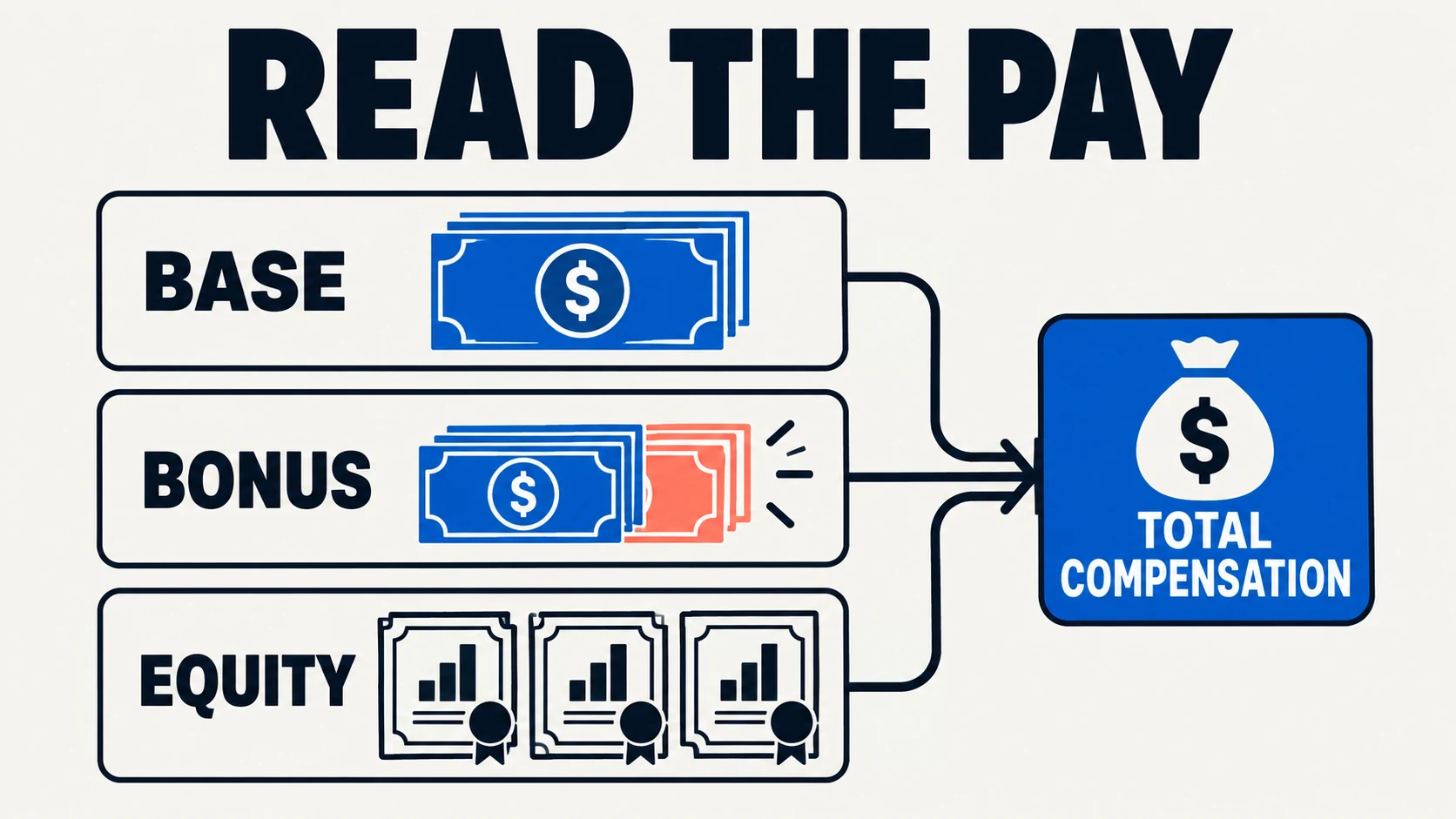
Base salary is the recurring cash amount in your employment agreement. A bonus can depend on company results, your performance, or other conditions. Equity is an ownership-related award with its own rules and risks. Employers can include these components in a total compensation figure. Compare like with like before you conclude that one offer pays more.
Consider a fictional offer with a $160,000 base, a $20,000 target bonus, and $40,000 in annualized equity. The package totals $220,000 on that stated basis. The recurring base remains $160,000, and the other amounts have conditions. A target bonus is not the same as guaranteed cash. Private-company equity may also be difficult to sell.
Annualized equity divides an award across an assumed period. Vesting determines when you earn the award under the agreement. A cliff is an initial period before any portion vests. Public share prices can change, and private awards have their own valuation and sale limits. Ask the recruiter to explain the actual award terms before you compare the headline amount.
3. Put Frontier And Senior Pay In Context
The U.S. Bureau of Labor Statistics reports a median annual wage of $120,230 for data scientists in May 2025. Its broader computer research occupation had a median annual wage of $140,300 for the same period. A median marks the midpoint of the wage distribution. These are national occupational wages, not 2026 offers or total compensation packages. The research occupation also includes work outside AI.
PwC’s 2026 AI Jobs Barometer reports an average AI-skills wage premium of 62 percent across sixteen sectors. That comparison uses advertised wages for AI-skilled and other postings in its 2025 data. It describes an association across job advertisements. It does not show that taking a course causes an individual pay rise. Use the result as context for employer demand, then inspect the actual role requirements.
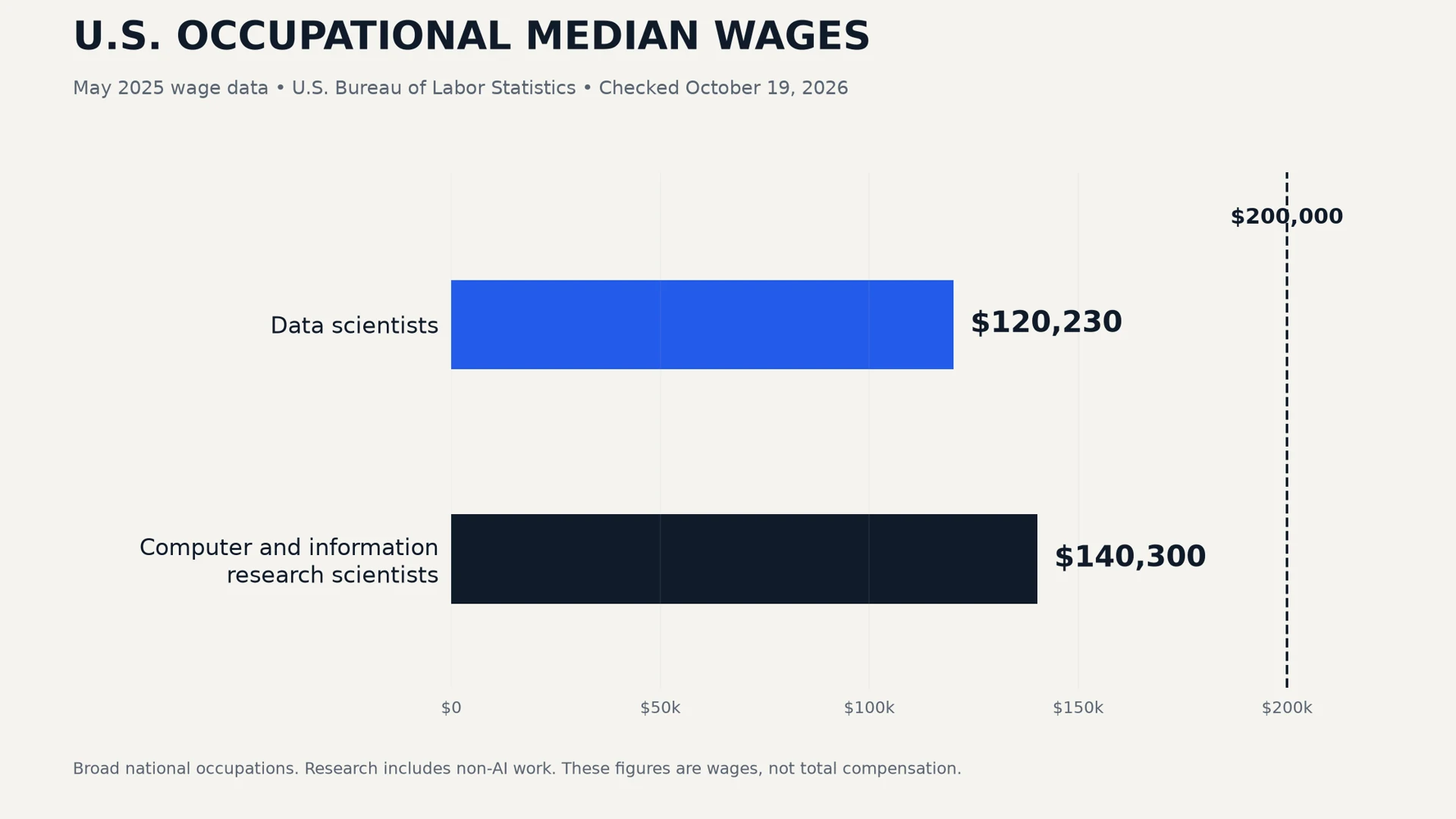
Government wage data and individual job postings answer different questions. Government data describes a broad occupation during a stated period. A posting describes an employer’s current hiring range for a particular job. Neither source tells you the offer you will receive. Use the first to understand the occupation and the second to understand a target role.
The practical lesson is to plan for the next credible step. A beginner can target an analyst, software, research assistant, or junior engineering position that develops relevant skills. An experienced engineer may already have part of the foundation for a senior AI role. Your starting point changes the work you need to do. A salary headline does not remove that difference.
Top 10 AI Jobs That Will Pay Over $200,000: Roles, Skills, And Projects
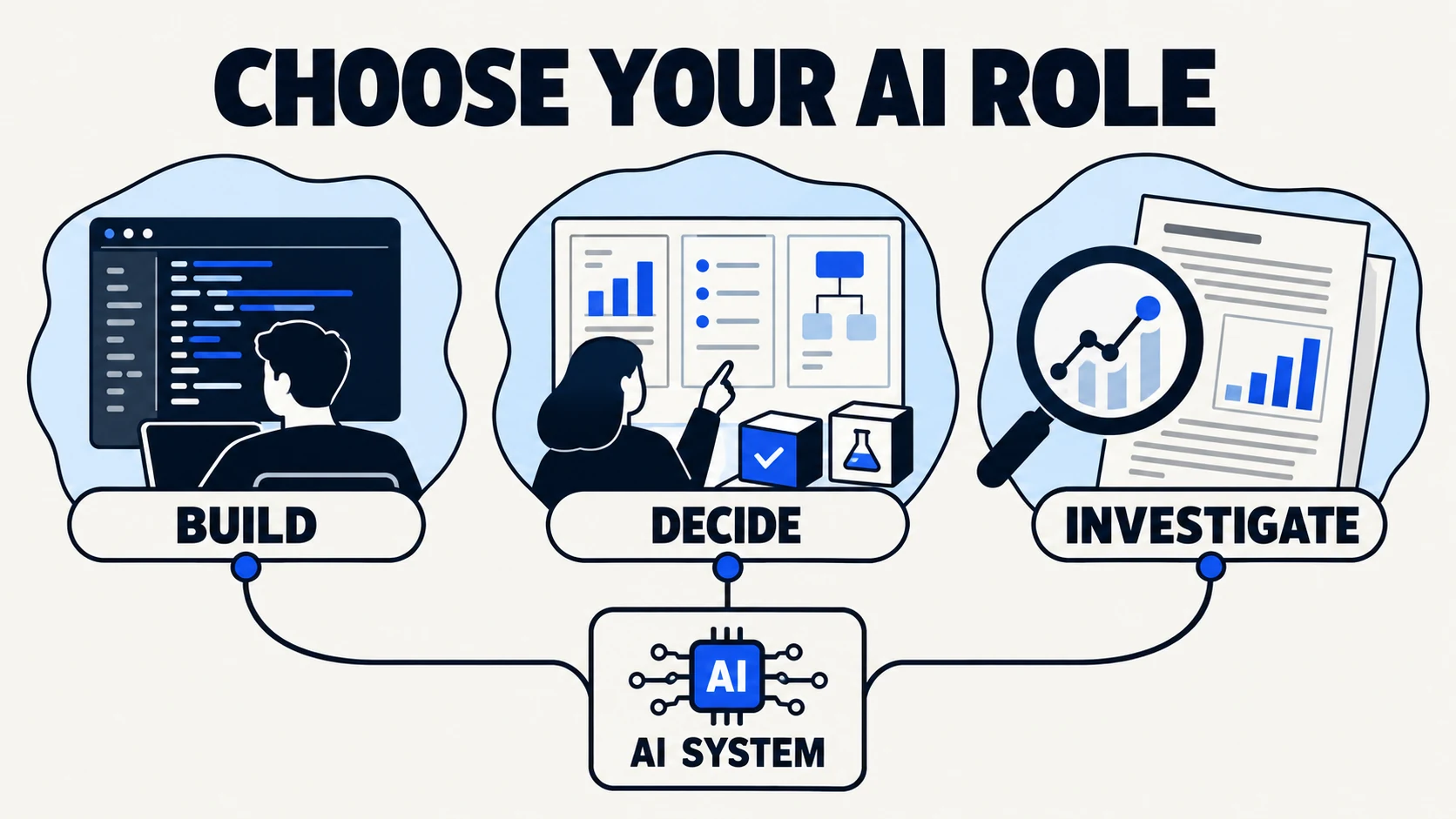
The ten role families below cover product decisions, systems, models, research, and responsible use. They preserve the useful breadth of an AI career comparison while reflecting current job titles. Each profile includes a practice project and a clear way to assess it. Treat those acceptance checks as suggested portfolio standards. Employers will set their own requirements.
1. AI Product Manager
An AI product manager decides which user problem a team should solve and how the team will measure success. You connect users, designers, engineers, and business leaders. You need enough technical knowledge to understand model limits and enough product judgment to choose a useful scope. Your responsibility includes the decision to use a simpler method when AI adds little benefit. Senior pay reflects responsibility for outcomes across the product.
Imagine a support team that wants to summarize customer conversations. You would interview agents, inspect their workflow, and define the point where a summary saves work. You would also identify mistakes that could mislead the next agent. An incomplete refund promise may matter more than an awkward sentence. Your product requirements should reflect that difference in harm.
You need to understand precision, recall, evaluation, and operating cost without pretending to be the model researcher. Precision measures how often a positive prediction is correct. Recall measures how many relevant cases the system finds. A product manager connects these measures to user needs. You should also understand the delay users experience and the cost of running the feature.
Build a portfolio case around a proposed support-summary tool. Write a problem brief, describe a manual baseline, and prepare a small set of fictional conversations. Define a review checklist for missing facts and unsupported claims. Add a release plan with a human review step and a way to disable the feature. Show which user outcome would justify further investment.
Your acceptance check is whether another person can follow the decision from evidence to release. Include interview notes if you conducted real interviews, with permission and identifying details removed. If you used fictional personas, label them as fictional. Explain which assumptions still need testing. Clear limits make the case easier to trust.
Product management experience transfers more directly than a collection of unrelated coding courses. A business analyst or operations manager can start by owning a narrow workflow improvement. A software engineer can strengthen user research and prioritization skills. Study AI For Everyone before a management-focused program if the concepts are new. For a deeper role transition, use the steps for becoming an AI product manager.
2. AI Architect
An AI architect designs how an AI system fits into a wider organization. You decide how data moves, where models run, and how services connect. You also plan access controls, failure handling, and operating costs. The role requires experience with systems that other people maintain. A diagram becomes useful when the team can implement and operate it.
Consider an internal document assistant. Different employees have access to different files, so retrieval must respect those permissions. Retrieval is the step that finds information before the model writes an answer. You need to decide how the system checks identity and filters results. You also need a plan for outdated documents and a model service outage.
Learn software architecture, networking, cloud services, databases, and security alongside model concepts. An application programming interface, or API, is a defined way for software components to communicate. A queue holds work until a service can process it. A cache stores reusable results. You should understand the failure conditions and cost of each component you add.
Build an architecture case for a document assistant with separate departments. Include a data-flow diagram, a permission model, and a short implementation. Describe the boundary between internal data and an external model provider. Compare a basic search tool with a generated-answer tool. Explain the conditions under which each design is appropriate.
Test the design with an unauthorized request, a missing document, and an unavailable model service. Define what users should see in each case. Record cost assumptions and show how they change with request volume. Your acceptance check is whether a reviewer can identify the failure behavior without guessing. Include a rollback plan for a bad deployment.
A backend engineer, cloud engineer, or data platform engineer often has useful starting experience. Add model evaluation and data-access design to that foundation. Avoid treating an architect title as a first job after an introductory course. The role depends on decisions across multiple systems and teams. Learn one cloud environment well enough to explain its actual behavior before adding another.
3. Machine Learning Engineer
A machine learning engineer builds and operates software that uses learned patterns to make predictions. You may train models, develop features, and serve predictions to an application. You also test data pipelines and monitor the deployed system. A model that performs well in an experiment still needs reliable software around it. This is where software engineering experience becomes useful.
Imagine a system that predicts which support tickets need urgent review. Training data contains past tickets and their outcomes. A feature is an input used by the model, such as a ticket category or message length. You must check that each feature would exist when a new ticket arrives. Information from the eventual resolution would leak the answer into training.
Build Python and SQL skills, then learn statistics and supervised learning. Supervised learning uses examples with known outcomes. Learn how to split training, validation, and test data. Training fits the model, validation guides choices, and testing checks the final system on separate data. Keep software tests distinct from model-quality tests.
Create a ticket-priority service with a simple rules baseline and a trained classifier. Use public data with suitable permissions or clearly labeled synthetic records. Separate your data by time if the intended use predicts later events. Package the prediction logic behind an API. Add checks for missing fields, invalid categories, and failed requests.
Report false positives and false negatives with examples. A false positive may send a routine ticket to urgent review. A false negative may leave an urgent ticket waiting. Your acceptance check should include model quality, request delay, and failure behavior. Keep the target values tied to your proposed workflow instead of choosing impressive-looking numbers.
Document how you would update the model and return to an earlier version. Track the training data version and the software environment. A reviewer should be able to reproduce your result from the repository instructions. If you already write software, strengthen data reasoning and experimentation. If you come from analysis, spend more time on APIs, testing, and deployment.
4. NLP And Large Language Model Engineer
A natural language processing engineer builds systems that work with human language. A large language model engineer often focuses on models that generate or interpret text. The work can include text classification, search, document extraction, or conversational applications. Current titles overlap, so inspect the duties. Some roles focus on model training while others focus on application behavior.
Consider a contract-search assistant that must cite the relevant clause. Retrieval-augmented generation, or RAG, supplies retrieved information to a model before it answers. You need to check whether retrieval found the correct clause. You must then check whether the answer used that clause faithfully. A fluent response can still contain an unsupported conclusion.
Learn Python, text processing, model evaluation, and the transformer architecture at a suitable depth. A tokenizer divides text into units that a model processes. An embedding represents an item as numbers that can support similarity search. Fine-tuning adapts a model through additional training. Each method solves a different problem, and you need evidence before choosing one.
Build a question-answering tool over a small collection of documents you can share. Prepare answerable questions, questions with missing evidence, and questions that contain misleading instructions. Require citations that point to actual source passages. Keep the retrieval and answer-generation results separate. This lets a reviewer see where a failure began.
Your acceptance check should include citation correctness, unsupported-answer rate, and response delay. Test whether the assistant declines a question that the documents cannot answer. Inspect long documents and conflicting passages. Explain how document updates affect search results. Publish the test questions and scoring rules alongside the code.
Start with classical NLP and neural-network foundations if you want model depth. Add a current open-model course and production practice after that. Calling a model API is a useful beginning, but senior roles require broader decisions about data and reliability. Study how to manage context for AI applications once you can build a small evaluated system. Keep your project narrow enough to diagnose its mistakes.
5. AI Research Scientist
An AI research scientist develops and tests new methods. You begin with a question whose answer is uncertain. You then design experiments that can support or challenge a hypothesis. The work requires mathematical depth, careful comparison, and clear scientific writing. A successful research result can also show that an appealing idea does not work under stated conditions.
Suppose you want to improve a model’s performance when training data is limited. You need to define the task and identify a credible baseline. A baseline is the existing method used for comparison. You must control the differences between experiments. Otherwise, extra compute or a different data split could explain the improvement.
Study probability, linear algebra, optimization, and the literature in your chosen field. Learn to read a paper’s assumptions, experimental setup, and limitations. Reproducing an existing result is a useful early task. It teaches you how much detail a short paper can leave unstated. You will also learn how to report a mismatch without hiding it.
Build a small replication project from a paper with available code and data. Record the exact version, configuration, and resource limits. Reproduce a manageable part of the result before changing the method. Then vary one factor and explain the reason. An ablation study removes or changes a component to test its contribution.
Your acceptance check is whether another researcher can inspect the evidence and reproduce the comparison. Include failed runs, uncertainty, and the limits of the dataset. Avoid describing a small benchmark improvement as a general breakthrough. A result on one task supports a claim about that task. Broader conclusions require broader evidence.
A doctorate is common in research careers, but requirements depend on the employer and position. Strong research engineering can provide another route into experimental teams. A course certificate alone does not establish research ability. Look for supervised research, open-source work, or a research assistant opportunity that provides feedback. Choose this path because you enjoy unresolved questions and extended experiments.
6. Computer Vision Engineer
A computer vision engineer builds software that extracts information from images or video. You may detect objects, identify defects, or estimate movement. The work combines data preparation, model development, and deployment constraints. A camera introduces changes in lighting, position, and image quality. Those conditions can matter as much as the model architecture.
Imagine a system that flags damaged packages on a conveyor. Classification assigns an image to a category. Object detection finds and locates objects within an image. Segmentation identifies regions at a finer level. You need to choose the task that matches the worker’s decision and the available labels.
Learn image processing, neural networks, and model evaluation. Python and a vision library provide a practical start; some jobs also need C++ or hardware knowledge. Learn how image resizing, compression, and camera calibration affect inputs. Calibration estimates properties needed to relate images to the physical scene. Keep near-duplicate images out of separate training and test sets.
Build a package-defect detector using a dataset with suitable usage rights. Split data by package or recording session so similar frames do not inflate performance. Test bright, dim, and partially blocked examples. Add a manual-review category for unclear cases. Describe the intended camera conditions and the conditions you did not test.
Measure missed defects, false alarms, and processing delay on the hardware you used. Your acceptance check should include an error review across image conditions. A single average score can conceal poor performance on dark images. Show examples that explain the problem. Record model size and the deployment environment so the speed result has context.
Choose courses that match your programming environment. The MathWorks specialization below uses MATLAB, while fast.ai offers a Python-oriented route. Both can teach useful concepts, but they serve different setups. Hardware and robotics teams may require additional sensor knowledge. Your portfolio should show how the model behaves outside the easiest examples.
7. AI Consultant And Implementation Lead
An AI consultant helps an organization decide where AI can solve a problem and how to implement the solution. Some positions emphasize strategy, while others require hands-on delivery. Senior consultants may lead teams, manage client expectations, and own project economics. Read the title together with the actual duties. A high-paying implementation leadership role is different from an introductory advisory role.
Consider a logistics business that wants an assistant for shipment exceptions. You would map the current process before proposing a model. You need to identify the information staff use and the systems they can access. You would also check the cost of an incorrect recommendation. A process change or better search may solve part of the problem without generation.
Build domain knowledge, business analysis, and technical fluency. Learn to estimate implementation effort and define an acceptance test. A proof of concept is a limited experiment that tests an idea. A production service needs support, access controls, and ongoing ownership. Explain the work between those stages in your proposal.
Create a consulting case for a fictional shipment-exception workflow. Include the current process, proposed scope, data requirements, and a simple cost model. Build a small working prototype or specify the implementation with testable detail. Separate assumptions from measured results. Add a handover plan that identifies who will maintain the service.
Your acceptance check is whether a client could make a reasoned decision from the case. State the conditions for continuing, changing direction, or stopping. Include a non-AI option and the tradeoffs of each design. Show how you would measure user effort and error. A polished slide deck needs supporting evidence that a technical reviewer can examine.
Operations, product, enterprise software, and industry experience can provide a strong base. Add the technical skills your chosen delivery role requires. Forward deployed engineering is one implementation-heavy neighboring path, with substantial coding duties. Compare that path through the guide to becoming a forward deployed engineer. Use the salary table’s exact title to judge whether an example matches your target.
8. Data Scientist With An AI Focus
A data scientist uses data and statistical methods to answer questions and improve decisions. An AI-focused position may include prediction, experimentation, or model evaluation. Some data scientists spend more time on product experiments than model training. Others work on forecasting or recommendation systems. The title alone does not define the work.
Imagine a team that wants to know whether an AI search feature helps users complete tasks. An increase in searches may mean interest, confusion, or repeated failure. You need to define the outcome before you inspect the result. An experiment can compare versions under a planned assignment process. You also need to check whether the recorded data represents what users did.
Learn SQL, statistics, Python or R, and clear analytical writing. Understand sampling, uncertainty, and the difference between association and causation. A confidence interval expresses uncertainty under stated statistical assumptions. A model’s prediction quality does not establish the effect of a product change. Match your method to the decision you need to support.
Build an evaluation case for a fictional AI search release. Create a data dictionary and define how each metric is calculated. Use public or synthetic data with the origin stated. Explain how you would assign users and handle missing events. Include a guardrail measure for an unwanted outcome, such as repeated failed searches.
Your acceptance check should cover reproducible calculations and the strength of the conclusion. A reviewer should be able to trace a chart back to the underlying query. State which questions the dataset cannot answer. If your example lacks randomized assignment, avoid claiming that the feature caused a change. Good analysis can end with a request for better evidence.
An analyst can build toward this role through stronger statistical reasoning and experimental work. A model-focused learner may need more practice with business questions and SQL. The Johns Hopkins path below uses R, so plan separately for Python when target roles require it. Use the roadmap for becoming a data scientist to compare your remaining gaps. Senior pay comes with broader judgment and ownership.
9. Robotics Engineer And Robot Learning Engineer
A robotics engineer develops systems that sense, plan, and act in the physical world. AI-focused roles can add learned perception or control methods. You need to understand how software interacts with sensors, actuators, and mechanical limits. An actuator produces physical movement. A mistake can affect equipment or people, so physical testing requires controlled procedures.
Consider a simulated robot that moves a package to a marked location. Perception estimates the state of the scene. Planning chooses a route or sequence of actions. Control adjusts movement to follow that plan. You need to understand how errors in one stage affect the others.
Study linear algebra, mechanics, programming, and feedback control. Feedback uses measured behavior to adjust the next action. Kinematics describes motion without focusing on the forces that cause it. Dynamics includes those forces. Learn these foundations before you assume that a language-model interface can replace them.
Build a simulation project with a small mobile robot or manipulator. Define a task, an operating area, and a safe stopping condition. Add variation in starting position and sensor noise. Noise is variation or error in a measurement. Keep a basic control method as a comparison before adding a learned component.
Your acceptance check should report task completion, tracking error, and recovery from failed attempts. Separate simulation results from any physical test. A simulated success does not prove safe operation on real hardware. Record the assumptions about sensors, friction, and timing. Show the conditions under which your controller becomes unreliable.
The Northwestern robotics sequence below provides mechanics and control foundations. Add machine learning and a suitable robotics software environment after that. Hardware access can shape your project choices, so simulation is a practical starting point. Senior robot-learning roles may require substantial research or production experience. Choose this field if you want to work across software and physical systems.
10. AI Ethics, Governance, And Responsible AI Specialist
A responsible AI specialist helps an organization identify risks and put controls around AI use. Governance defines who can approve a system, what evidence they need, and who remains accountable. Ethics examines the effects on people and the reasons behind a decision. These subjects overlap, but employers divide the duties in different ways. Some roles require technical testing; others focus on policy or program management.
Imagine an organization that wants to use AI to rank support requests. You would identify affected users and review the data behind the ranking. You would ask who can challenge a result and who can suspend the tool. You also need a record of the intended use. A system approved for one workflow may be unsuitable for another.
Learn model evaluation, data governance, impact assessment, and clear policy writing. An impact assessment examines possible effects before and during use. A model inventory records which systems exist, who owns them, and where they operate. Controls turn a principle into an action that someone can verify. For example, an approval rule needs a named owner and evidence requirements.
Build a responsible-use assessment for a fictional document assistant. Map the data, users, possible failures, and people affected. Create an approval checklist and a test plan for access violations and unsupported answers. Define escalation and withdrawal procedures. Include a review date and a way to record changes.
Your acceptance check is whether another team can apply the process without relying on your personal judgment at every step. Use plain rules and attach example evidence. Identify which questions need specialist legal review in a real organization. Do not claim that a short course establishes legal compliance. Keep the portfolio focused on controls you can explain and test.
Policy, risk, privacy, audit, product, and technical backgrounds can contribute to this work. Add the missing part of the role you want. A policy professional may need model evaluation practice, while an engineer may need stronger impact analysis. The salary evidence uses an exact governance-related posting, with its scope stated. It does not establish a universal salary for every person with an ethics title.
Which High Paying AI Career Fits Your Background?
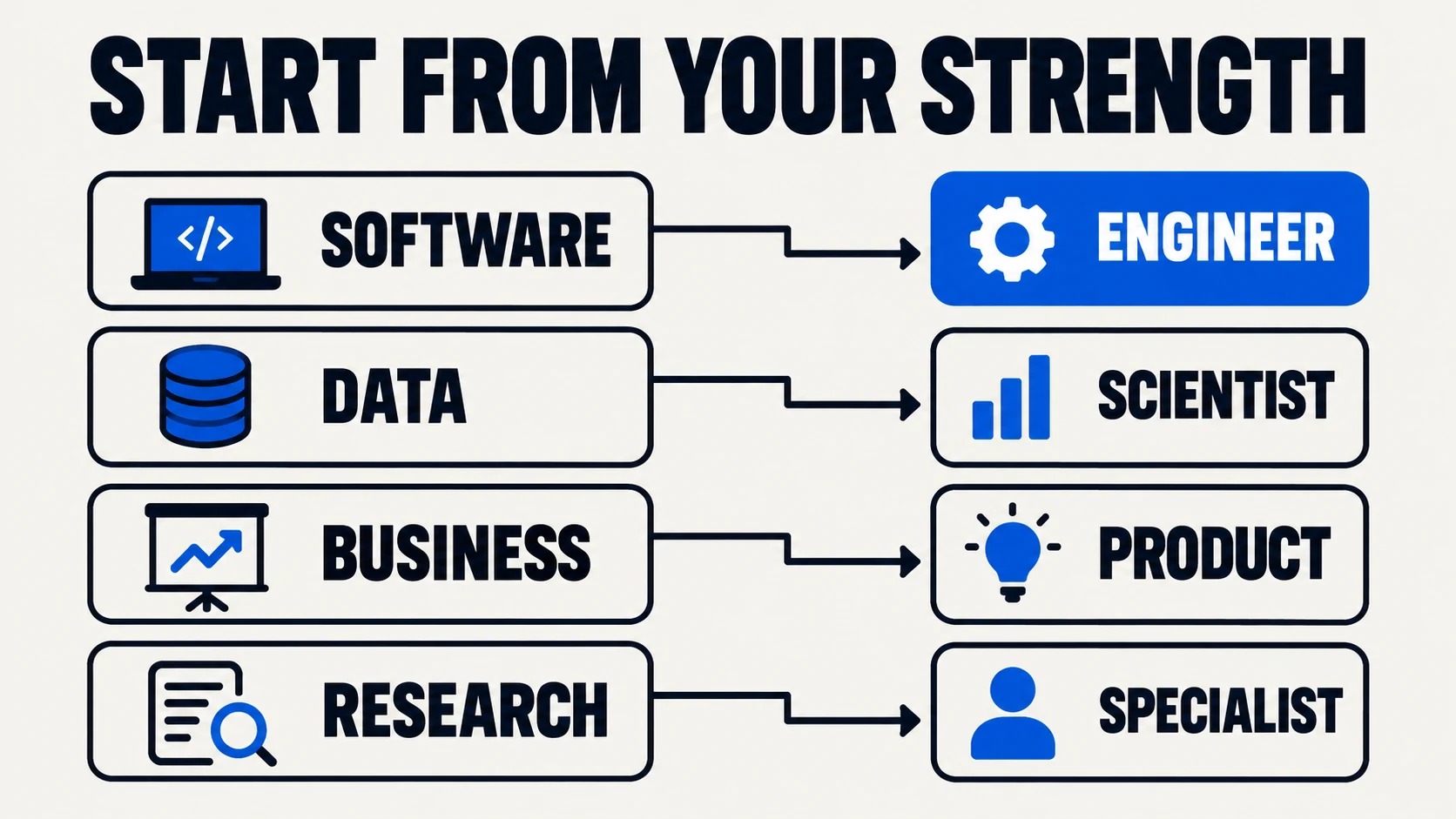
Choose the role that builds on work you can already do and work you want to practice. Pay matters, but daily tasks will shape your progress. A person who enjoys user research may dislike extended model experiments. A person who enjoys debugging may prefer engineering to client advisory. Use the role descriptions to make a practical choice before you commit to a course path.
1. Match Your Existing Strengths To The Work
A software developer can begin with ML engineering, LLM applications, or platform work. You may already know testing, APIs, and deployment. Your gaps may be statistics, data quality, and model evaluation. Start with a small prediction service and inspect its errors. Keep using your software discipline while you learn how uncertain model behavior changes testing.
An analyst can begin with data science or product analytics. You may already understand business questions, SQL, and charts. Add experimental design and a stronger treatment of uncertainty. Practice explaining why a result supports a decision and where it falls short. Move toward ML engineering if you also enjoy maintaining services and writing production software.
A product, operations, or industry professional can consider AI product management and consulting. Your domain knowledge can help you find useful problems and spot costly mistakes. Add enough technical skill to inspect a prototype and question its evaluation. Build a workflow case with a measured baseline. Avoid relying on generic strategy language that a reviewer cannot test.
A researcher or engineer with strong math can explore research, vision, or robotics. Choose the field whose experiments interest you. Read a small group of related papers and reproduce a manageable result. Compare the work with the requirements of real jobs in your location. The learning route becomes clearer when you can name the kind of question you want to solve.
2. Use A Small Trial Before A Large Commitment
Run a short trial project before you choose a long program. A product trial can be a user interview and a requirements brief. An engineering trial can be a small API with tests. A research trial can be a replication of a published experiment. Pay attention to the work you want to continue after the first failure.
Write down the parts you found difficult and the parts you enjoyed. Difficulty alone does not mean the role is a poor fit. You may need foundations or better feedback. Persistent dislike of the central task deserves more attention. A course can teach a method, but it cannot decide which work you want to own.
3. Keep U.S., India, And Remote Pay Separate
The employer ranges in this guide apply to the stated U.S. locations. Do not convert a U.S. salary into rupees and call it an Indian salary benchmark. Indian employers can describe pay through fixed compensation, variable compensation, and cost to company. Cost to company can include items beyond your recurring cash salary. Ask for the actual breakdown before comparing offers.
Remote work also has location rules. A U.S. remote listing can limit employment to approved states. An international employer may use a local entity or an employer of record. A contractor agreement can leave you responsible for expenses that an employer would otherwise cover. Compare the employment arrangement together with compensation and eligibility.
For an India-based search, collect current local postings and separate company type, city, level, and pay definition. Use a consistent source and record the date. A staff engineer at a global product company is a different comparison from an entry-level services position. This guide does not invent India ranges to fill a table. Its U.S. evidence is useful when you are eligible for those jobs or comparing their requirements.
4. Decide Whether You Need A Degree
Degree requirements depend on the work and the employer. Research roles can require advanced academic training, while applied roles may accept equivalent experience. Inspect the exact requirement in each posting. Distinguish a required qualification from a preferred one. Then decide what evidence can support your application.
A no-degree route still needs depth, feedback, and credible work. You may need an earlier job that develops the missing experience. A strong portfolio can start a discussion, but it does not replace every requirement. Use a gradual plan to learn AI from scratch if you are new to programming and model concepts. Keep the next achievable role separate from the eventual salary target.
How To Build Skills For The Highest Paying AI Jobs
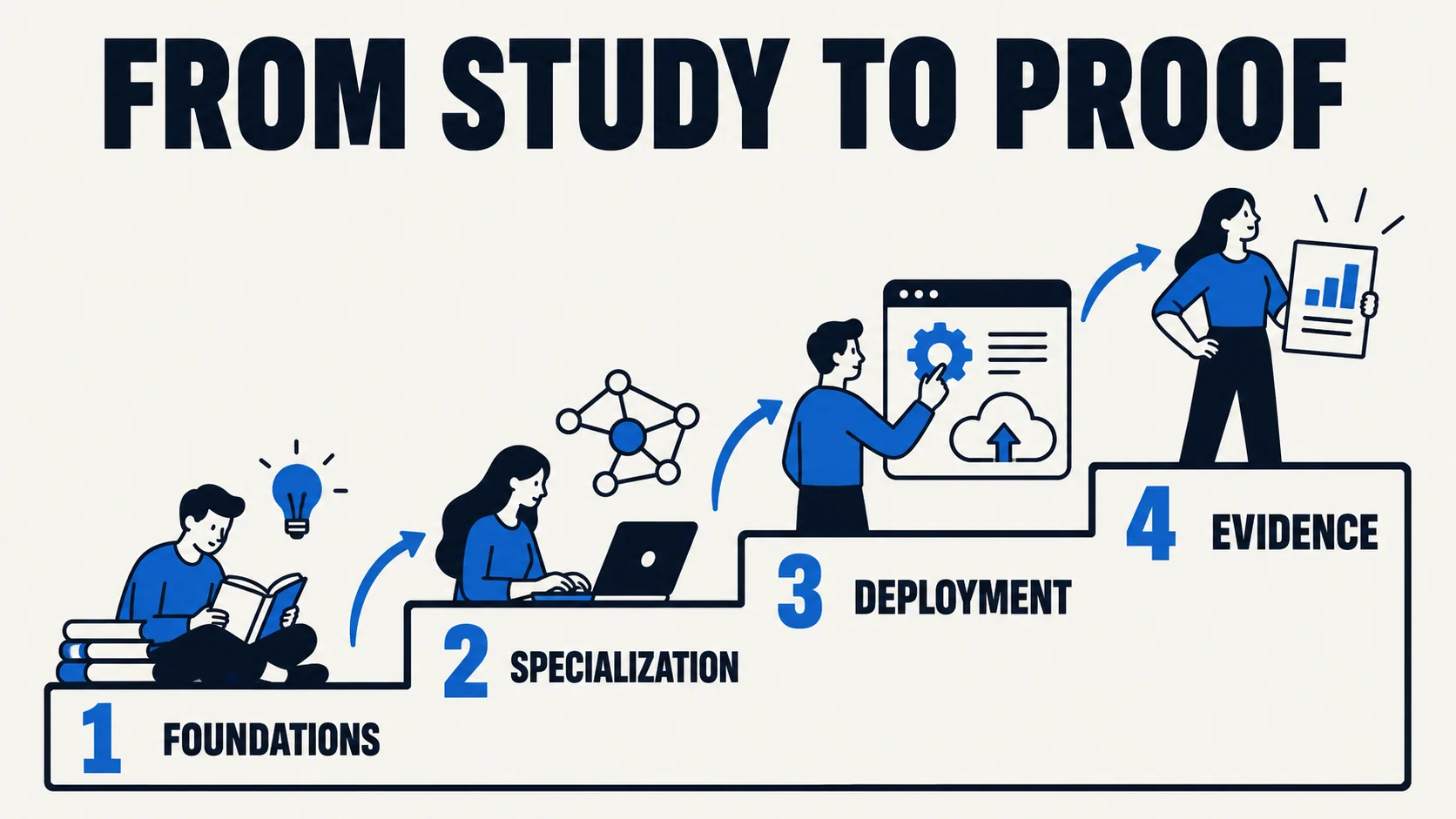
Build shared foundations first, then specialize and prove that you can use the skills. The sequence below is an editorial learning plan. It describes work to complete, not a promised time to employment. You can move faster through areas you already know. Use the readiness checks to decide when to continue.
1. Learn Enough Programming And Data Handling
For technical roles, begin with Python functions, collections, files, and error handling. Learn how to use a terminal and a project environment. An environment keeps the software dependencies for a project together. A dependency is a library or package your code needs. Record those dependencies so another person can run your work.
Practice with a small dataset before you add a model. Read a file, inspect missing values, and validate the columns. Write a function that accepts input and returns a clear result. Add tests for an empty file and an invalid value. Explain the error message a user should receive.
Learn SQL if your target work uses stored business data. SQL lets you select, combine, and summarize records in a database. Practice joins and check whether they multiply rows. Define the meaning of each row before you calculate an average. A model trained on duplicated records can inherit a data mistake that began much earlier.
Use Git to record changes in your code. Write a short explanation for each meaningful change and keep credentials out of the repository. A private repository still needs careful handling of sensitive data. Use public or synthetic examples for a portfolio. Your first readiness check is whether someone can follow your setup instructions on a clean environment.
2. Build Statistical And Model Foundations
Learn the difference between prediction and explanation. A prediction estimates an outcome from available inputs. An explanation about cause requires a suitable study design and assumptions. Learn averages, variation, probability, and sampling before you rely on a model score. Use a small example you can inspect by hand.
Train a basic model and compare it with a simple baseline. A baseline might predict the most common class or use a clear rule. Keep separate data for evaluation. Write down which mistakes matter in the intended workflow. The highest accuracy score may be unsuitable if it hides costly missed cases.
Study overfitting and leakage through experiments. Overfitting occurs when a model learns details that do not transfer well to new examples. Leakage occurs when training includes information that would not be available during real use. Make one controlled change and observe the effect. Explain the failure in plain language before adding another technique.
For product and governance roles, you need enough depth to review these choices. You do not need to copy an engineer’s entire study plan. Practice reading an evaluation report and identifying missing evidence. Ask how the test data differs from expected users. Your readiness check is whether you can explain why the reported score supports the proposed use.
3. Choose One Specialization And One Project
Choose a role from the ten profiles and select a project that tests its central skill. Use the project to choose the next course. A language-model project may need retrieval and evaluation. A robotics project may need control theory and simulation. A product case may need user research and a release decision.
Define the project scope in a short brief. Name the user, the problem, the input, and the output. State what the project will leave outside its scope. Choose data that you can use and share. Keep a record of its source, permissions, and known limits.
Set acceptance checks before you tune the solution. Write the test cases you expect the system to handle. Include difficult and missing-information cases. Separate the target you propose from the result you measure. This prevents you from changing the definition of success after you see the output.
4. Learn Deployment And Operating Behavior
Deployment puts the system into an environment where someone can use it. Start with a controlled demo and a narrow user group. Add input validation, access rules, and readable error messages. Keep a way to disable the system when it fails. A portfolio service can demonstrate these habits without a large infrastructure budget.
Measure response delay and resource use in your stated environment. A request that works on your laptop may behave differently under concurrent use. Concurrency means handling more than one task during the same period. Test a manageable workload and describe its limits. Do not claim scale beyond what you tested.
Add logging that helps diagnose failures without exposing private input. A log is a record of events during operation. Decide which events need a timestamp, a version, and an error category. Keep test data separate from sensitive production information. Explain what a maintainer would inspect after a failed request.
For an AI agent, add limits around tool use and actions. An agent can choose steps or tools to pursue a task. Define which actions require human review and which resources the agent may use. Test attempts to exceed those permissions. Study agent harness engineering when you need a clearer design for those controls.
5. Use A Twelve-Week Practice Plan With Readiness Gates
The schedule below is a suggested way to organize practice. It assumes you adjust the workload to your starting point. A week is a planning unit, not a claim about how quickly you can learn the material. Repeat a stage when its checks fail. Keep notes on what you changed and why.
| Practice stage | Main work | Evidence to keep | Readiness check |
|---|---|---|---|
| Weeks 1 to 3 | Programming, SQL, and data checks | Small scripts, tests, and a data dictionary | Another person can run the project |
| Weeks 4 to 6 | Model foundations or role-specific analysis | Baseline, evaluation set, and error review | You can explain the important failures |
| Weeks 7 to 9 | One specialization project | Versioned implementation or decision case | The project meets its stated scope |
| Weeks 10 to 12 | Deployment, documentation, and interview practice | Demo, results, limits, and change log | You can defend the decisions without a tutorial |
Keep a recurring review session with a peer, mentor, or practitioner when possible. Give the reviewer a specific question and a small artifact to inspect. Ask them to identify an unclear assumption or a missing test. Revise the work and record the reason. Feedback becomes useful when you can connect it to a change.
Best Online Courses For High Paying AI Jobs: Eighteen Learning Options
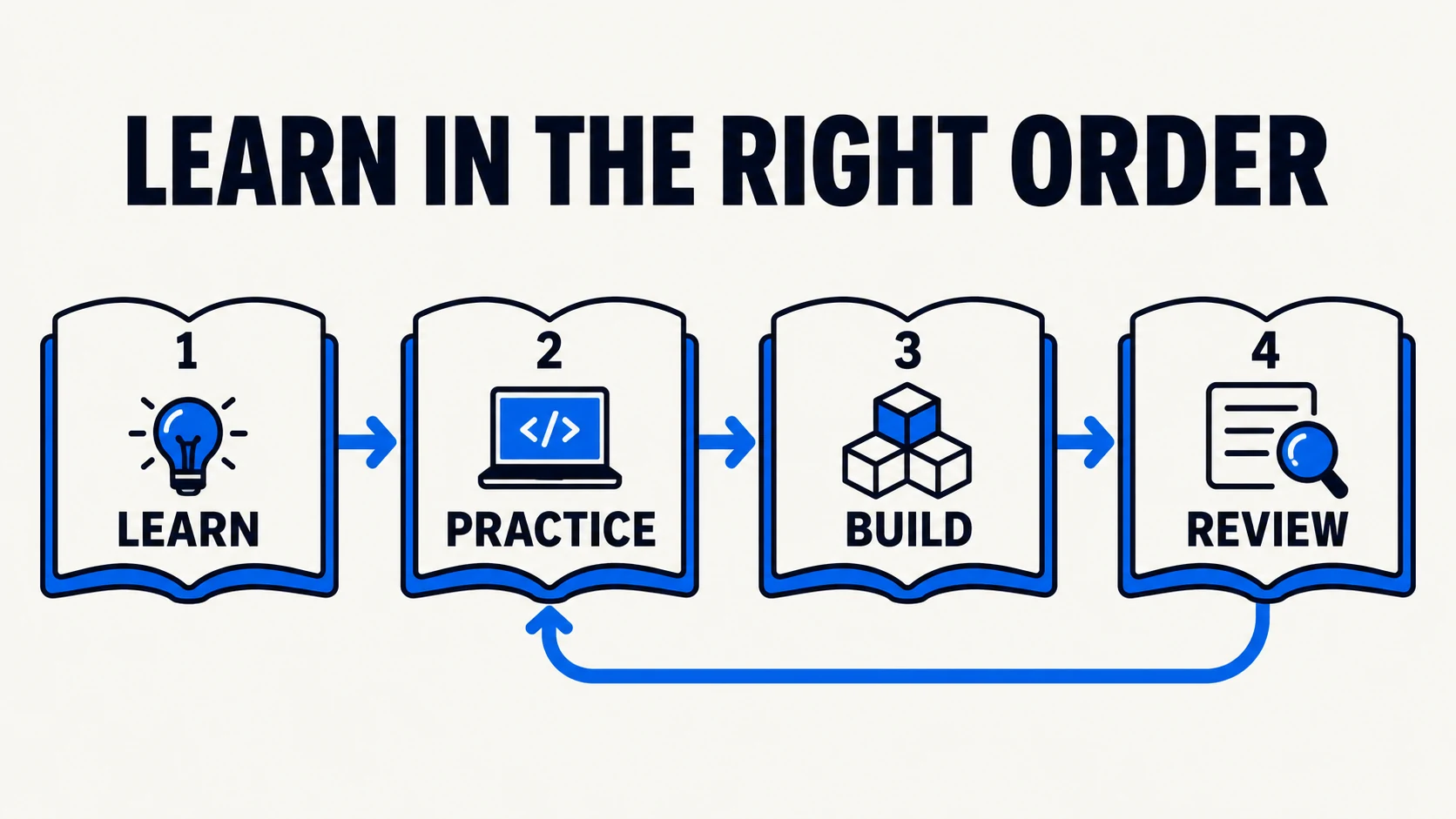
Choose one foundation course and the specialist resource that matches your project. These eighteen options serve different goals and starting points. Several overlap, so you do not need to complete the whole list. The practice tasks are my suggested exercises, separate from provider assignments. Check the live curriculum before you begin, because providers can revise content and access conditions.
Some course links are affiliate links. If you buy through them, I may earn a commission. The recommendations also include official resources without affiliate links. Course completion does not establish senior-level experience. Use the learning material to produce work that you can explain and test.
1. AI For Everyone, DeepLearning.AI
AI For Everyone introduces AI capabilities, business opportunities, and the work of machine learning teams. It suits product managers, consultants, and domain specialists who need a conceptual start. You can begin without coding experience. Use it to examine a real workflow and decide whether AI fits the problem. Write a proposal with the user need, required data, success measure, and failure cost. Compare the proposal with a simpler process change. Continue to a technical course if you plan to implement the solution yourself.
2. Supervised Machine Learning: Regression And Classification, DeepLearning.AI And Stanford Online
Supervised Machine Learning: Regression and Classification teaches prediction and binary classification with Python tools. It includes regression, logistic regression, and gradient-based learning. Prepare with basic Python and algebra so you can focus on the models. This link reaches the first course in the wider Machine Learning Specialization. Build an independent classifier after you finish the relevant lessons. Explain a false positive, a false negative, and the effect of changing the decision threshold. Keep the test data separate while you make those choices.
3. Deep Learning Specialization, DeepLearning.AI
Deep Learning Specialization develops neural-network foundations across several model families. It covers optimization, project structure, convolutional networks, and sequence models. Intermediate Python and basic linear algebra will help you follow the work. Choose it if you want more depth for ML, NLP, vision, or research engineering. Reproduce a small experiment and change one design choice. Report the result and the errors that remain. Add current deployment practice separately when your target job needs it.
4. Natural Language Processing Specialization, DeepLearning.AI
Natural Language Processing Specialization covers classical and neural methods for language tasks. You study word representations, sequence methods, attention, and applications such as translation or question answering. Prepare with machine learning, Python, and the relevant math. This is a foundation path for understanding language systems below the application interface. Compare a simple text classifier with a pretrained transformer on the same dataset. Inspect errors by category and document length. Use the comparison to explain where added model complexity helps.
5. Computer Vision For Engineering And Science, MathWorks
Computer Vision for Engineering and Science covers image features, detection, registration, and video tracking. The provider is MathWorks, and the specialization uses MATLAB. Choose it when that environment fits your work or study plans. Prior image-processing knowledge will help. Build an object-tracking exercise with video you have permission to use. Record missed objects and duplicate counts under different lighting. Python-first learners can consider the fast.ai option below for an alternative starting environment.
6. AI Concepts And Strategy, Rutgers University
AI Concepts and Strategy develops conceptual understanding and strategic judgment about AI. It suits a consultant, product professional, or leader who needs to assess opportunities and risks. The course does not focus on programming or LLM engineering. Bring a specific business decision to examine while you study. Write a decision memo that names the owner, expected evidence, and stop conditions. Explain the assumptions behind your recommendation. Add hands-on technical work if your target role includes delivery.
7. Data Science Specialization, Johns Hopkins University
Data Science Specialization follows the path from a question through data preparation, statistics, and reproducible analysis. Its curriculum uses R. Choose it if you want statistical foundations and are willing to work in that language. Add Python separately when your target postings require it. Publish a small analysis with the cleaning decisions and uncertainty stated. Include the code needed to reproduce every chart. End with a decision that the evidence supports and a question it cannot answer.
8. Modern Robotics: Mechanics, Planning, And Control, Northwestern University
Modern Robotics teaches the mechanics, mathematics, planning, and control behind robotic systems. Prepare with engineering-level physics, calculus, linear algebra, and programming. The courses build on one another, so gaps in the foundations can make later work difficult. Use the sequence for robotics depth before adding robot-learning methods. Implement a trajectory in simulation and test a disturbance. Measure tracking error and describe the assumptions. Keep simulated performance separate from any claim about physical hardware.
9. Artificial Intelligence: Ethics And Societal Challenges, Lund University
Artificial Intelligence: Ethics & Societal Challenges examines bias, surveillance, responsibility, and social effects. It provides a conceptual starting point for responsible AI work. Product managers and engineers can also use it to examine decisions beyond model accuracy. Select a concrete fictional system while you study. Write an impact assessment that names affected people and a way to challenge decisions. State who can suspend the system. Add technical testing and governance practice for roles that require implementation.
10. DeepLearning.AI TensorFlow Developer Professional Certificate
DeepLearning.AI TensorFlow Developer develops practical TensorFlow skills across vision, language, and time-series tasks. Prepare with Python and neural-network basics. Choose it when TensorFlow matches your target environment. This is a Coursera Professional Certificate program. Completion does not establish that you passed a separate Google certification exam. Train a classifier with and without data augmentation. Compare held-out errors and check whether exporting and reloading the model preserves behavior. Explain the changes using your own experiment results.
11. IBM AI Engineering Professional Certificate
IBM AI Engineering offers a broader applied path across machine learning and deep learning. The current curriculum includes generative AI work alongside established model methods. Prepare with working Python and Jupyter knowledge. A notebook such as Jupyter combines executable code with written explanation. Choose one independent project to develop during the program. Add evaluation, failure cases, and deployment limits. Keep the result focused instead of presenting a set of copied course notebooks as a finished portfolio.
12. Machine Learning In Production, DeepLearning.AI
Machine Learning in Production connects model work with scoping, data requirements, deployment, and monitoring. It suits a learner who already has a working model project. Prepare with Python and basic deep-learning experience. The verified link reaches a single course. Use it to add a baseline, input checks, and a rollback plan to your project. Investigate how a change in incoming data affects behavior. Describe what evidence would trigger a review before retraining.
13. MLOps Specialization, Duke University
Duke’s MLOps specialization develops model lifecycle and operational skills. Its curriculum includes Python, cloud tools, pipelines, and model management. MLOps means the engineering practices used to deliver and maintain machine learning systems. Prepare with programming and a project you can improve. Build a versioned training pipeline and an experiment log. Demonstrate a failed-data check and a return to an earlier model. Check cloud access and billing requirements before running hosted exercises.
14. Generative AI With Large Language Models, DeepLearning.AI And AWS
Generative AI with Large Language Models covers the model lifecycle, adaptation, evaluation, and deployment tradeoffs. It suits an ML learner adding language models to an existing foundation. Prepare with Python and an understanding of training, validation, and loss functions. A loss function measures the error a training process tries to reduce. Compare a baseline prompt with one adaptation method on a fixed task. Record quality, response delay, and operating constraints. Use current library documentation when you adapt lab code.
15. AI Product Management Specialization, Duke University
Duke’s AI Product Management specialization covers ML projects, human factors, and product decisions. It does not require prior programming for participation. Choose it if you need a structured product path alongside user research. Build a requirements document with a baseline and a human-review process. Define a user outcome separately from model accuracy. Add a limited release plan and a way to collect feedback. Use the project to practice decisions you will need to defend in an interview.
16. Hugging Face LLM Course
The Hugging Face LLM Course provides free official lessons on transformers and open-model tooling. It covers datasets, tokenizers, model use, and further training. Good Python knowledge and introductory deep learning will help. Choose a small model and dataset that fit your available resources. Fine-tune a modest classifier or language model and publish its evaluation. Include a model card that states intended use and limits. Compute or optional hosted services can have separate access conditions.
17. Practical Deep Learning For Coders, fast.ai
Practical Deep Learning for Coders offers a practical route through vision, language, tabular data, and deployment. It suits a person who can already code, preferably in Python. The official part-one material describes its 2022 course, so treat it as durable foundations. Use current package guidance for setup and deployment details. Train an image classifier on data you can share. Test an unfamiliar image and explain what happens. Publish the demo together with a clear account of its limits.
18. Embrace Responsible AI Principles And Practices, Microsoft Learn
Microsoft’s responsible AI module connects principles with organizational policies and controls. It suits product, strategy, and governance learners with basic AI knowledge. Use a simple system inventory while you study. Create an approval checklist with named owners and evidence requirements. Add escalation triggers, review dates, and a withdrawal process. Test whether another person can apply the checklist to a fictional system. The exercise builds governance practice. It does not establish a legal qualification.
Choose A Short Course Path For Your Role
The following combinations are suggested routes through the eighteen choices. Start at the stage that matches your existing skill. You may need additional foundations before an advanced option. Complete an independent task between courses. Continue only when the next resource fills a gap you can name.
| Career direction | Suggested foundation | Next specialist resource | Independent proof |
|---|---|---|---|
| AI product or consulting | AI For Everyone | Duke AI Product Management or Rutgers AI Concepts and Strategy | Decision case with baseline and rollout criteria |
| ML engineering | Supervised Machine Learning | Deep Learning, then Machine Learning in Production | Tested prediction service |
| NLP and LLM engineering | ML and neural-network foundations | NLP, Hugging Face, or Generative AI with LLMs | Evaluated document assistant |
| Vision and robotics | Programming and relevant math | MathWorks vision, fast.ai, or Modern Robotics | Error-tested vision or simulation project |
| Data science | Programming and statistics | Johns Hopkins Data Science | Reproducible analysis and experiment design |
| Responsible AI | AI concepts | Lund ethics and Microsoft governance | Impact assessment with tested controls |
A free resource can be enough to start an independent project. Paid programs can add structure or assessment, depending on the program. Neither option removes the need to practice. Use the project failures to decide what to study next. That approach keeps your learning connected to work you can demonstrate.
The highest paying AI jobs require evidence that fits the role. Choose one direction before you collect more courses. Build a small project with a clear baseline. Test the cases that could make it fail. Record the result and the limits. Use the next resource to solve a gap you found in that work.
How To Build A Portfolio And Prepare For AI Interviews
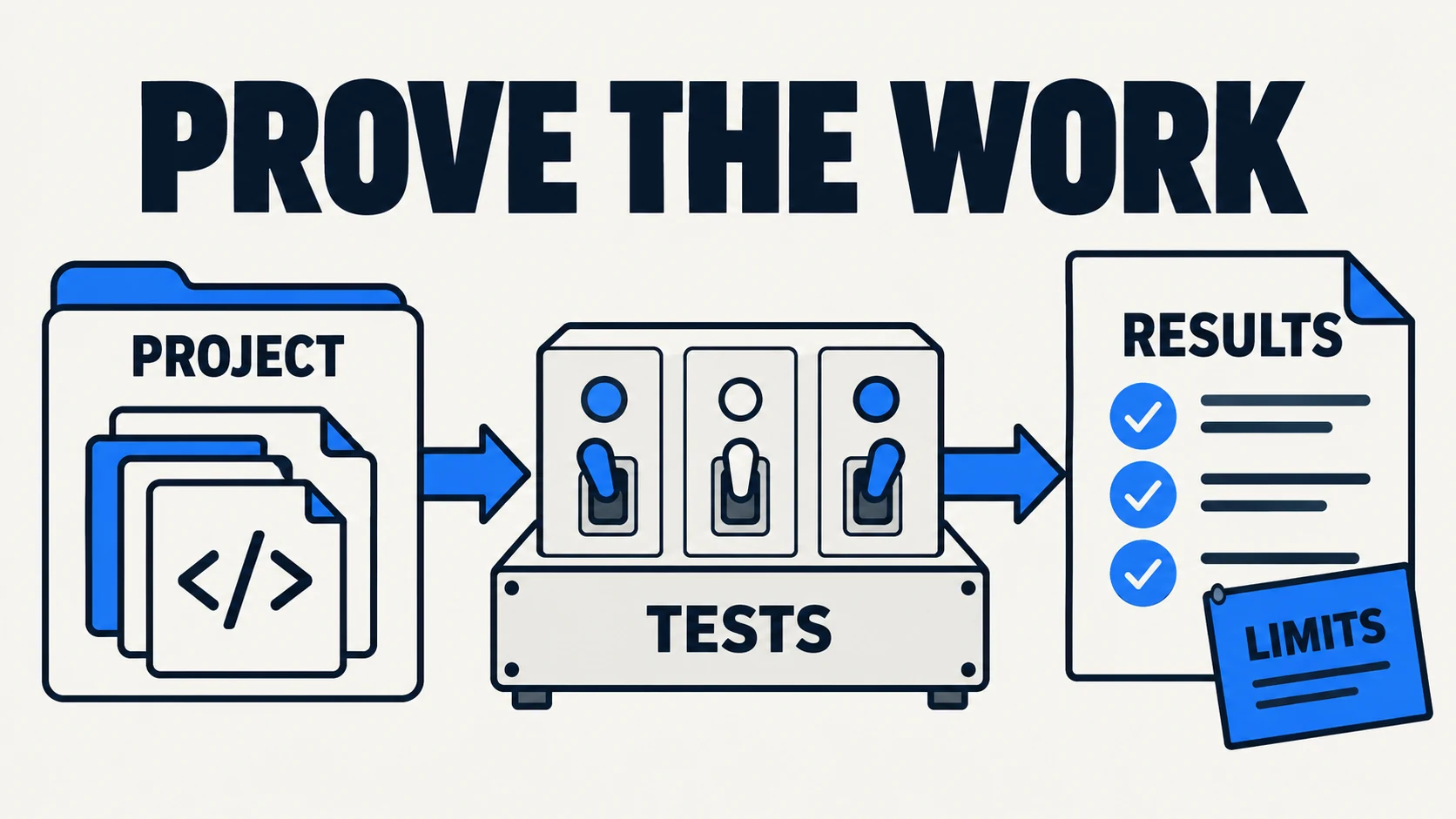
A strong portfolio makes your decisions and results easy to inspect. It needs enough detail for another person to understand the task, run the work, and challenge the conclusion. Select the project from your role profile and build it to that standard. An interview then becomes a discussion of choices you understand. Keep a record of your own contribution when you work with others.
1. Write A Case Study That A Reviewer Can Verify
Start with the user and the decision the project supports. Explain the input data and its origin. State the baseline and the method you chose. Present the measured result with the test conditions. End with the limits and the next experiment you would run.
Keep setup instructions short and complete. Name the software versions and any resource requirements. Provide a small example that a reviewer can run without private credentials. If the full system needs a hosted service, include recorded output or a local test path. Do not expose account keys to make a demo easier to inspect.
Show the result that your evaluation produced, including an unsatisfactory result. A failed experiment can demonstrate useful reasoning when you explain the method and diagnosis. Avoid changing the test set until the score looks better. Record changes to the evaluation and explain their effect. A reviewer needs to know which version produced the published result.
2. Design Checks For The Errors That Matter
Use the role-specific checks in the profiles as a starting point. A document assistant needs source and permission tests. A prediction service needs meaningful error measures. A product case needs evidence about user behavior and a release decision. A governance case needs controls that another team can apply.
The following matrix helps you choose evidence without forcing every project into the same format. Its checks are editorial suggestions. Set the actual target to match your proposed use and available data. Report the values you measure. Do not present a target as an achieved result.
| Project type | Compare against | Inspect closely | Deliverable |
|---|---|---|---|
| Prediction service | A simple rule or basic model | False positives, false negatives, missing inputs | API, tests, and error report |
| Document assistant | Search without generated answers | Citations, unsupported answers, access violations | Question set and scored outputs |
| Vision system | A basic image method or smaller model | Lighting, near duplicates, missed objects | Condition-based error review |
| Robotics simulation | A basic controller | Tracking error, disturbances, recovery | Simulation runs and assumptions |
| Product or consulting case | Current manual workflow | User need, operating effort, release criteria | Decision memo and prototype |
| Responsible AI review | Existing approval process | Ownership, evidence, escalation, withdrawal | Assessment and tested checklist |
3. Practice The Interview For Your Chosen Role
Engineering interviews can examine coding, data handling, debugging, and system design. Practice solving a small task while explaining assumptions. For model work, explain why you chose a metric and how you kept evaluation separate. For architecture, describe failure handling and access boundaries. Use your project to practice the connection between code and operating behavior.
Research interviews can examine experimental design and mathematical understanding. Be ready to explain the baseline and the reason for each comparison. Product interviews can examine user needs, prioritization, and success measures. Consulting interviews can examine a business case and delivery risks. Governance interviews can examine how a principle becomes a repeatable control.
Prepare to discuss one decision you would change. Describe the evidence you lacked and the experiment that would help. Avoid inventing a polished answer about a result you never measured. It is reasonable to explain how you would investigate an unfamiliar issue. Keep the difference between your completed work and your proposed next step clear.
4. Remove Common Portfolio Mistakes
A copied tutorial gives a reviewer little evidence about your decisions. Keep the lesson as practice, then change the problem or test conditions. Add a baseline and an error analysis of your own. Explain which parts came from an external source. Credit open-source work and follow its license.
A large demo can also conceal weak understanding. Reduce the scope until you can explain each component. Remove tools that solve no current need. Keep a visible issue list for unresolved problems. The result should help a reviewer understand what you can own on a team.
How To Find AI Jobs And Compare A $200,000 Offer
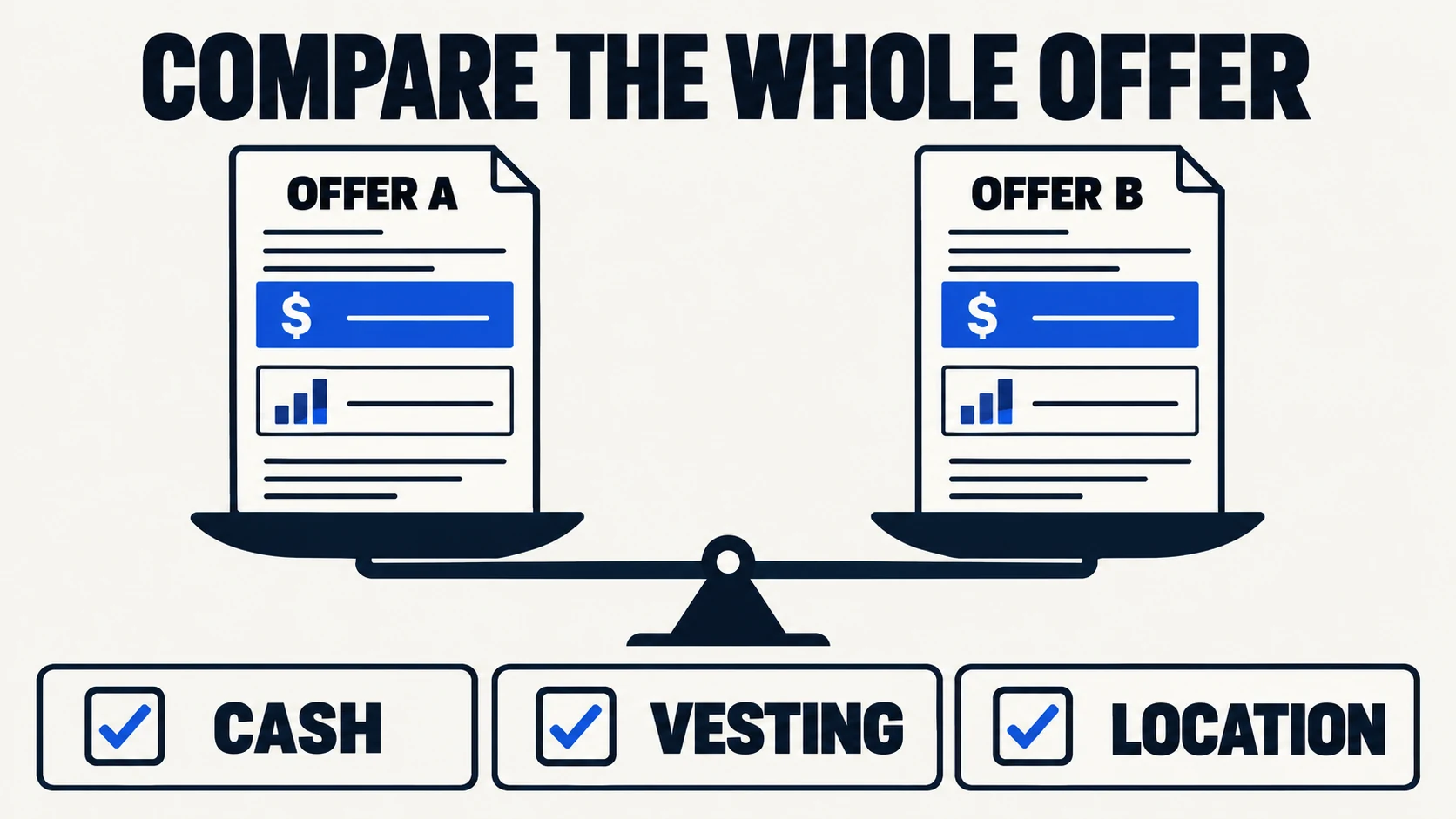
Search by responsibilities and job level, then check the pay definition and location rules. A title can change across employers while the work stays similar. Use the exact postings in the salary table as examples of how to inspect requirements. Confirm that a role remains open before you apply. Keep your search focused enough to improve each application.
1. Build A Job Search Record
Create a record with the employer, role title, location, level, and source URL. Add required skills, preferred skills, and the stated compensation type. Record the date you checked the posting. Keep a separate field for your evidence against each requirement. A missing requirement is easier to address when you can name it.
Search related titles from the role families you selected. An NLP position may use an LLM or machine learning title. A responsible AI position may sit within risk, engineering, or governance. An implementation position may use solutions engineering or forward deployment. Read enough of the description to distinguish a match from a similar-sounding title.
Check the employer’s own careers page when you find a role on another board. Verify the application destination before sharing personal information. Use salary platforms as additional context when their location, level, and pay components match. A small or unclear sample deserves less weight. Do not merge incompatible figures into a precise-looking average.
2. Apply With Evidence That Matches The Role
Choose a project or work example that addresses the job’s central responsibility. Link to a short case study with a clear result and scope. Explain your contribution to team work. Use measured figures only when you can support them. A specific description of the problem and your decision can be stronger than an inflated percentage.
Adjust the order of your evidence for the application. An architecture role needs system decisions near the top. A research role needs experiments and scientific reasoning. A product role needs user and release decisions. Keep the underlying facts consistent across versions of your resume.
Seek feedback from people who understand the work. Ask a focused question about an artifact they can inspect. A useful technical discussion can also help you learn about a team. Keep networking respectful and specific. Do not assume that a referral removes the need to meet the role’s requirements.
3. Ask The Recruiter To Explain The Compensation
Ask which location band and level apply to your offer. Confirm the base salary in writing. Ask how the bonus is calculated and whether the quoted amount is a target. Request the equity type, vesting schedule, and conditions for selling it. Separate a signing payment from recurring annual pay.
Use a comparison sheet with different scenarios. One scenario can include base salary alone. Another can include the stated target bonus. An equity scenario should show the valuation assumptions and vesting period. Keep uncertain amounts visible instead of treating them as cash you already own.
Return to the fictional $220,000 package from the salary section. It includes a $160,000 base, a $20,000 target bonus, and $40,000 in annualized equity. A second fictional offer with a $205,000 base has more recurring base pay. The first package has a higher stated total under its assumptions. Your decision depends on the terms and your priorities.
4. Evaluate The Work Alongside The Pay
Ask who owns the system after release and how the team measures success. Understand support expectations, travel, and the normal review process. Find out whether the team has access to the data and infrastructure needed for the work. A senior title can carry broad accountability. You need the authority and resources to perform that work.
Compare the role with the experience you want to build next. A lower headline package can still provide useful responsibility and feedback. A higher package can be suitable when the scope matches your skills and priorities. Decide from the actual terms and work. Keep the salary target connected to a career you want to sustain.
AI Career Glossary: Terms You Will See In Job Descriptions
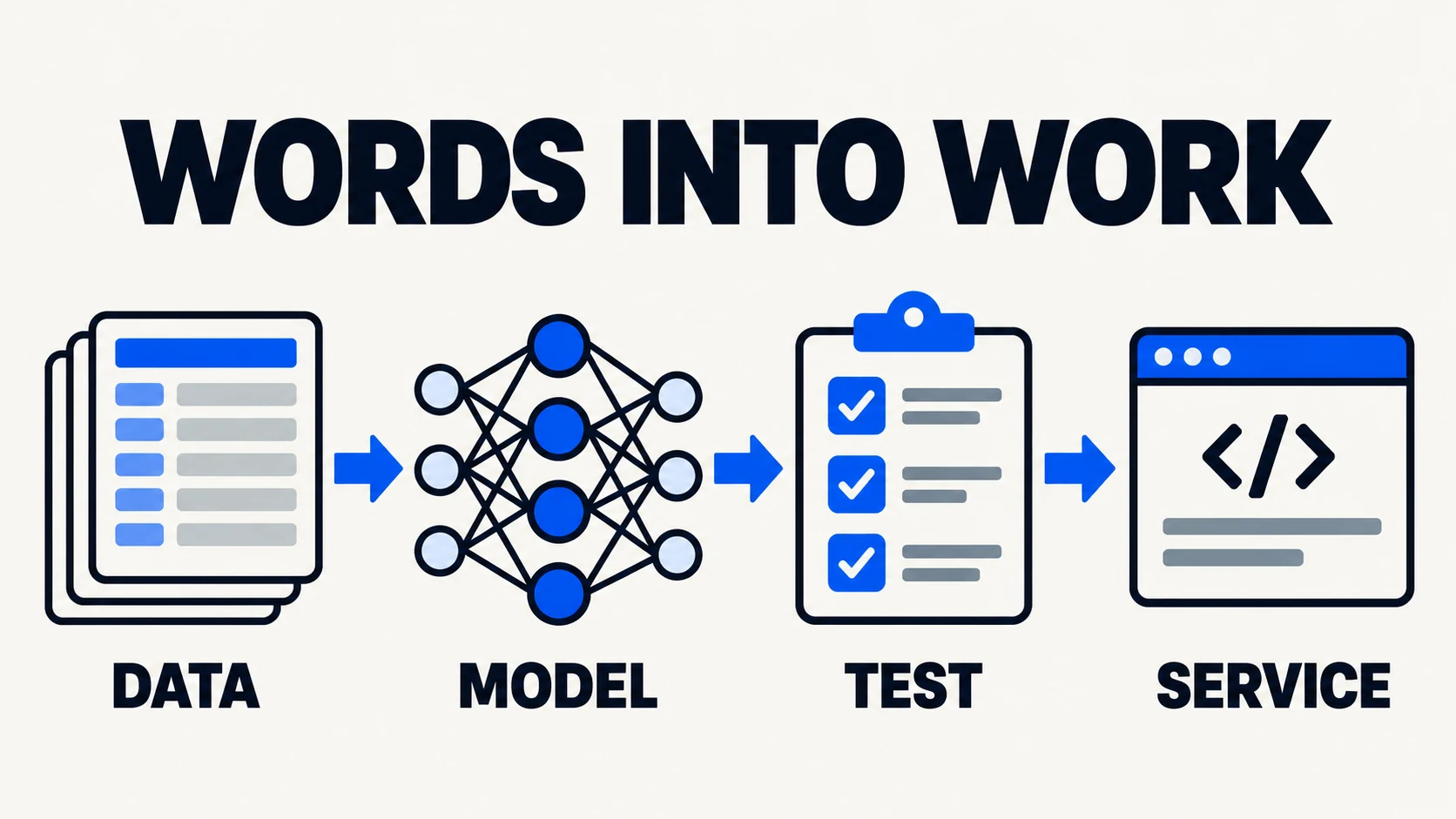
These terms connect the course material with job requirements. Use them to read descriptions more accurately. Each definition names a specific idea, and the profiles show how to apply it. Learn the terms that appear in your project first. Add depth as you use them in practice.
Inference is the process of running a trained model on a new input. Training is the process of fitting a model using examples. Fine-tuning is further training that adapts an existing model. A feature is an input representation used by a model. A label is the known outcome attached to a supervised example.
A baseline is a reference method used for comparison. Evaluation is the process of checking behavior against defined tasks and criteria. Data leakage occurs when unavailable or answer-revealing information enters the learning process. Overfitting occurs when learned behavior transfers poorly beyond the training examples. Drift is a change in data or task conditions that can affect performance.
An embedding represents an item numerically for tasks such as similarity search. RAG supplies retrieved information to a model before generation. A tokenizer divides text into units that the model processes. An agent selects steps or tools to pursue a task. Observability is the ability to investigate a system through recorded signals such as logs and metrics.
MLOps covers practices for delivering and maintaining machine learning systems. A rollback returns a service to an earlier version. Red teaming tests a system through planned attempts to trigger harmful or unwanted behavior. A model card documents a model’s intended use, evaluation, and limits. AI governance defines ownership, evidence requirements, and controls for AI use.
Conclusion
The highest paying AI jobs can offer compensation above $200,000 at selected employers and levels. The salary evidence in this guide shows where that potential exists. It also shows the experience and location limits attached to the numbers. Use those details to choose a path that matches your current skills. Keep the eventual pay target separate from the next role you can credibly perform.
Start with the work itself. Product managers need user and release judgment. Engineers need reliable implementations and tests. Researchers need controlled experiments, while responsible AI professionals need evidence and repeatable controls. Each path gives you a different way to demonstrate readiness.
Choose one course sequence and one independent project. Set a baseline before you tune the solution. Record the failures and revise the work from evidence. Ask a reviewer to challenge the decisions. You will then have a clearer basis for further study and job applications.
FAQs
1. What Are The Highest Paying AI Jobs In 2026?
The highest paying AI jobs include senior model engineering, architecture, research, product, and responsible AI leadership roles. This guide gives direct employer examples for ten career families. The figures apply to specific U.S. jobs and levels. Compare their duties and pay components before you use them as a target.
2. Can AI Jobs Pay Over $200,000 In Base Salary?
Yes, selected employer postings advertise base salary ranges above $200,000. Other ranges cross that threshold only at the upper end. A listing is evidence of one employer’s range, not a guarantee of an offer. Check the job level and location together with the figure.
3. Is $200,000 A Normal Entry-Level AI Salary?
You should not treat $200,000 as normal entry-level pay. Many examples in this guide require staff, principal, or management experience. The national occupation benchmarks also sit below that threshold. Plan for a first role that builds the experience your later target requires.
4. Which AI Job Is Best For A Beginner?
The best starting role depends on your existing skills and local opportunities. A software developer may build toward applied engineering, while an analyst may build toward data science. A beginner without those foundations can start with programming and data work. Use a small trial project to test your interest.
5. Can I Work In AI Without A Computer Science Degree?
Some applied AI roles accept equivalent experience, while other positions require a degree. Read the exact requirement for each job. A portfolio can demonstrate skills but does not remove every qualification rule. Research careers can require more formal mathematical and scientific training.
6. Do I Need A PhD To Become An AI Research Scientist?
Many research scientist positions expect doctoral training or a strong equivalent research record. The requirements vary by employer and research area. Research engineering can provide a related route through implementation and experiments. Inspect the distinction before choosing a degree or application plan.
7. Which Programming Language Should I Learn For AI Jobs?
Python is a useful starting language for many applied AI projects. SQL is also useful for work with business data. Vision and robotics positions may require other languages or environments, including C++ or MATLAB. Follow the requirements of the role you selected instead of learning languages without a project.
8. Is AI Product Management A Nontechnical Career?
AI product management combines product work with technical judgment. You may not write production model code, but you need to understand evaluation, data limits, and operating costs. Practice reviewing a prototype and defining release criteria. The depth you need depends on the product and team.
9. Can Online Courses Get Me A High Paying AI Job?
Online courses can build knowledge and provide structured practice. They do not establish senior responsibility or guarantee employment. Use the lessons to create independent work with tests and clear limits. Choose a course because it fills a specific gap in your chosen path.
10. Are There Free Courses For AI Careers?
Yes, the Hugging Face LLM Course and fast.ai provide free official learning material. They suit learners who have the relevant programming foundations. Hosted compute or optional services can have separate access conditions. Start with a small project that fits the resources available to you.
11. What Is The Difference Between An NLP Engineer And An LLM Engineer?
NLP covers a broad set of language-processing tasks and methods. LLM engineering often focuses on large language models and the systems around them. Employers use overlapping titles, so read the duties. A role may emphasize application delivery, model adaptation, or research.
12. Can I Get A U.S. Remote AI Salary While Living In India?
A U.S. remote listing does not automatically permit work from India. Employers can limit location because of employment, tax, security, or operating requirements. Check the approved locations and employment arrangement. Do not use a U.S. range as an Indian salary estimate.
13. How Should I Compare Equity With Salary?
Compare recurring cash separately from equity. Review the award type, vesting schedule, valuation assumptions, and sale conditions. A private equity award may not provide accessible cash. Keep uncertain amounts separate when you compare the package with another offer.
14. What Should An AI Portfolio Include?
An AI portfolio should explain the problem, baseline, method, results, and limits. Include reproducible work or a testable decision case that fits your target role. Show difficult cases and your own contribution. A reviewer should be able to inspect the evidence without guessing what you did.
Final Thoughts
You may have read the salary table and felt that the target is far from your current work. That distance can become easier to judge once you choose a role. You do not need to prepare for all ten careers. You need to understand one next step and complete it well. Give yourself a task small enough to finish and inspect.
Today, choose one current job description from the career family that interests you. Save the requirements and mark the ones you can demonstrate. Select one missing skill that appears central to the work. Create a project brief that will let you practice it. Write down the evidence a reviewer should see when you finish.
Keep the brief beside your study plan. After each lesson, apply one idea to the project. Record the result, including the part that failed. Ask for feedback on a specific decision when you have something concrete to show. Revise the work from that feedback before you add more scope.
The highest paying AI jobs are a useful long-term reference, but your next finished piece of work is the action you control. Start with that brief and a clear acceptance check. Build from the skills you already have. Let the evidence from your own work guide the next decision.