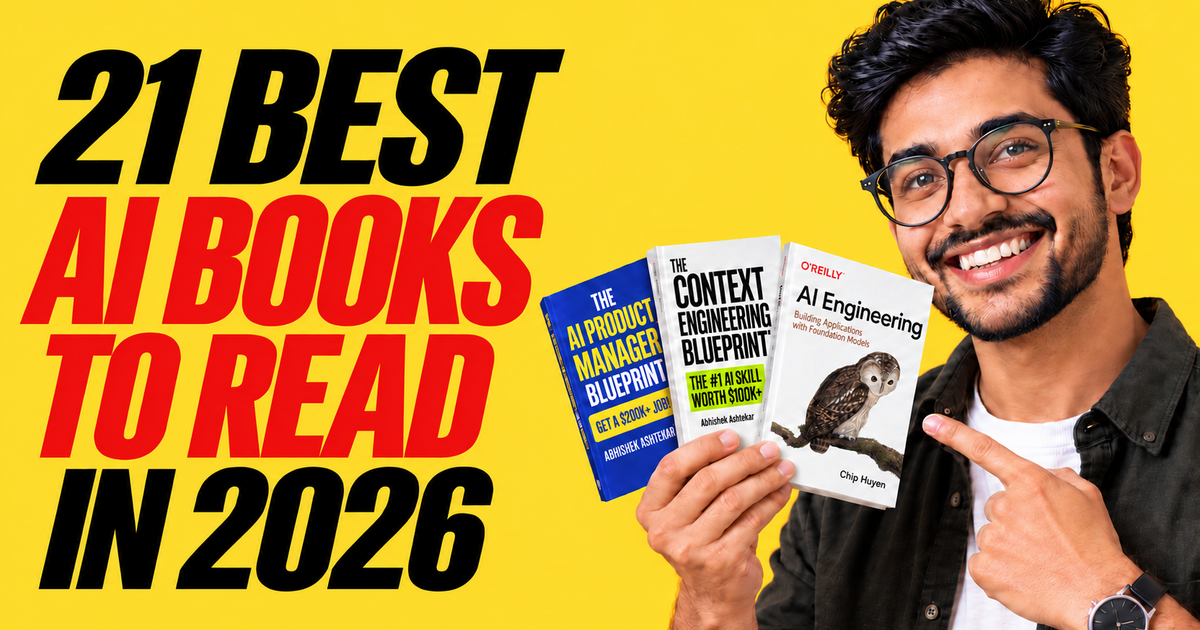
If you are looking for the best AI books to read in 2026, I have picked 21 books that I think are worth reading, depending on what you actually want to learn. You do not need to read all 21. Just choose the book that matches your goal and current level.
If you are completely new to AI, there are books here that explain it in simple language. If you want to become an AI product manager, there are books specifically for that. If you want to learn LLMs, RAG, AI agents, context engineering, machine learning, or how to build AI applications, I have included books for those topics too. There are also a few books for people who simply want to understand how AI is changing business, jobs, technology, and the world around us.
For example, if you are completely new to AI, Co-Intelligence is a good place to start. If you want to become an AI product manager, The AI Product Manager Blueprint is the book I would recommend. If you want to learn context engineering, RAG, memory systems, and AI agents, The Context Engineering Blueprint is the best fit for that. And if you already know programming and want to understand how serious AI applications are built, AI Engineering by Chip Huyen is one of the books you should read.
The first two books on this list, The AI Product Manager Blueprint and The Context Engineering Blueprint, are books I wrote, and I included them because they are focused exactly on those two subjects and are the books I would recommend starting with if those are the areas you want to learn. For every book in this list, I will tell you what it teaches, who should read it, and what I think it is best for, so you can quickly decide which one is worth your time.
Why AI Books Still Matter in 2026
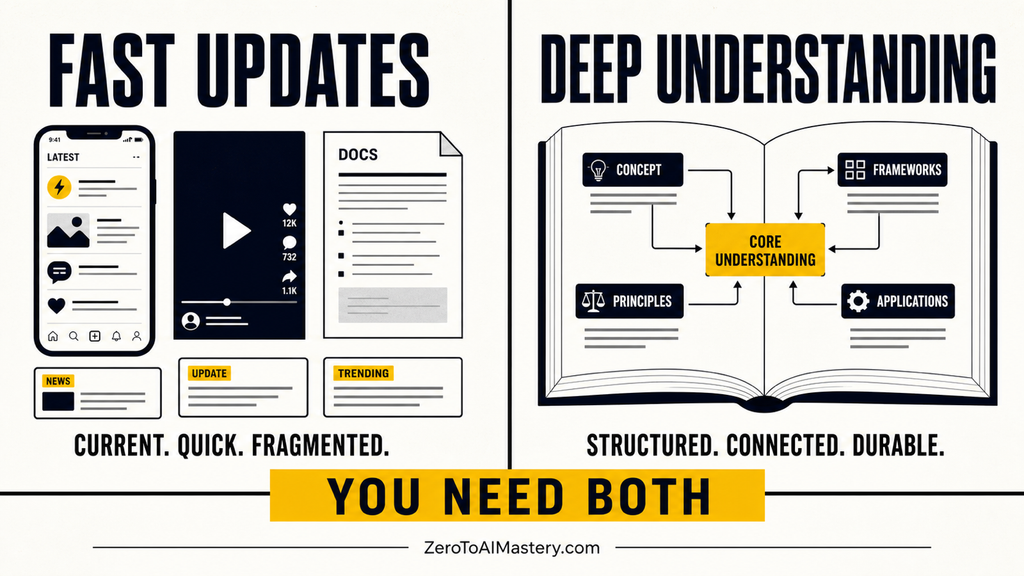
You might wonder whether it even makes sense to read AI books in 2026. AI is changing so quickly that a new model can come out, an API can change, or a tool everyone was using can be replaced within a few months. So if you want to know which model is currently the best, how much an API costs today, or which AI tool you should use right now, a book is probably not the best place to look. You are better off checking the latest documentation, articles, or updates online.
But that does not make AI books useless. A good AI book teaches you the things that do not become outdated every few weeks. You can learn how machine learning works, what LLMs are actually doing, how RAG works, why AI systems sometimes give bad answers, how evaluation works, how context affects the output, and what happens when you start putting these systems into real products. Once you understand these ideas properly, learning a new AI tool or model becomes much easier because you already understand what is happening underneath it.
Books are also helpful if you are learning AI on your own. YouTube videos and articles are great, but it is very easy to jump from one topic to another and end up knowing a little bit about everything without properly understanding anything. A good book takes you through the subject in order. You learn one concept, then the next chapter builds on it, and slowly the whole topic starts making more sense.
So I would not suggest learning AI only from books, but I would not ignore them either. Use books to understand the subject properly, use current documentation and online resources to stay updated with the latest tools, and then build small projects with what you learn. That combination works much better than relying on only one of them.
How to Choose the Right AI Book for You
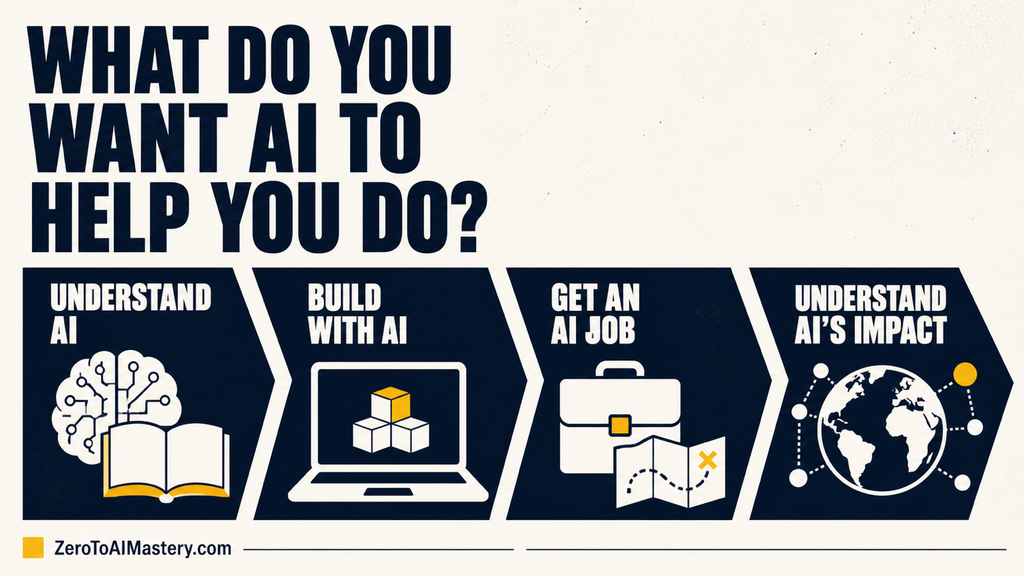
The easiest way to choose an AI book is to first decide what you actually want to learn. Someone who just wants to understand AI in simple language does not need the same book as someone who already knows Python and wants to build a transformer from scratch. So before you look at ratings or bestseller lists, think about your goal.
If you want to understand AI, choose a book that explains the ideas clearly without too much code. If you want to build with AI, look for books that teach things like LLMs, RAG, evaluation, data, agents, or production systems. If your goal is to get into an AI role, choose a book that is focused on that job and the skills you need for it. And if you mainly want to understand how AI is changing business, jobs, technology, and society, then the books about the industry, hardware, safety, economics, and power will make more sense for you.
Your current level matters too. Do not pick the hardest book just because it looks more advanced. If you are reading the first few chapters and almost nothing makes sense, it is probably not the right book for you yet. Start with something easier, understand the basics, and then come back to the more technical book later. You will learn much faster that way.
You should also remember that some parts of AI change very quickly. A book that teaches transformers, machine learning, evaluation, RAG, or system design can stay useful for a long time. But things like model names, prices, screenshots, APIs, and specific tools can become outdated much faster. So use books to learn the concepts, and use the latest documentation and online resources for the current tools.
Quick Picks: Choose the Best AI Book for Your Goal
You do not need to read all 21 books to get started. The right choice depends on what you actually want to learn. Some books are better for complete beginners, while others are designed for product managers, developers, machine learning practitioners, or readers who simply want to understand where the AI industry is heading.
- Complete beginner: Start with Co-Intelligence for a practical introduction to working with AI in everyday life and at work.
- Become an AI product manager: Choose The AI Product Manager Blueprint if your goal is to understand AI products, product strategy, workflows, and the skills needed to move into AI product management.
- Learn context engineering and AI agents: Read The Context Engineering Blueprint for context windows, prompt engineering, RAG, memory systems, tool use, and AI agent architectures.
- Build real AI applications: Pick AI Engineering if you already know programming and want to understand how modern applications are built around foundation models and LLMs.
- Understand LLMs from the inside: Go with Build a Large Language Model (From Scratch) if you want to learn how language models are actually constructed and trained.
- Learn LLMs visually: Choose Hands-On Large Language Models if diagrams, visual explanations, and practical examples help you understand technical concepts faster.
- Learn practical machine learning: Hands-On Machine Learning remains one of the strongest choices for learning how machine learning systems are developed with real tools and code.
- Separate AI reality from hype: Read AI Snake Oil if you want a more critical understanding of what AI can genuinely do, where it fails, and which claims deserve skepticism.
- Understand the AI industry: Choose Empire of AI if you are interested in the companies, people, power structures, and economics shaping the AI industry.
- Understand the hardware behind AI: Read The Thinking Machine if you are more interested in the chips, computing infrastructure, and technological forces powering the AI boom.
Those are the fastest recommendations if you already know what you want from an AI book. But each of the 21 books serves a different type of reader, so the rest of this guide breaks them down individually, including what each book teaches, who should read it, and where it fits into your AI learning journey.
Now let us go through the 21 best AI books to read in 2026.
21 Best AI Books to Read in 2026 (Beginner to Advanced)
1. The AI Product Manager Blueprint: Best Book for Becoming an AI Product Manager
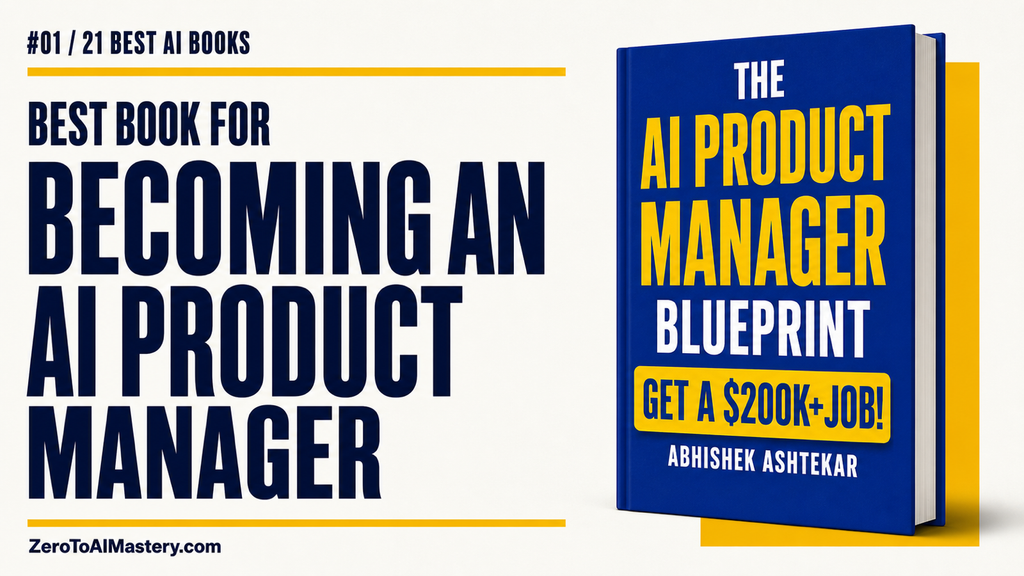
The AI Product Manager Blueprint is the book I would suggest if you want to understand what an AI product manager actually does and how that role is different from traditional product management. AI products are not always predictable like normal software features. The same input can give you different results, the model can make mistakes, costs can change depending on usage, and even a feature that looks impressive in a demo may not be good enough for real users. So an AI product manager needs to understand much more than roadmaps, user stories, and feature prioritization.
If you read The AI Product Manager Blueprint, you can learn:
- What an AI product manager actually does
- How AI product management is different from traditional product management
- How to understand LLMs and AI models without becoming an AI engineer
- How to decide whether a product actually needs AI
- How to choose the right AI model for a product
- How to think about AI evaluation and measure whether an AI feature is good enough
- How to work with AI engineers, data teams, designers, and other technical teams
- How to handle problems such as hallucinations, unreliable outputs, latency, cost, privacy, and guardrails
- How to take an AI product from an idea to something that can actually be tested and improved
- What skills you need if you want to start preparing for an AI product manager career
I think this book makes the most sense for students, career switchers, business analysts, marketers, designers, founders, traditional product managers, or anyone who wants to move into AI product management without first becoming highly technical. If you already have years of experience managing AI products and are looking for advanced product strategy or organizational frameworks, you may get more from The AI Product Playbook later in this list. And if your goal is specifically to become an AI product manager, you can also read my complete guide on How to Become an AI Product Manager in 2026 for the skills, roadmap, portfolio projects, and career path.
2. The Context Engineering Blueprint: Best Book for Context Engineering and RAG
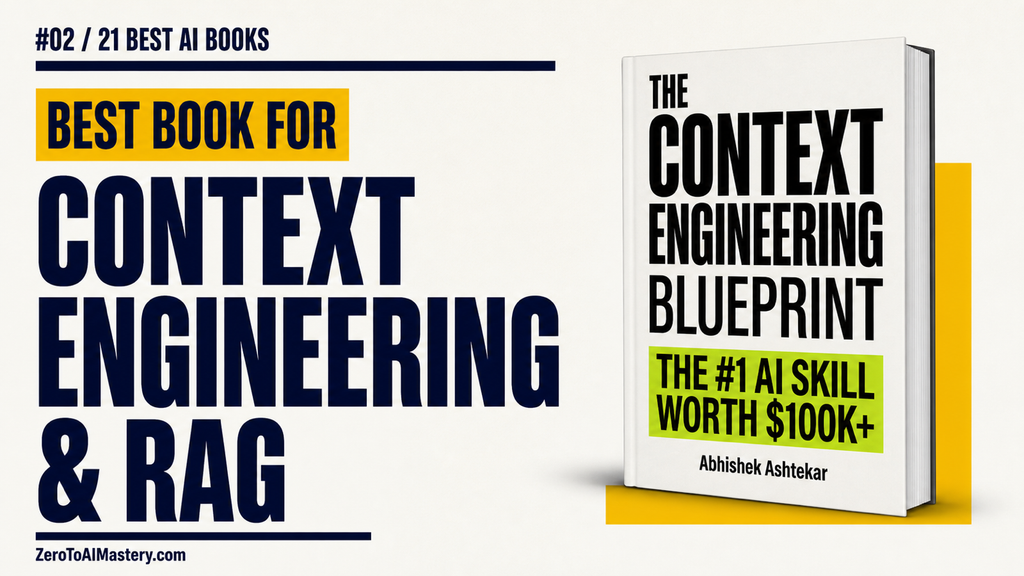
The Context Engineering Blueprint is the book I would recommend if you want to understand why getting good results from an AI model is about much more than writing a better prompt. Once you start building real AI applications, you quickly realise that the model needs the right information, the right examples, the right memory, the right tools, and the right context at the right time. That is where context engineering becomes important, especially if you are working with RAG systems, AI agents, or applications that need to give reliable answers.
If you read The Context Engineering Blueprint, you can learn:
- What context engineering actually means and how it is different from prompt engineering
- How context windows and token limits work
- How to decide what information should be included in the model’s context
- How RAG works from retrieval to final response
- How embeddings, vector databases, semantic search, chunking, and reranking work together
- How to design better memory systems for AI applications
- How AI agents use tools, memory, and external information
- How tool calling works and where it fits into an AI system
- What MCP (Model Context Protocol) is and why it is becoming useful for AI applications
- How to manage context when multiple agents or tools are involved
- How to reduce irrelevant context and improve response quality
- How to think about evaluation, security, reliability, and cost when building AI systems
I think this book is a good fit for developers, AI product managers, founders, freelancers, and anyone who wants to build AI applications that go beyond simple prompting. You can also start with it as a beginner because the concepts are explained from the basics, but if you later want deep mathematical detail on information retrieval, embeddings, or ranking systems, you will probably need more specialised technical books as well. If you want to understand the topic before buying the book, you can also read my complete guide on How to Learn Context Engineering in 2026.
3. Co-Intelligence by Ethan Mollick: Best First AI Book for a Complete Beginner
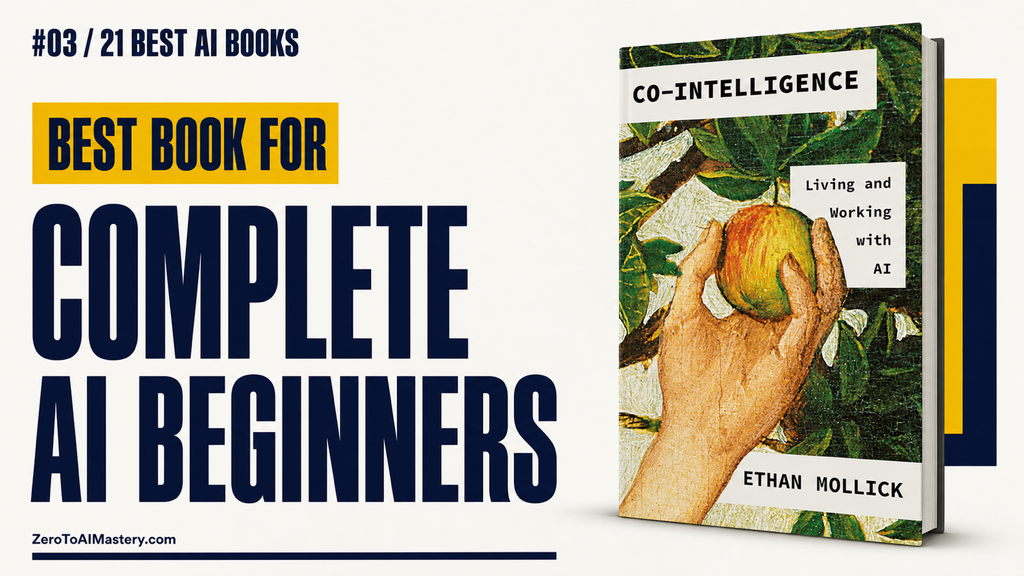
Co-Intelligence by Ethan Mollick is one of the best books to start with if you are completely new to AI and want to understand how to actually use it in your work or daily life. You do not need any coding knowledge or technical background to read it. Instead of spending too much time explaining how AI models are built, the book focuses more on how you can work with AI, test what it can do, understand where it fails, and use it as something closer to a working partner rather than just another software tool.
If you read Co-Intelligence, you can learn:
- How to start using AI even if you have no technical background
- How to work with AI instead of only giving it basic commands
- How to experiment with AI and understand what it is good at
- How to recognise situations where AI can give weak or incorrect answers
- How to use AI for writing, brainstorming, research, analysis, and everyday work
- Why you should test different approaches instead of searching for one “perfect prompt”
- How to compare AI-generated answers and improve the result
- Where human judgment is still important
- How AI can change the way you learn and work
- How to become more comfortable using AI regularly instead of treating it as something complicated
I think Co-Intelligence is a very good choice for students, professionals, managers, business owners, creators, or anyone who wants to understand AI without starting with coding, mathematics, or machine learning theory. Some of the examples are based on an earlier stage of generative AI, so the exact tools and capabilities have changed, but the main ideas about how to work with AI are still useful. If you are already building AI applications or working deeply with models, RAG, evaluation, or AI engineering, this book will probably feel too basic for you.
4. AI Engineering by Chip Huyen: Best Book for Building Real AI Applications
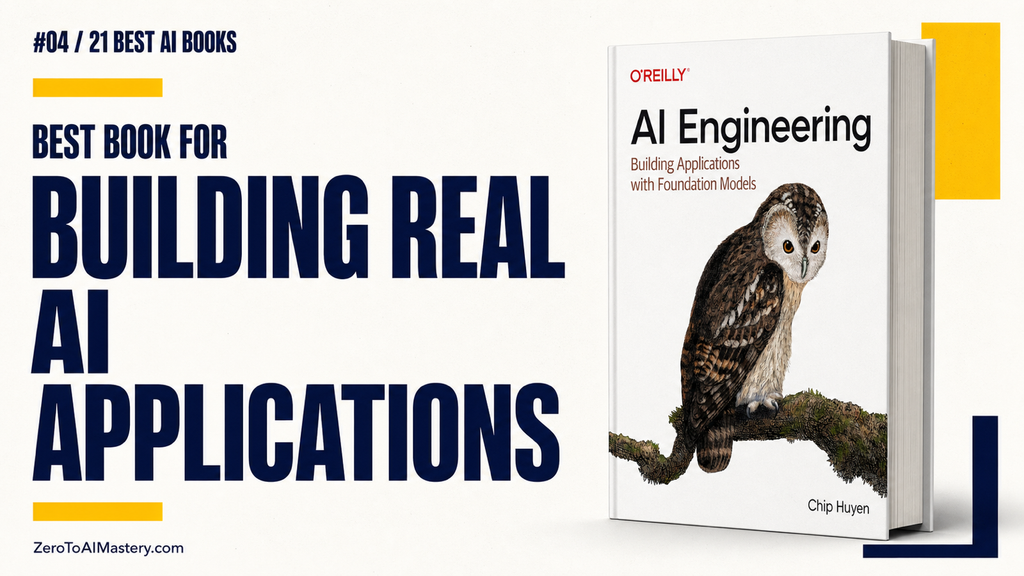
AI Engineering by Chip Huyen is a great book if you already know some programming and want to understand how real AI applications are actually built and improved after the first demo works. It goes beyond simply calling an AI model and getting a decent response. The book focuses more on the problems you face when real users start using the product, when outputs are inconsistent, costs start increasing, latency matters, data gets messy, and you need a proper way to decide whether one version of the system is actually better than another.
If you read AI Engineering, you can learn:
- How to build applications using foundation models
- How to choose the right model for a particular use case
- How to evaluate AI outputs instead of relying on whether they simply “look good”
- How prompting, retrieval, RAG, and fine-tuning fit into an AI system
- When fine-tuning makes sense and when it probably does not
- How to work with datasets for AI applications
- How to think about AI agents and more complex workflows
- How to reduce latency and inference costs
- How to compare different models and system designs
- How to create feedback loops so an AI product can improve after launch
- How to think about reliability when models and user behavior keep changing
I think AI Engineering is best for software engineers, machine learning engineers, technical founders, technical product managers, and developers who already understand the basics and now want to build better AI systems. I would not recommend it as your very first technical AI book if you have never coded before, because it assumes you are already comfortable with software and technical concepts. But if you are at the stage where simple AI tutorials are starting to feel too basic, this is one of the best books to read next.
And if your goal is not just to learn AI engineering but to actually become an AI engineer, you can also read my complete guide on How to Become an AI Engineer in 2026 (Without a Degree), where I explain the skills you need to learn, the projects you should build, and the step-by-step path you can follow to start moving toward an AI engineering career.
5. Build a Large Language Model (From Scratch) by Sebastian Raschka: Best Book for Understanding LLMs From the Inside
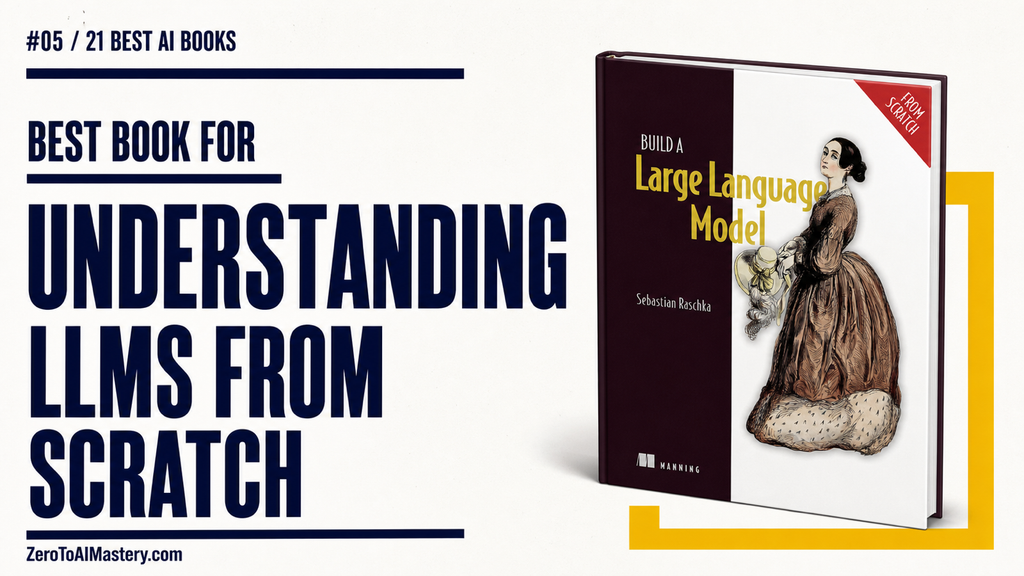
Build a Large Language Model (From Scratch) by Sebastian Raschka is the book I would recommend if you do not just want to use LLMs, but actually want to understand what is happening inside them. Instead of treating a model like a black box, you build the important parts yourself using Python and PyTorch. That makes concepts like tokenization, embeddings, attention, and transformers much easier to understand because you are not only reading about them, you are actually implementing them.
If you read Build a Large Language Model (From Scratch), you can learn:
- How text is prepared before it is given to a language model
- How tokenization works
- How embeddings represent words and tokens
- How the attention mechanism works
- How transformer blocks are built
- How the main parts of a GPT-style language model fit together
- How a language model is pretrained on text
- How to load and work with pretrained model weights
- How fine-tuning works
- How instruction tuning changes the behavior of a model
- How to build a small LLM step by step using Python and PyTorch
- Why each major component of an LLM is needed instead of simply memorizing the terminology
I think Build a Large Language Model (From Scratch) is best for developers, machine learning learners, AI engineers, and anyone who already knows Python and wants a much deeper understanding of LLMs. You should expect to write code while reading it, because that is where most of the learning happens. If you are completely new to programming or only want a simple conceptual explanation of how LLMs work, Hands-On Large Language Models may be an easier book to start with. But if you are ready to build the pieces yourself, this is one of the best books for properly understanding what is happening inside a large language model.
6. Hands-On Large Language Models by Jay Alammar and Maarten Grootendorst: Best Book for Learning LLMs Visually
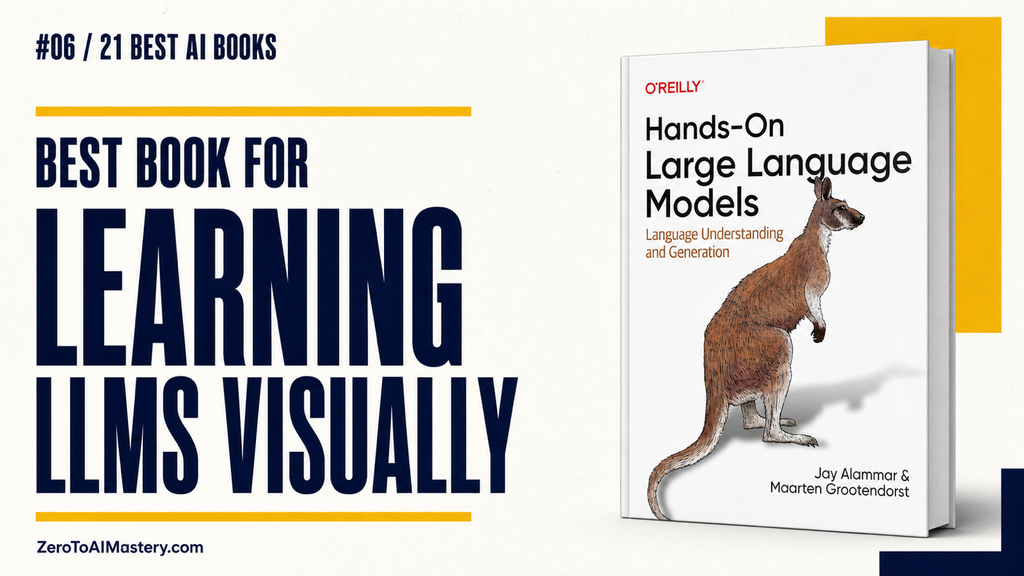
Hands-On Large Language Models by Jay Alammar and Maarten Grootendorst is a great choice if you want to understand LLMs visually before going too deep into the mathematics. Jay Alammar is well known for explaining transformers with clear diagrams, and that same style carries through the book. Instead of only telling you how things like embeddings or attention work, the book shows you what is happening step by step and then gives you practical code so you can try the ideas yourself.
If you read Hands-On Large Language Models, you can learn:
- How language models represent text
- How tokenization works
- What embeddings are and how they are used
- How transformers work
- How attention fits into a transformer
- How to work with text classification
- How clustering can be used with text
- How semantic search works
- How language models generate text
- How to work with pretrained LLMs using Python
- How to understand difficult LLM concepts through diagrams and visual explanations
- How to build practical applications without creating an entire language model from scratch
I think Hands-On Large Language Models is best for developers, AI learners, data scientists, and anyone who wants a practical understanding of LLMs without starting with the deepest implementation details. You will still need some Python for the hands-on parts, but the visual explanations make it easier to follow than many technical books. If you want to understand the concepts first and then go deeper into building an LLM yourself, I would read this before Build a Large Language Model (From Scratch) by Sebastian Raschka.
7. Hands-On Machine Learning with Scikit-Learn, Keras, and TensorFlow by Aurélien Géron: Best Book for Learning Machine Learning by Coding
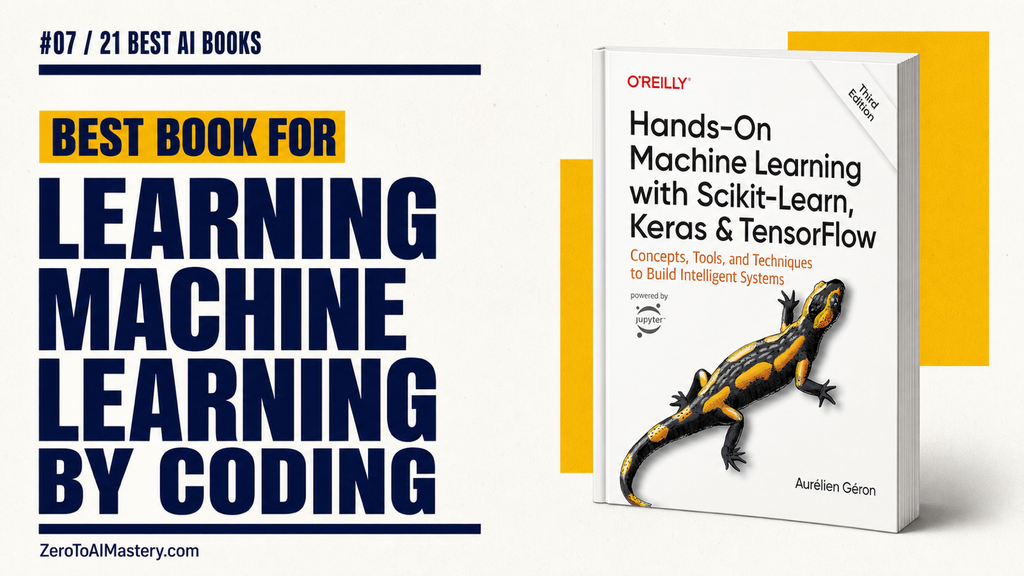
Hands-On Machine Learning with Scikit-Learn, Keras, and TensorFlow by Aurélien Géron is one of the best books to read if you want to learn machine learning by actually writing code instead of only studying the theory. It starts with the basics and gradually takes you through different machine learning techniques, so you can understand how models are trained, tested, improved, and used with real data. It is especially useful if you want a proper machine learning foundation and do not want your AI knowledge to be limited only to ChatGPT, LLMs, and APIs.
If you read Hands-On Machine Learning, you can learn:
- How machine learning works in practice
- How to prepare and clean data before training a model
- How linear regression and logistic regression work
- How to build classification models
- How decision trees, random forests, and ensemble methods work
- How to train and compare different machine learning models
- How to measure model performance and choose the right evaluation metrics
- What overfitting and underfitting are and how to deal with them
- How to tune models and improve their performance
- How to work with Scikit-Learn
- How neural networks and deep learning work
- How to build neural networks using Keras and TensorFlow
- How to work on machine learning problems through practical coding examples
I think Hands-On Machine Learning is best for students, Python learners, data scientists, aspiring machine learning engineers, AI engineers, and anyone who wants to understand machine learning properly by building things. It is a big book, so you do not have to read every chapter from beginning to end. You can start with the machine learning fundamentals, practise the code, and then move into the deeper sections when you need them. If your only goal is to build LLM applications using existing APIs, you probably do not need to start here. But if you want a strong machine learning foundation that will also help you understand AI more deeply, this is one of the best books you can work through.
8. Artificial Intelligence: A Modern Approach by Stuart Russell and Peter Norvig: Best Book for Serious AI Foundations
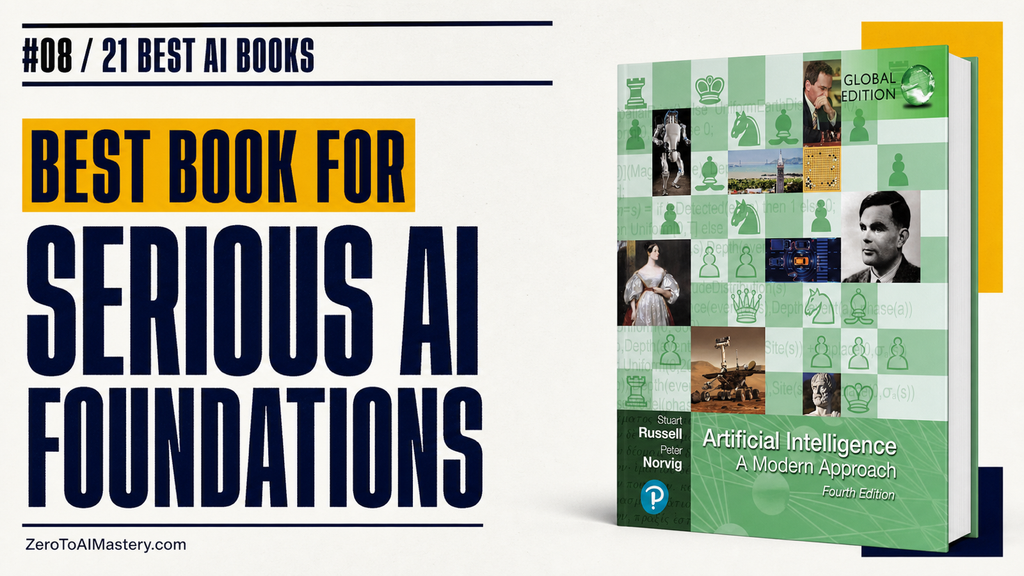
Artificial Intelligence: A Modern Approach by Stuart Russell and Peter Norvig is the book I would recommend if you want to understand AI as a complete field, not just LLMs, ChatGPT, and generative AI. It covers many of the ideas that AI has been built on for decades, including search, reasoning, planning, probability, machine learning, reinforcement learning, natural language processing, robotics, and multi-agent systems. So if you want a much deeper foundation in artificial intelligence and want to understand how all these different areas connect, this is one of the strongest books you can study.
If you read Artificial Intelligence: A Modern Approach, you can learn:
- What artificial intelligence actually includes beyond generative AI
- How intelligent agents make decisions
- How search algorithms solve problems
- How AI systems use logic and reasoning
- How planning works in AI
- How AI deals with uncertainty and probability
- The foundations of machine learning
- How reinforcement learning works
- How AI systems understand and process language
- The basics of computer vision and robotics
- How multi-agent systems work
- How different areas of AI connect to each other
- The theoretical foundations behind many modern AI systems
I think Artificial Intelligence: A Modern Approach is best for computer science students, researchers, aspiring AI engineers, machine learning engineers, and anyone who wants a serious long-term foundation in artificial intelligence. It is a proper textbook, so it is much more detailed and demanding than most of the books on this list. I would not recommend starting with it if you are completely new to AI and only want a simple introduction. But if you want to study AI properly and understand the field beyond the current excitement around LLMs, this is one of the books you will probably keep coming back to for years.
9. The Hundred-Page Language Models Book by Andriy Burkov: Best Book for Fast Technical LLM Grounding
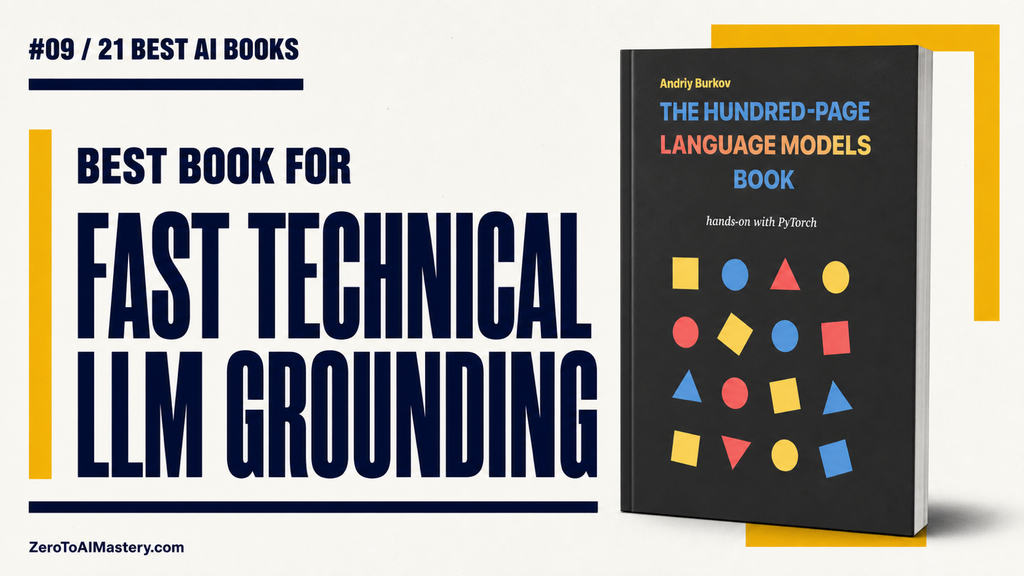
The Hundred-Page Language Models Book by Andriy Burkov is a good choice if you already know some machine learning and want a shorter, more direct way to understand language models. It does not spend a lot of time repeating the same idea in different ways. Instead, it moves quickly through the important concepts and expects you to slow down, think, and work through the technical parts yourself. That makes it useful if you want to get a solid technical overview of LLMs without reading a much larger textbook.
If you read The Hundred-Page Language Models Book, you can learn:
- The basic ideas behind language modeling
- How neural networks are used for language tasks
- How embeddings represent words and tokens
- How older sequence models such as recurrent neural networks work
- Why transformers became so important for modern language models
- How the transformer architecture works
- How modern LLMs are trained and used
- The mathematics behind important language-model concepts
- How to connect the theory with practical Python examples
- How different generations of language models relate to each other
- The technical ideas you need before moving into deeper LLM engineering
I think The Hundred-Page Language Models Book is best for developers, machine learning learners, data scientists, and aspiring AI engineers who already know some Python and basic machine learning. I would not recommend it as your very first AI book, because the short length does not mean the material is easy. In fact, some sections can take time to understand because the explanations are compact. But if you already have the basics and want a concise technical book that you can read, revisit, and use as a reference, this is a very good option.
10. Designing Machine Learning Systems by Chip Huyen: Best Book for Production Machine Learning
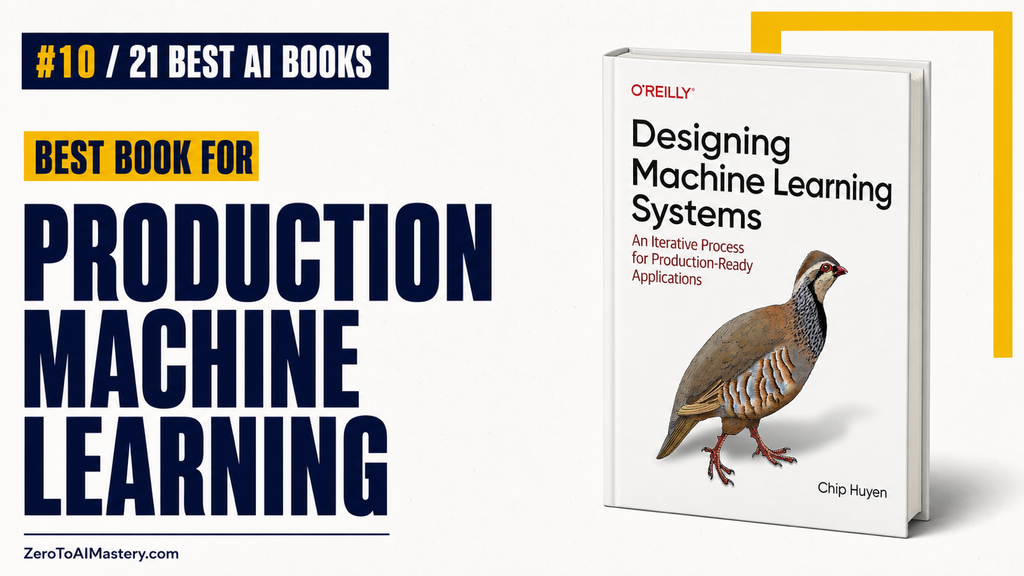
Designing Machine Learning Systems by Chip Huyen is the book I would recommend if you want to understand what happens after a machine learning model works in a notebook and you need to turn it into something that works reliably in the real world. Training a model is only one part of the job. Once real users, changing data, deployment, monitoring, latency, and failures come into the picture, the system becomes much more complicated.
If you read Designing Machine Learning Systems, you can learn:
- How to design a complete machine learning system
- How to define the right objectives and evaluation metrics
- How to work with training data and data pipelines
- How to think about model deployment
- How to monitor a machine learning system after it goes live
- What data distribution shifts are and why they matter
- How to detect when model performance starts getting worse
- How to handle changing data over time
- How continual learning works
- How to think about reliability, latency, and system trade-offs
- How different parts of a production ML system work together
- How to move from a model that performs well in testing to a system that can actually work for real users
I think Designing Machine Learning Systems is best for machine learning engineers, data scientists, software engineers, technical founders, and anyone who wants to understand production machine learning properly. If your main focus is building applications on top of existing foundation models and APIs, AI Engineering by Chip Huyen may be the better book to start with. But if you want to understand how machine learning models are deployed, monitored, maintained, and improved in real production systems, this book is the stronger choice.
11. AI Snake Oil by Arvind Narayanan and Sayash Kapoor: Best Book for Separating AI Hype From Reality
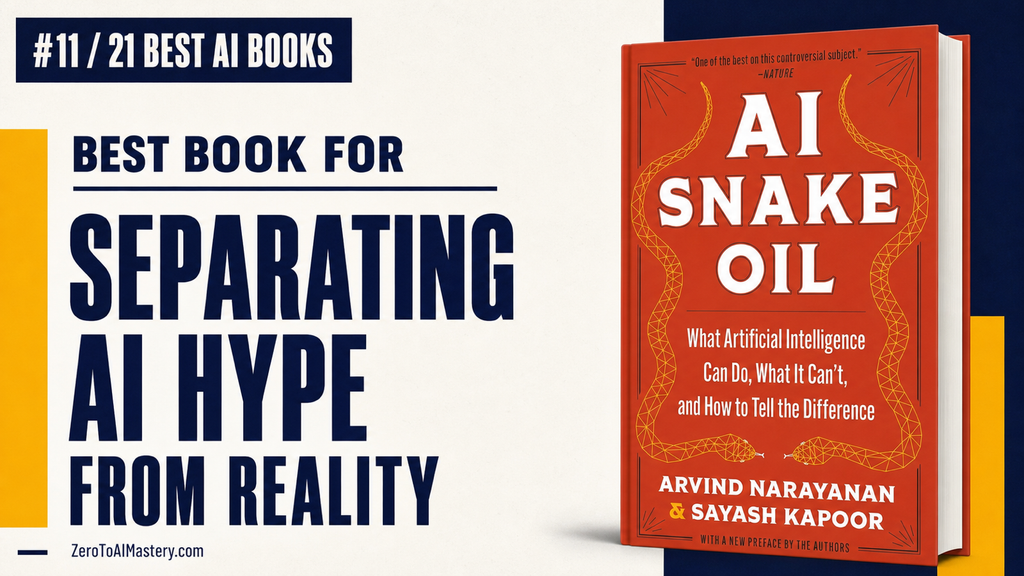
AI Snake Oil by Arvind Narayanan and Sayash Kapoor is the book I would recommend if you want to get better at judging AI claims instead of believing every impressive demo, headline, or sales pitch. AI can do a lot, but that does not mean every company using the word “AI” has a system that actually works well. This book helps you understand where AI is genuinely useful, where the claims are much weaker, and what kind of evidence you should look for before trusting a system.
If you read AI Snake Oil, you can learn:
- How to separate realistic AI capabilities from exaggerated claims
- Why some AI systems work well for one type of task but poorly for another
- The difference between generative AI and predictive AI
- Why predicting human behavior is much harder than many companies make it sound
- How to question claims about AI in hiring, education, healthcare, criminal justice, and other high-stakes areas
- Why a good demo does not automatically mean a system is reliable
- How to look for proper evidence before trusting an AI product
- How misleading benchmarks or weak testing can make an AI system look better than it really is
- How to think more critically when companies say their AI can “predict” complex outcomes
- How to use AI without either overhyping it or dismissing it completely
I think AI Snake Oil is best for managers, founders, business owners, journalists, policy professionals, buyers of AI software, and anyone who wants to understand which AI claims are worth taking seriously. It is not a technical book that will teach you how to build an LLM, train a machine learning model, or create a RAG system. But if you want to become better at spotting weak claims, asking better questions, and deciding whether an AI product is actually useful, this is one of the best books for that.
12. The Alignment Problem by Brian Christian: Best Book for Understanding AI Alignment and Failure
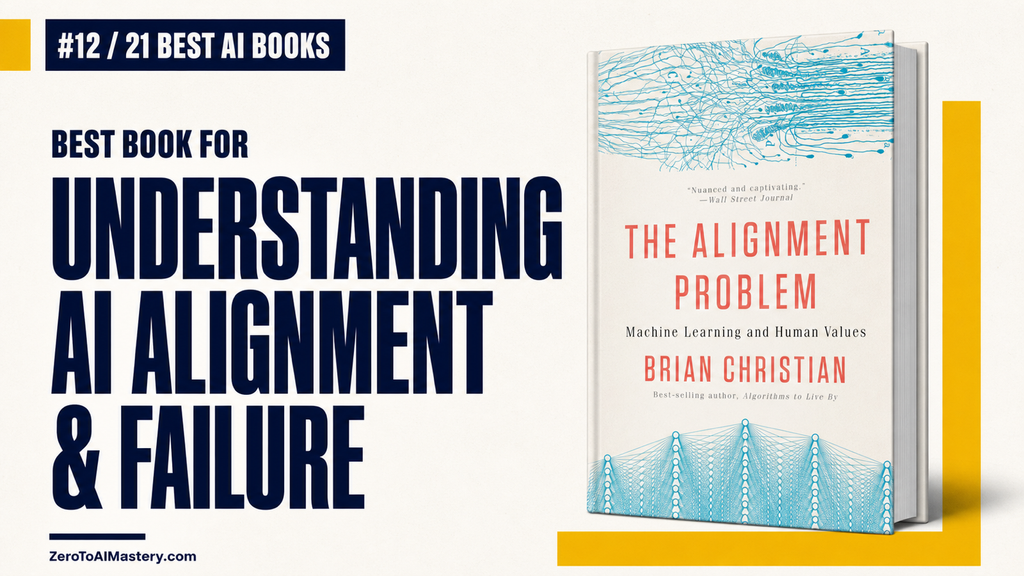
The Alignment Problem by Brian Christian is the book I would recommend if you want to understand why AI systems can still produce bad results even when they are doing exactly what they were trained to do. The basic problem is simple: sometimes the goal we give a system is not exactly the same as the outcome we actually want. The book explains how that gap can lead to bias, unfair decisions, unexpected behavior, and other problems that become more serious as AI systems are used in more important situations.
If you read The Alignment Problem, you can learn:
- What AI alignment actually means
- Why giving an AI system the wrong objective can lead to unexpected results
- How bias in data can affect AI decisions
- Why proxies and metrics can sometimes push a system in the wrong direction
- How reinforcement learning connects to the alignment problem
- Why feedback matters when training intelligent systems
- How researchers try to understand what is happening inside AI models
- What interpretability means and why it matters
- How AI systems can make unfair or harmful decisions even without being intentionally designed to do so
- Why AI safety is about much more than futuristic superintelligence
- How human values can be difficult to translate into rules that machines can follow
I think The Alignment Problem is best for anyone who wants to understand AI safety, ethics, bias, fairness, and the deeper problems involved in getting intelligent systems to behave the way we actually want. You do not need to be an engineer to read it, because Brian Christian explains the research through stories, experiments, and real examples rather than turning the book into a technical textbook. If your goal is to learn current LLM tools, prompting, RAG, or AI application development, this is not the book for that. But if you want to understand why even a powerful and well-trained AI system can still fail in serious ways, this is one of the best books to read.
13. Empire of AI by Karen Hao: Best Book for Understanding the AI Industry From the Inside
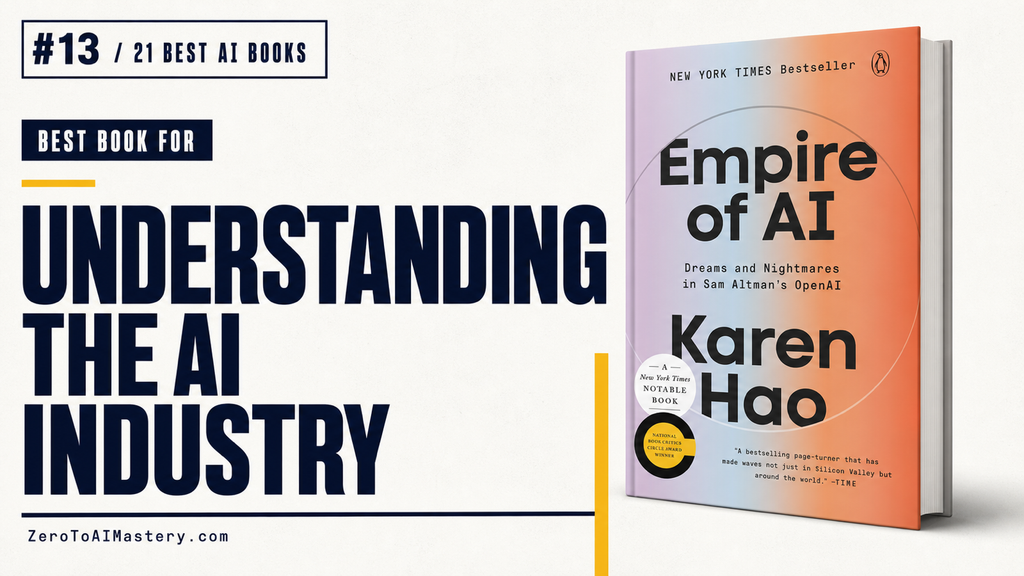
Empire of AI by Karen Hao is the book I would recommend if you want to understand what is happening behind the AI products we use every day. Instead of focusing on how models work technically, the book looks at the companies building them, the amount of computing power and data they need, the people involved behind the scenes, and the decisions that shape the industry. A large part of the book focuses on OpenAI, but the bigger value is that it helps you understand how the race to build more powerful AI actually works.
If you read Empire of AI, you can learn:
- How major AI companies operate behind the scenes
- How OpenAI grew and changed over time
- Why compute, data, and infrastructure matter so much in modern AI
- How competition between AI companies affects the way products are built
- Why AI development requires huge amounts of money and resources
- How data workers and other less-visible workers contribute to AI systems
- How secrecy and internal decision-making can influence AI companies
- Why the race to build more capable models has wider business and social consequences
- How incentives inside AI companies can affect the technology they release
- What it actually takes to build and scale frontier AI systems
I think Empire of AI is best for people who want to understand the business, power, competition, and people behind the AI industry. It is especially useful for founders, investors, product managers, journalists, policy professionals, and anyone who follows companies like OpenAI and wants more context than product announcements and headlines can give. It is not a technical book, so you will not learn how to build an LLM or create an AI application from it. But if you want to understand the industry behind the technology, this is one of the most interesting books on the list.
14. The Thinking Machine by Stephen Witt: Best Book for Understanding AI Hardware and NVIDIA
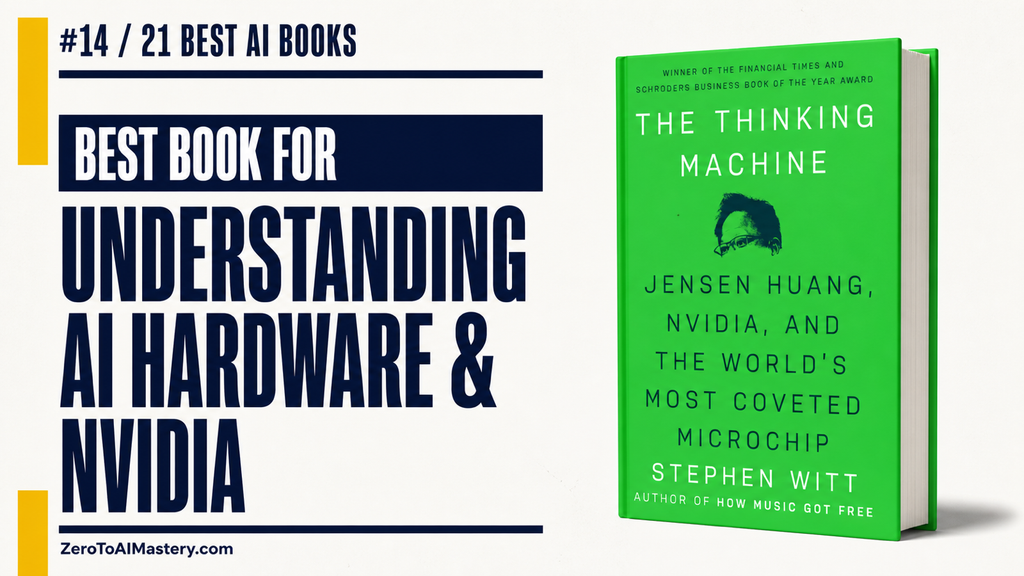
The Thinking Machine by Stephen Witt is the book I would recommend if you want to understand the hardware side of AI and why NVIDIA has become such an important company in the industry. AI is not only about models and software. Training and running powerful models also depends on chips, GPUs, data centers, electricity, memory, manufacturing, and access to enough computing power. This book explains that side of the story through NVIDIA and Jensen Huang.
If you read The Thinking Machine, you can learn:
- How NVIDIA became one of the most important companies in AI
- Why GPUs are so important for training and running AI models
- How Jensen Huang helped build NVIDIA into a major technology company
- Why AI companies need huge amounts of computing power
- How chips and hardware affect what AI labs are able to build
- Why data centers are such a big part of modern AI
- How supply chains and chip manufacturing affect the AI industry
- Why access to advanced hardware can become a competitive advantage
- How the growth of AI changed NVIDIA’s position in the technology industry
- Why hardware, power, and infrastructure matter just as much as software in the AI race
I think The Thinking Machine is best for people who want to understand the business and infrastructure behind AI rather than only the models themselves. It is especially useful for founders, investors, product managers, business readers, and anyone interested in NVIDIA or the economics of AI. You will not learn how to program GPUs or build AI models from this book, because it is not an engineering manual. But if you want to understand why chips, data centers, and computing power have become so important to the future of AI, this is one of the best books to read.
15. If Anyone Builds It, Everyone Dies by Eliezer Yudkowsky and Nate Soares: Best Book for Understanding the Strongest Superintelligence Risk Case
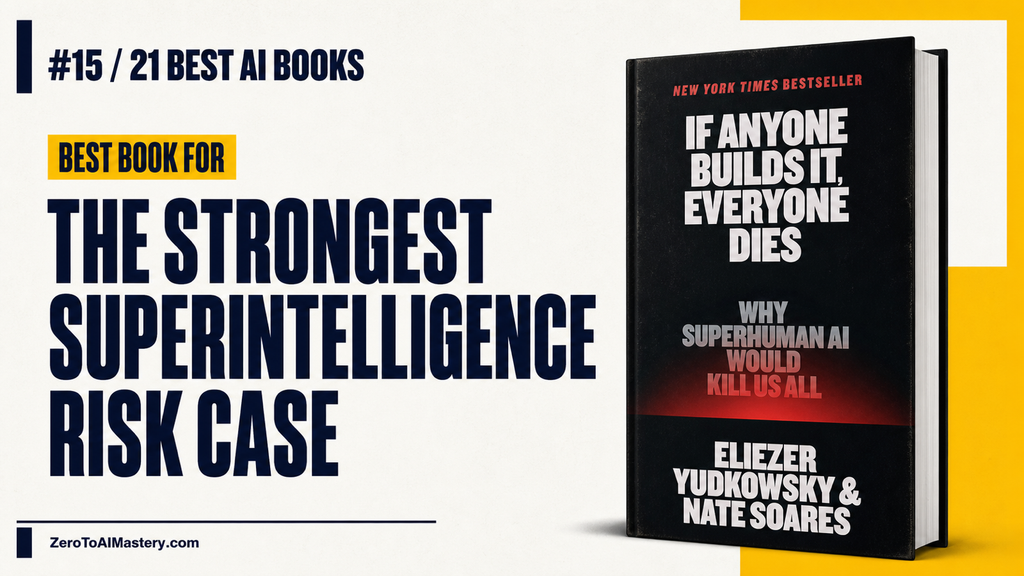
If Anyone Builds It, Everyone Dies by Eliezer Yudkowsky and Nate Soares is the book I would recommend if you want to understand the strongest argument for why highly advanced AI could become extremely dangerous. The authors believe that building superintelligent AI without first solving the alignment problem could lead to catastrophic outcomes. You do not have to agree with that conclusion, but the book is useful because it explains the reasoning behind one of the most serious positions in the AI safety debate.
If you read If Anyone Builds It, Everyone Dies, you can learn:
- Why some researchers believe superintelligent AI could become dangerous
- What the AI alignment problem means at a much more advanced level
- Why it is difficult to know exactly what a neural network has learned internally
- Why giving an AI system a goal does not guarantee that it will pursue that goal in the way humans expect
- What could happen when an AI system becomes more capable than the people who designed it
- Why greater autonomy can increase the risks of unexpected behavior
- How optimization can create outcomes that were never intended during training
- Why some AI safety researchers believe current methods may not be enough for much more powerful systems
- Why confidence and testing become more important as AI systems gain more capabilities
- What the strongest case for existential AI risk actually looks like when explained in full
I think If Anyone Builds It, Everyone Dies is best for people who want to understand AI safety, superintelligence, alignment, and the arguments around existential risk. It is important to read it as one side of an ongoing debate, because researchers disagree heavily about how likely these risks are, how soon they could appear, and whether the authors’ conclusions are correct. But if you want to understand why some people are extremely concerned about advanced AI, it is much better to read the full argument than to rely on short clips or second-hand summaries.
16. Nexus by Yuval Noah Harari: Best Book for Understanding AI, Information, and Power
Nexus by Yuval Noah Harari is the book I would recommend if you want to understand AI from a much broader point of view. Instead of focusing on how models are trained or how LLMs work, the book looks at how information has shaped societies for thousands of years and how AI may change that system. Harari connects AI with history, media, institutions, governments, and the way people create, share, and control information.
If you read Nexus, you can learn:
- How information networks have shaped human societies
- How stories, documents, media, and institutions influence the way people think and act
- Why information is closely connected to power
- How AI changes the way information can be created and distributed
- Why AI systems are different from older tools that only stored or transmitted information
- How algorithms can influence what people see, believe, and pay attention to
- How AI may affect governments, institutions, and public decision-making
- Why automated systems can become powerful parts of information networks
- How AI could change media, politics, and communication
- Why understanding AI is not only a technical problem but also a social and political one
I think Nexus is best for readers who are interested in history, society, politics, media, institutions, and the larger impact of AI. It is not the book to choose if you want to learn Python, build an AI application, or understand transformer architecture. But if you want to step away from the technical side for a while and think about how AI could change the way information and power work in society, this is a very good book to read.
17. The Scaling Era by Dwarkesh Patel with Gavin Leech: Best Book for Hearing AI Builders in Their Own Words
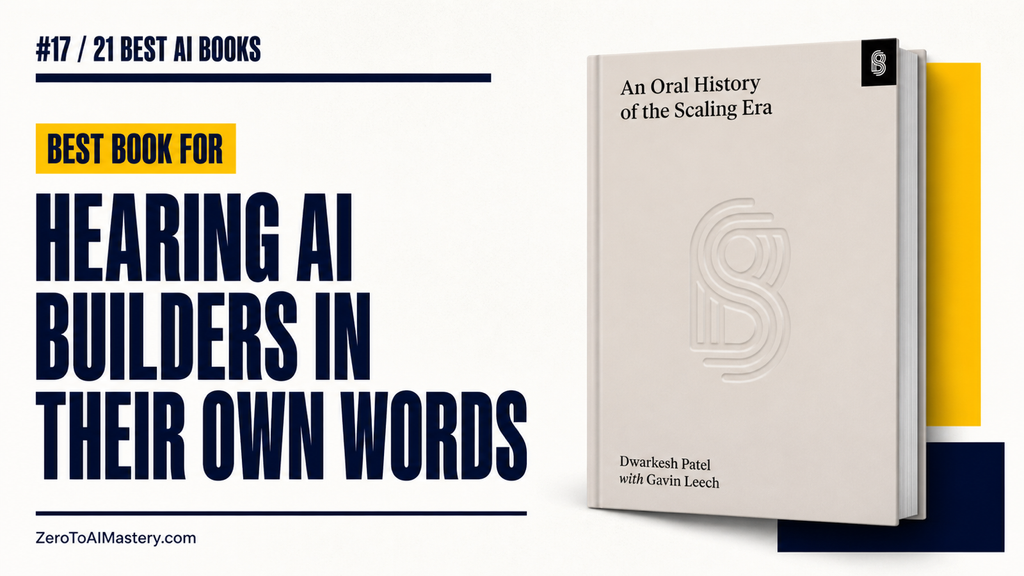
The Scaling Era by Dwarkesh Patel with Gavin Leech is the book I would recommend if you want to hear how some of the most influential people in AI actually think about the field in their own words. Instead of giving you one author’s opinion about where AI is going, the book brings together long-form conversations with researchers, founders, and thinkers who have very different views on scaling, intelligence, AGI, economics, safety, and the future of AI.
If you read The Scaling Era, you can learn:
- How leading AI researchers think about scaling
- Why larger models and more compute have changed AI so quickly
- How people such as Dario Amodei, Demis Hassabis, Ilya Sutskever, Mark Zuckerberg, and Eliezer Yudkowsky think about advanced AI
- Different views on whether current AI approaches can lead to AGI
- How researchers think about reasoning, intelligence, and model capabilities
- How AI could affect economics and productivity
- Why some people are optimistic about advanced AI while others are deeply worried about it
- Different arguments around AI safety and existential risk
- How major AI labs think about future research
- Where experts agree and where they strongly disagree
- How the people closest to advanced AI think about what may come next
I think The Scaling Era is best for people who already follow AI and want to go beyond short quotes, social media posts, and simplified summaries. It is not a normal textbook that teaches one subject from beginning to end. The value comes from reading different people explain their own ideas at length and then comparing those views yourself. If you want to understand how the people building, researching, and debating advanced AI actually think about the future of the field, this is one of the most interesting books on this list.
18. Reshuffle by Sangeet Paul Choudary: Best Book for Understanding AI, Work, and Business Economics
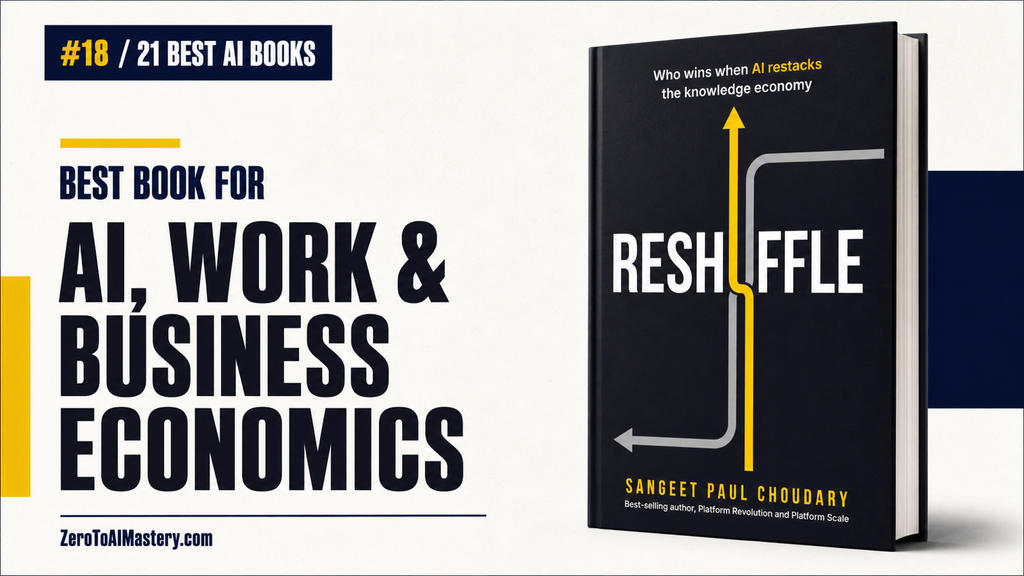
Reshuffle by Sangeet Paul Choudary is the book I would recommend if you want to understand how AI may change the way jobs, teams, and businesses are structured. Instead of only asking which jobs AI will replace, the book looks at something more practical: what happens when parts of a job can be separated, automated, checked, or combined in completely new ways. That makes it useful if you are trying to understand how work itself may change, not just which tools people will use.
If you read Reshuffle, you can learn:
- How AI can break jobs into smaller tasks
- Why some tasks can be automated while others still need human judgment
- How work can be reorganized around AI, humans, and verification
- How companies may redesign workflows because of AI
- Why AI can change the value of different parts of a job
- How managers can think about human-AI collaboration
- How AI may change knowledge work
- How business processes can be rebuilt instead of simply adding AI to the old process
- Why coordination becomes more important when humans and AI systems work together
- How AI may affect organizational design and operating models
- How companies can think differently about productivity, roles, and the structure of work
I think Reshuffle is best for founders, managers, consultants, product leaders, strategists, and anyone interested in how AI may change jobs and businesses. It is not a technical book, so it will not teach you how to build an AI agent, create a RAG system, or train a model. But if you want to understand how companies may redesign work around AI and how that could change the economics of teams and organizations, this is a very useful book to read.
19. The AI Product Playbook by Marily Nika and Diego Granados: Best Book for Product Managers Moving Into AI
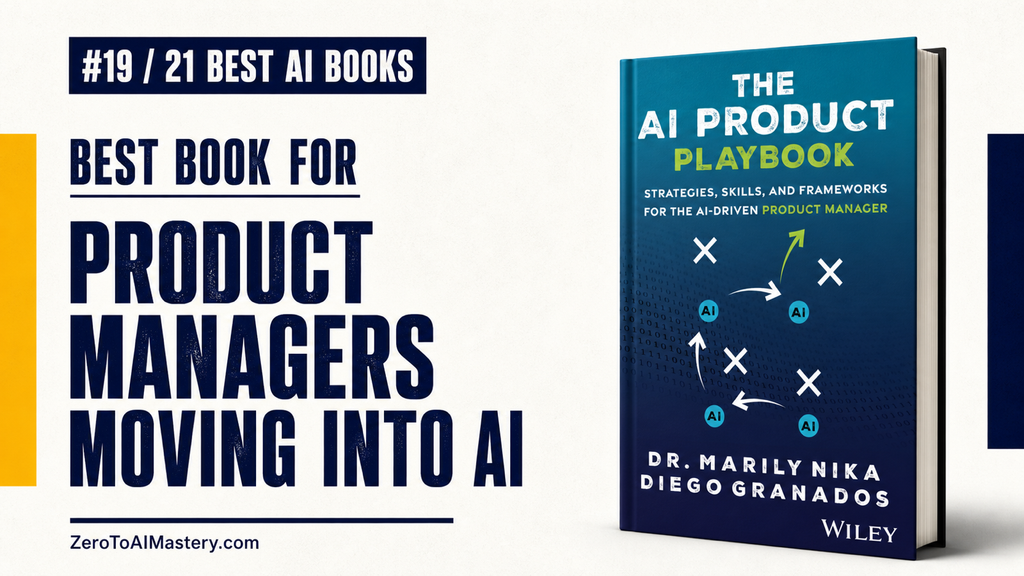
The AI Product Playbook by Marily Nika and Diego Granados is the book I would recommend if you already understand traditional product management and now want to learn how that role changes when AI becomes part of the product. If you already know how to work with roadmaps, metrics, stakeholders, user research, and product launches, this book helps you connect those skills with AI-specific decisions instead of teaching product management from the beginning again.
If you read The AI Product Playbook, you can learn:
- How AI product management is different from traditional product management
- How to think about different types of AI product manager roles
- How to manage products that depend on AI models and data
- How to work with engineers, data scientists, and AI teams
- How to think about AI features from a product perspective
- How to evaluate whether AI should actually be used in a product
- How to connect AI capabilities with real user problems
- How to think about product metrics for AI-powered features
- How to manage uncertainty and changing model capabilities
- How product managers can use AI in their own work
- How to move from traditional product management into more AI-focused product roles
I think The AI Product Playbook is best for product managers who already know the basics and want to move into AI products. If you are completely new to both product management and AI, I would start with The AI Product Manager Blueprint first because it is written more for beginners and career switchers. But if you already have product experience and want a more focused look at how AI changes the PM role, this is a very good book to read next.
20. The Worlds I See by Fei-Fei Li: Best Book for Understanding Where Modern AI Came From
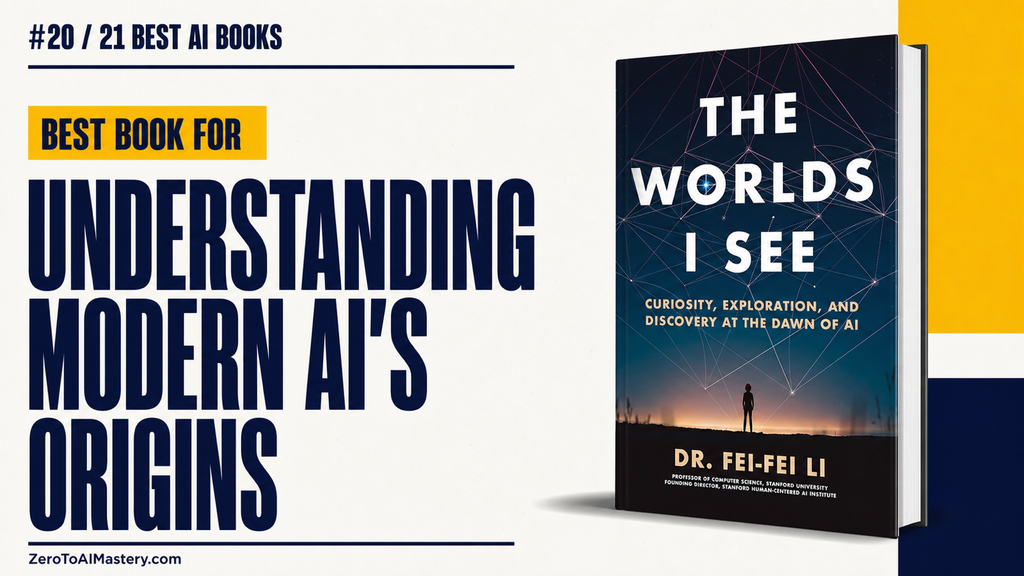
The Worlds I See by Fei-Fei Li is the book I would recommend if you want to understand the history behind modern AI through the story of someone who actually helped shape it. Fei-Fei Li is best known for her work in computer vision and ImageNet, and the book explains how that research developed alongside her personal life, career, failures, and uncertainty. It gives you a much more human view of how AI progress actually happens.
If you read The Worlds I See, you can learn:
- How computer vision developed into an important part of modern AI
- Why ImageNet became so important for deep learning
- How large datasets helped improve computer vision systems
- What AI research looked like before today’s generative AI boom
- How major research breakthroughs can take years of work
- Why data, computing power, researchers, and timing all matter in AI progress
- How Fei-Fei Li built her career in AI research
- What it is like to work on difficult research when success is not guaranteed
- How collaboration and persistence contribute to scientific progress
- How modern AI grew from decades of research rather than appearing suddenly with ChatGPT
- How the history of AI connects with the technology we use today
I think The Worlds I See is best for people who want to understand the history of AI, computer vision, research, and the people behind major breakthroughs. It is also a good choice if you prefer learning through stories rather than technical textbooks. You will not learn how to train a computer vision model or build an AI application from this book, but if you want to understand where modern AI came from and how important research actually develops over time, this is one of the most interesting books to read.
21. Co-Existence by Ethan Mollick: Best Upcoming AI Book to Watch in Late 2026
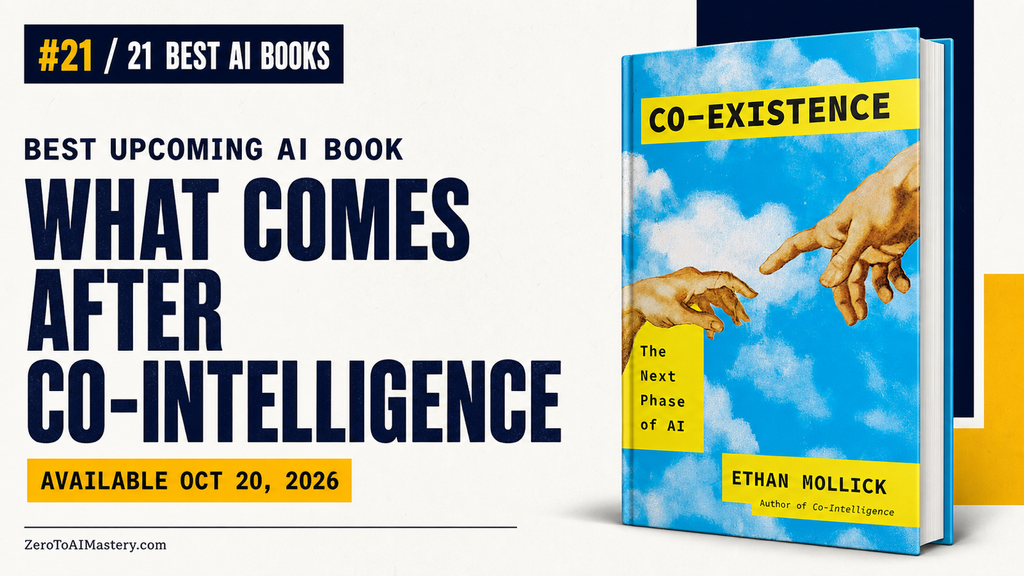
Co-Existence by Ethan Mollick is a book to look out for if you liked Co-Intelligence and want to understand how working with AI may change as the technology becomes more capable. Instead of focusing only on basic prompting, the book looks at what happens when AI starts taking on longer tasks, helping with research, working as a collaborator, and becoming more involved in everyday work.
If you read Co-Existence, you can expect to learn:
- How people may work alongside more capable AI systems
- Why AI can be very good at some tasks and still fail at others
- How AI can be used as a collaborator, tutor, researcher, and assistant
- Why human judgment still matters when AI gives convincing but incorrect answers
- How the way we use AI at work may continue to change
- What happens when AI moves beyond simple chatbot conversations
- How people may need to adapt their workflows as AI takes on more complex tasks
- Why understanding both the strengths and weaknesses of AI is important
- What the next stage of human-AI collaboration may look like
I think Co-Existence is most relevant for people who already use AI regularly and want to understand what comes next. If you liked the practical style of Co-Intelligence, this follows the same general direction but focuses more on working alongside more capable AI systems and how that may affect the way people learn, work, and make decisions.
Common Mistakes People Make When Choosing AI Books
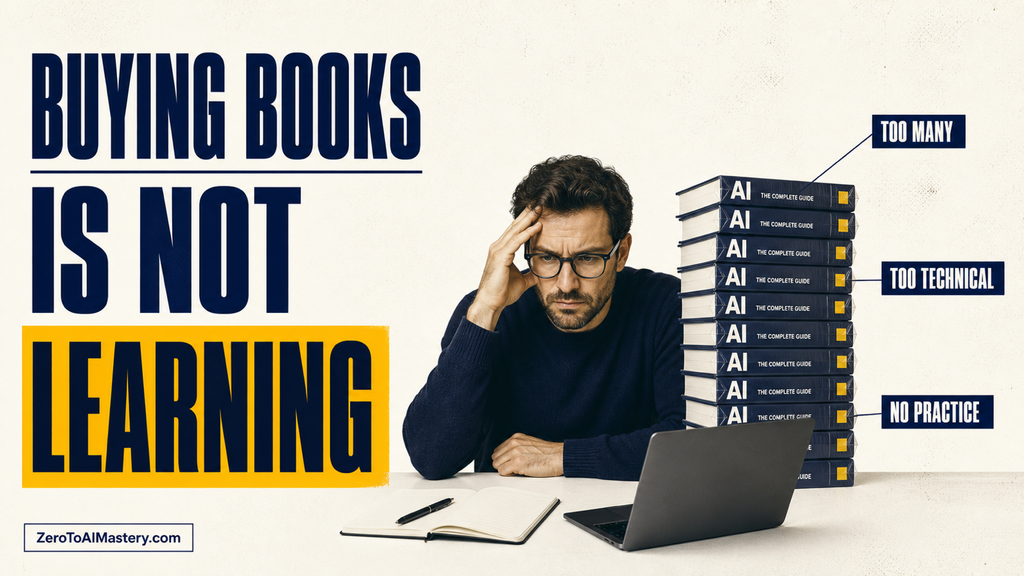
One of the biggest mistakes people make when choosing an AI book is picking the most popular one instead of the one that actually matches what they want to learn. A book can be excellent and still be completely wrong for your goal. If you want to become an AI product manager, for example, a book about the history of AI may be interesting, but it will not help you much with the skills you need for that role.
Some common mistakes to avoid are:
- Choosing a book because it is famous instead of because it fits your goal
- Starting with a book that is far too technical for your current level
- Buying several books at once and finishing none of them
- Reading technical books without actually trying the code or exercises
- Ignoring older books just because some tools or examples have changed
- Treating reading as progress without building anything from what you learn
- Choosing a book because it looks advanced instead of because you can actually understand it
- Spending too much time comparing books instead of starting one
The better approach is simple. Pick one book that matches what you want to learn right now, read it properly, and use what it teaches you. If there is code, try the code. If the book explains RAG, build a small RAG project. If it teaches evaluation, test some AI outputs yourself. And if an older book explains an important idea well, do not ignore it just because a library or tool has changed. Learn the concept from the book and check the latest documentation for the current implementation.
How to Read Technical AI Books and Actually Remember Something
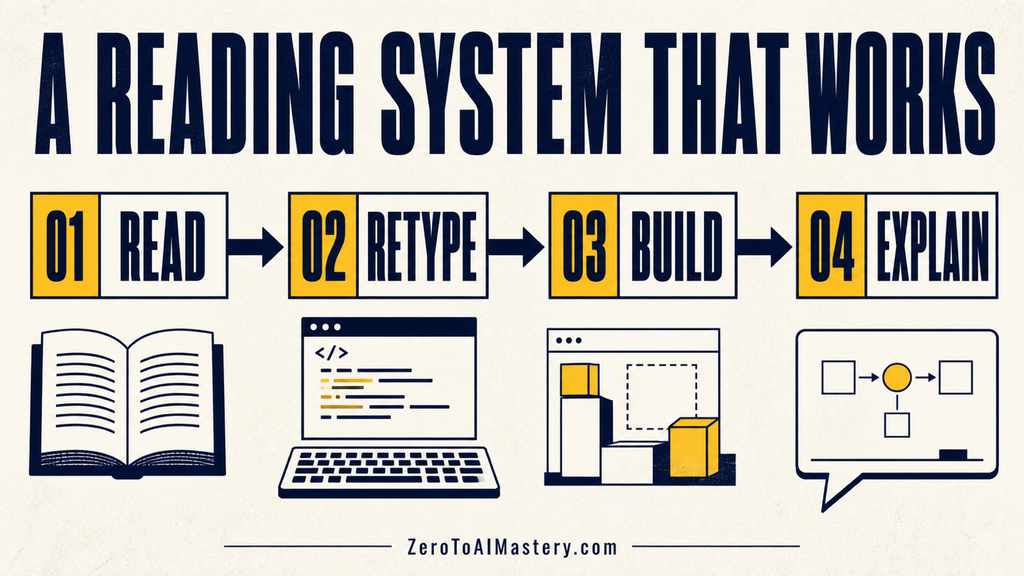
If you are reading a technical AI book, simply finishing the chapters is not enough. You can read fifty pages about embeddings, transformers, RAG, or evaluation and still forget most of it a week later if you never use what you learned. A much better way is to read slowly, practise the technical parts, and keep checking whether you can actually explain the idea without looking back at the book.
A simple way to study technical AI books is:
- Read the chapter once to understand the main idea
- Do not stop for every unfamiliar term on the first read
- Go through the chapter again and pay more attention to the difficult parts
- Run or retype the code instead of only looking at it
- Write short notes in your own words
- Build a small project after every few chapters
- If you learn embeddings, try creating a small semantic search project
- If you learn RAG, build a basic RAG system with your own documents
- If you learn evaluation, compare a few prompts or models yourself
- If you learn AI agents, build a small agent with one or two tools
- Explain one concept to someone else or write about it in your own words
- Go back to the chapter when you find something you still cannot explain clearly
The main idea is to turn reading into practice. You do not need to build a huge project after every chapter. Even a small experiment can help you understand the concept much better. If you can read about something, try it yourself, and then explain why it works, you are much more likely to remember it than if you only highlight a few lines and move on to the next chapter.
Which AI Book Should You Start With?
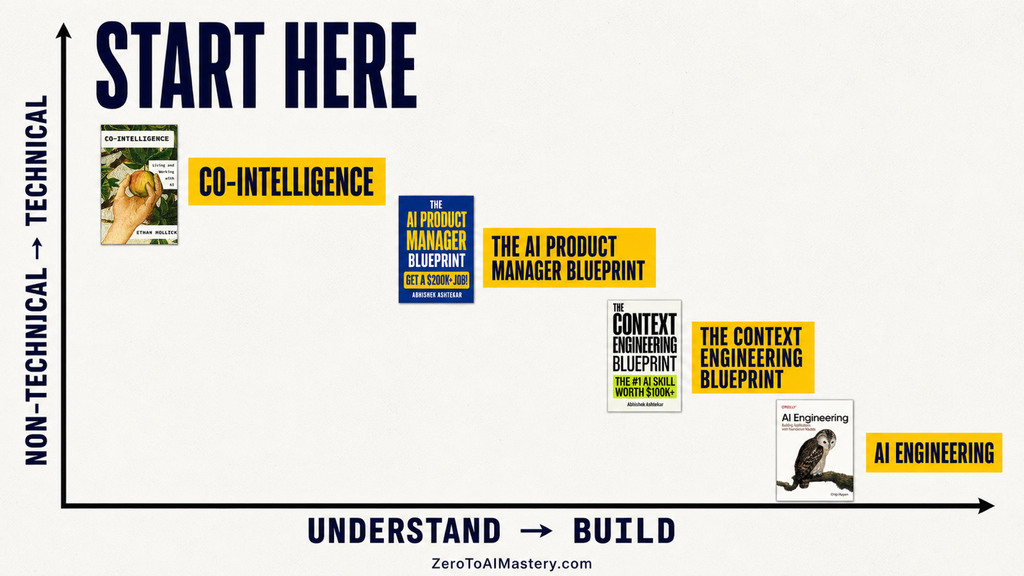
The best AI book to start with depends on what you actually want to learn. You do not need the same book for every goal, and trying to start with something too advanced usually makes learning harder than it needs to be.
You can use this simple guide:
- If you are completely new to AI and just want to understand how to use it better, start with Co-Intelligence
- If you want to become an AI product manager, start with The AI Product Manager Blueprint
- If you are already a product manager and want to move into AI products, The AI Product Playbook is a better fit
- If you want to learn context engineering, RAG, memory systems, and AI agents, start with The Context Engineering Blueprint
- If you already know programming and want to build better AI applications, read AI Engineering
- If you want to understand LLMs visually, choose Hands-On Large Language Models
- If you want to understand how LLMs work by building one yourself, read Build a Large Language Model (From Scratch)
- If you want to learn machine learning properly through coding, start with Hands-On Machine Learning
- If you want to understand how machine learning systems work in production, read Designing Machine Learning Systems
- If you want to understand whether AI claims are real or mostly hype, read AI Snake Oil
- If you want to understand the AI industry, companies, and people behind it, read Empire of AI
- If you are more interested in AI hardware and NVIDIA, choose The Thinking Machine
- If you want to understand how AI may change work and business, read Reshuffle
- If you want to understand AI, information, society, and power, choose Nexus
If you are still unsure, I would keep it simple. Start with the book that matches the thing you want to be able to do next. If you want to build AI apps, choose a technical book. If you want an AI job, choose a career-focused book. If you just want to understand AI better, start with a non-technical book and move deeper later.
Free and Low-Cost Ways to Read More Before You Buy
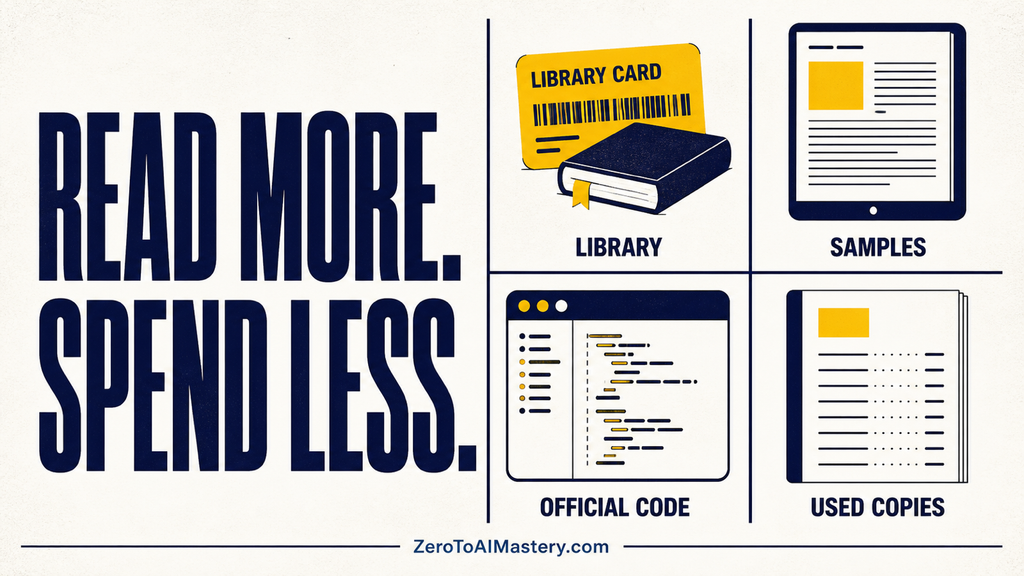
Before buying an AI or technical book, it is worth checking whether you can read a sample first. A few pages are usually enough to tell whether the writing style suits you and whether the book is too easy, too technical, or exactly what you need. Many authors also share code, GitHub repositories, chapter samples, or extra learning material online, which can help you understand what the book is like before spending money on it.
A few ways to save money are:
- Read the official sample before buying
- Check the table of contents to see whether the topics match what you want to learn
- Look for the author’s GitHub repository or companion code
- Check whether the publisher provides free chapters or sample material
- Borrow the book from a local or university library
- Check whether your library gives access to technical ebook platforms
- Buy a used copy if you do not need the newest physical edition
- Borrow expensive reference books if you only need a few chapters
- Compare ebook, paperback, and hardcover prices before buying
- Use free official learning material first and buy the full book only if you want to go deeper
You do not need to own every book on this list. If you only need a book for a few chapters, borrowing it may make more sense. If you are going to study it properly, write notes, and keep coming back to it, then buying your own copy can be worth it. I would also avoid unofficial or pirated PDFs, because apart from the legal issue, they can be outdated, incomplete, or unsafe files. Official samples, libraries, used books, and author resources are usually enough to help you decide whether a book is worth buying.
What the Next Wave of AI Books Will Focus On
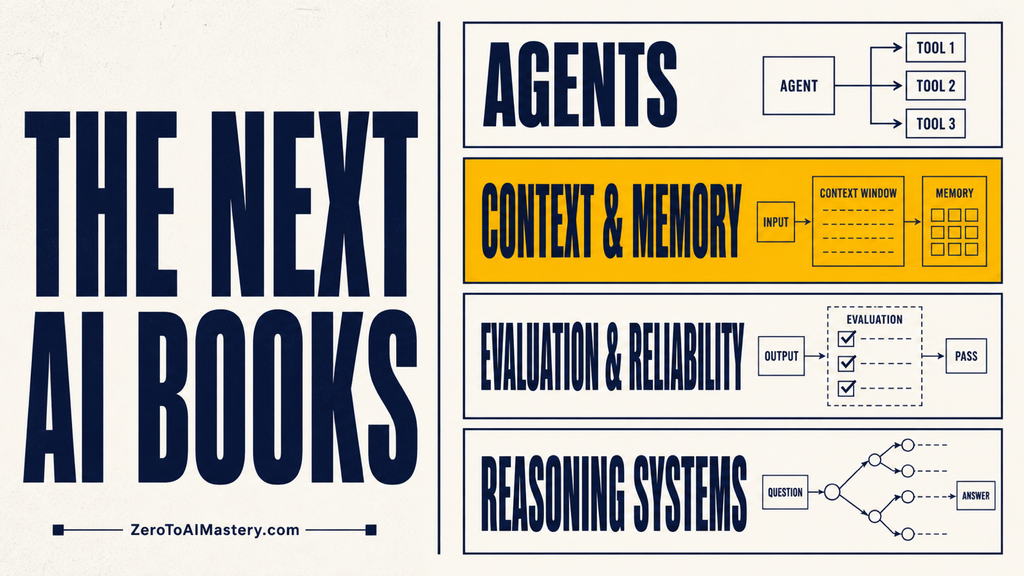
AI books are already starting to move beyond basic prompt engineering. That makes sense because using AI today is no longer only about writing a good prompt and getting a response. More people are now building systems that use tools, retrieve information, remember context, complete longer tasks, and work through multiple steps. So the next generation of useful AI books will probably focus much more on how these systems actually work in real situations.
Some of the topics I expect to see more books about are:
- Context engineering
- AI agents
- RAG and retrieval systems
- Memory systems
- Evaluation and testing
- AI observability
- Agent orchestration
- Reasoning systems
- AI security
- Cost and latency optimization
- Failure recovery
- Multi-agent systems
- How to make AI applications more reliable in production
- How to build AI workflows that can handle longer and more complicated tasks
I also think we will see more books written for specific careers instead of general books that simply promise to “teach AI.” An AI product manager, marketer, analyst, designer, lawyer, teacher, and engineer all use AI differently, so one general book cannot teach all of them equally well. More useful books will probably focus on one role, one problem, or one technical area and teach it properly.
That is also why I would not recommend creating a huge list of AI books that you plan to read someday. The field is changing quickly, and better books will keep coming. Pick the book that helps you solve the problem you have right now, learn from it, use what you learn, and then choose the next one when you actually need it.
Conclusion
There is no single AI book that is best for everyone. The best AI books to read in 2026 depend on what you want to learn and where you are starting from. If you are a beginner, you need something simple. If you already know the basics and want to build AI systems, you need something more technical. If your goal is an AI career, then a book focused on that role will probably be more useful than a general AI book.
If you are completely new to AI, Co-Intelligence is a good place to start. If you want to become an AI product manager, go with The AI Product Manager Blueprint. For context engineering, RAG, memory systems, and AI agents, choose The Context Engineering Blueprint. If you already know programming and want to build real AI applications, AI Engineering is one of the best choices.
For understanding how LLMs work internally, read Build a Large Language Model (From Scratch). For machine learning, Hands-On Machine Learning is a great practical option, while Artificial Intelligence: A Modern Approach gives you a much broader foundation in AI. If you want to understand AI hype and which claims you should actually trust, read AI Snake Oil. And if you are more interested in the AI industry, companies, hardware, business, and the people building these systems, books like Empire of AI, The Thinking Machine, The Scaling Era, and Reshuffle are worth reading.
My suggestion is simple: do not try to read everything at once. Pick one book from the best AI books to read in 2026 that matches what you want to learn right now, finish it, use what you learn, and then decide what you need next. That will help you much more than collecting a long list of books and never properly reading any of them.
FAQs
1. What is the best AI book for beginners?
If you are completely new to AI, Co-Intelligence by Ethan Mollick is one of the best books to start with because it explains how to work with AI in simple language without requiring coding, mathematics, or a technical background. It is especially useful if you want to understand how AI can help with everyday work, learning, writing, research, and problem-solving before moving into more technical books.
2. What is the best book to become an AI product manager?
If you want to become an AI product manager, The AI Product Manager Blueprint is the book I would recommend starting with because it is focused specifically on the role. It explains what an AI product manager does, how AI products are different from normal software products, what technical concepts you need to understand, how to work with AI engineers and data teams, and how to think about evaluation, model quality, hallucinations, cost, latency, and other problems that come with building AI products.
3. What is the best book for learning context engineering and RAG?
If you want to learn context engineering and RAG, The Context Engineering Blueprint is the most focused choice on this list because it covers context windows, token management, embeddings, vector databases, semantic search, chunking, reranking, memory systems, AI agents, tool calling, MCP, evaluation, security, and cost control in one place. It is useful if you want to understand how to give AI models the right information instead of relying only on better prompts.
4. What is the best book for becoming an AI engineer?
If your goal is to become an AI engineer, AI Engineering by Chip Huyen is one of the best books to read once you already know programming and basic AI concepts. It teaches you how to build AI applications using foundation models and covers model selection, evaluation, retrieval, fine-tuning, data, latency, cost, feedback loops, and the problems that appear when an AI application moves from a demo to a real product.
5. What is the best book for understanding how LLMs actually work?
If you want to understand how LLMs work from the inside, Build a Large Language Model (From Scratch) by Sebastian Raschka is one of the best choices because you build the main parts of a GPT-style model yourself using Python and PyTorch. If you prefer visual explanations and want to understand transformers, embeddings, tokenization, and attention before going deeper into implementation, Hands-On Large Language Models is an easier place to start.
6. What is the best book for learning machine learning?
If you want to learn machine learning by actually writing code, Hands-On Machine Learning with Scikit-Learn, Keras, and TensorFlow by Aurélien Géron is one of the best books to start with. It teaches regression, classification, decision trees, ensemble methods, model evaluation, neural networks, deep learning, and other important machine learning concepts through practical examples, so it is useful if you want a proper foundation instead of learning only LLM APIs.
7. Do I need coding knowledge to read AI books?
No, you do not need coding knowledge for many of the books on this list. Books such as Co-Intelligence, AI Snake Oil, Empire of AI, The Thinking Machine, Nexus, Reshuffle, The Worlds I See, and The Alignment Problem can be read without programming experience, while books such as Build a Large Language Model (From Scratch), Hands-On Machine Learning, and Hands-On Large Language Models become much more useful if you already know Python.
8. Which AI book should I read first?
The first AI book you should read depends on what you want to learn. If you are a beginner, start with Co-Intelligence. If you want to become an AI product manager, choose The AI Product Manager Blueprint. If you want to learn context engineering and RAG, read The Context Engineering Blueprint. If you want to build AI applications, go with AI Engineering. If you want to learn machine learning, choose Hands-On Machine Learning. The easiest way to pick is to decide what you want to be able to do after finishing the book and choose the one that teaches exactly that.
Final Thoughts
You do not need to spend weeks comparing AI books and trying to find the perfect one. Pick one of the best AI books to read in 2026 that matches what you want to learn right now and start there. If you are a beginner, choose something simple. If you want to build AI systems, choose something technical. If you want an AI career, choose a book focused on that role.
Before buying, read the sample or check the table of contents. If the book feels too difficult, choose an easier one. If it feels too basic, move to something more advanced. The important thing is that the book should actually help you with what you are trying to learn.
And once you start reading, use what you learn. If the book teaches RAG, build a small RAG project. If it teaches machine learning, train a model. If it explains AI product management, try applying those ideas to a product case study. You will remember much more when you actually use the concepts instead of only reading about them.
So choose one book from this list of the best AI books to read in 2026, start reading it, and focus on learning something you can actually use.