A hospital wants an AI assistant that can find the right policy, draft a response, and leave a clear audit trail. The demo works in a quiet meeting room. Then the team connects it to the hospital’s real systems. Old databases return incomplete records. Two policies contradict each other. Access rules differ by department. Nurses abandon the tool if it adds thirty seconds to a busy shift. An executive has already promised a launch date.
Someone has to sit with the people doing the work, understand what can go wrong, write the software, test the risky cases, launch it, and stay close enough to learn why people use it or ignore it.
That person may be a forward deployed engineer.
Quick answer: If you’re working out how to become a forward deployed engineer, start with a dependable software foundation. Learn data and AI systems, practise turning unclear customer problems into technical plans, and prove you can deliver software in production. You also need sound judgment, calm communication, and evidence that the system improved the work it was built to support.
The role sits at an unusual intersection. You may write Python in the morning, map a customer process after lunch, trace a production failure in the evening, and explain the next tradeoff to a senior leader the following day. The title also varies. Companies advertise forward deployed engineers, forward deployed software engineers, forward deployed AI engineers, deployment strategists, applied AI engineers, implementation engineers, and customer engineers. The exact balance changes, but the core job stays familiar: solve a valuable customer problem with real software and own the path to adoption.
This forward deployed engineer roadmap follows the work from that first messy conversation to a stable production system. You will learn what FDEs do, which skills matter, how to build convincing projects, what interviews test, and how compensation differs across markets. Beginners can follow the full 12-month plan. Experienced engineers and customer-facing technical professionals can enter at the stage that matches the evidence they already have.
What Is a Forward Deployed Engineer?
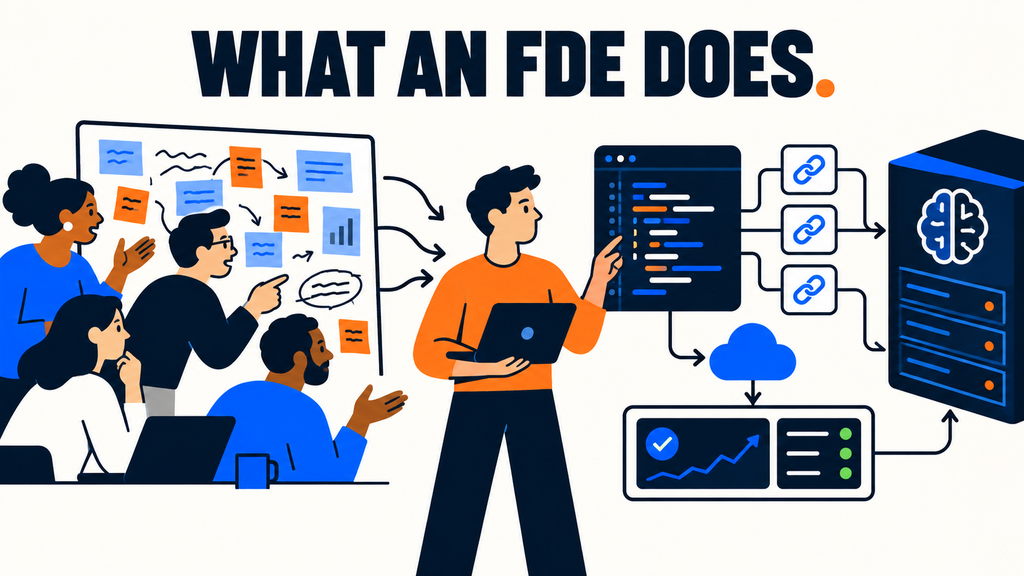
A forward deployed engineer, usually shortened to FDE, is a software engineer who works directly with customers to design, build, deploy, and improve technical solutions for important business problems. Unlike an engineer who works mainly on a general product, an FDE spends much of the job adapting technology to one customer’s data, systems, constraints, and working habits.
A useful way to picture the job comes from Palantir’s early-career material. Its product developers tend to build one capability for many customers. Its forward-deployed teams combine many capabilities to solve one customer’s problem. Real jobs do not divide this neatly, but the comparison explains why an FDE moves between product knowledge, customer data, and custom engineering.
An FDE does not merely install software. The engineer may need to write backend services, connect APIs, model data, configure cloud infrastructure, build an interface, create an evaluation set, set up monitoring, and train users. The engineer also has to decide which work matters. A customer may ask for a chatbot when the real bottleneck is a broken approval process. A capable FDE notices the difference.
According to OpenAI’s current FDE job description, the work begins with discovery and technical scoping, then continues through design, implementation, rollout, adoption, and measured workflow impact. Databricks uses similar language for its AI FDE team, which builds first-of-kind AI applications with customers and takes them into production. These are employer job pages, not neutral definitions, but both make one point clear: the engineer remains responsible after the demonstration ends.
The simplest definition
A forward deployed engineer turns an important but messy customer problem into working software that people use.
Each part of that definition matters:
- Important: The problem should affect revenue, cost, risk, speed, or another measurable business outcome.
- Messy: The requirements will not arrive as a perfect specification. Data can be incomplete. Teams can disagree. Existing systems can be old.
- Customer problem: The engineer works close to the people who own the process and feel the pain.
- Working software: Slides and prototypes help, but the job normally ends in production code, integrations, monitoring, and support.
- People use: A technically correct system has little value when the intended users ignore it or work around it.
What “forward deployed” means
The phrase comes from placing technical people close to the environment where the technology must work. That environment may be a bank, manufacturer, retailer, hospital, government agency, logistics company, or software business. Some FDEs spend time at a customer site. Others work remotely with customer teams and travel for discovery, launches, or difficult phases.
Deployment does not always mean installing software on a machine. It can mean embedding with a team, learning its operating reality, connecting the product to its systems, and staying responsible until the solution becomes useful. The engineer moves toward the problem instead of waiting for a clean request to reach a product backlog.
What an FDE is not
An FDE is not a salesperson who happens to know technical terms. Sales engineers usually help prospects understand a product before a purchase. FDEs usually spend more time after a serious commitment, when the problem must become a production system.
An FDE is also not a consultant who only recommends a plan. Good FDEs analyse processes and advise leaders, but they also build. Their credibility comes from software that works under real constraints.
The role is not an excuse to write careless custom code. Strong forward-deployed teams look for reusable patterns, protect product quality, document decisions, and avoid creating a separate unmaintainable product for every customer.
Common FDE titles
Search for more than one title when you explore the market. Relevant listings may include:
- Forward Deployed Engineer
- Forward Deployed Software Engineer
- Forward Deployed AI Engineer
- Applied AI Engineer
- Customer Engineer
- Solutions Engineer, post-sales
- AI Implementation Engineer
- Deployment Engineer
- Field Engineer
- Resident Engineer
- Technical Implementation Consultant
Read the responsibilities, not only the title. A “solutions engineer” at one company may build production systems, while the same title elsewhere may focus on demonstrations and pre-sales work.
What Does an FDE Do From Discovery to Production?
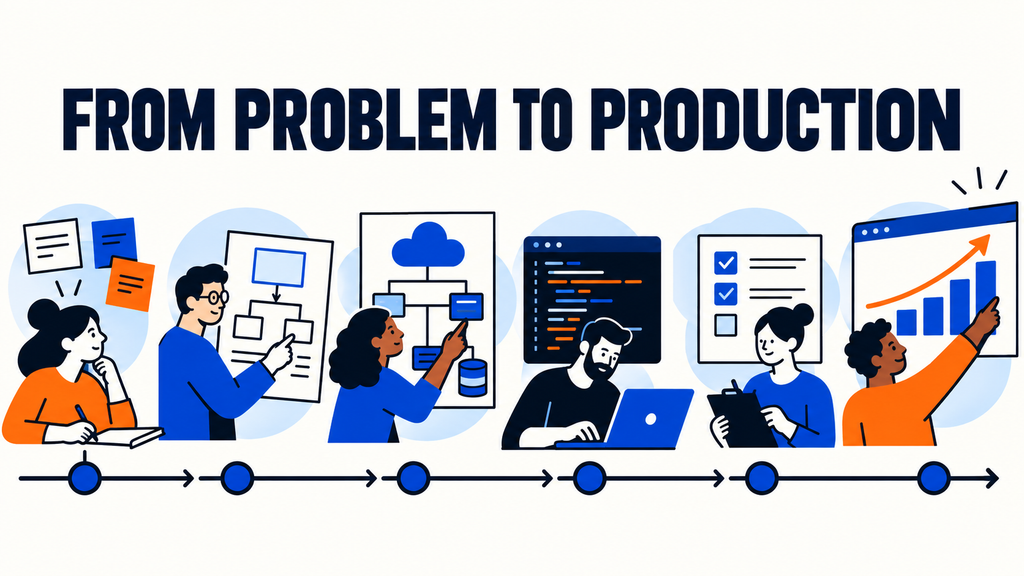
Follow the hospital assistant from the opening example and the job becomes much easier to understand. The engineer cannot start with a model and hope the workflow will fit around it. The work moves through discovery, scoping, design, building, evaluation, launch, adoption, and handoff. Teams may rename or combine those stages, but they still have to answer the same practical questions.
1. Discover the real workflow
A customer rarely begins with a precise engineering problem. The first request may be “build an AI assistant for operations” or “make our teams use the data platform.” Start by watching the current work. In the hospital example, that means sitting with the people who search for policies, asking which questions slow them down, and seeing what happens when they cannot find a trustworthy answer. The FDE has to learn where the delays occur, which decisions carry risk, and who owns the outcome.
Discovery involves interviews, observation, data inspection, and uncomfortable follow-up questions. Which step takes the longest? What happens when the system is wrong? Who can approve a change? Which source is authoritative? How will the customer know that the project worked?
A useful discovery output does not need fifty pages. It needs a process map that the users recognise, a clear description of the target workflow, named constraints, and a small set of success measures. If a nurse or operations manager reads it and says, “That is not how the work happens,” the engineer has learned something before writing expensive code.
2. Reduce the problem to a useful first release
Enterprise problems grow quickly. One workflow touches another. Every team wants an exception. The FDE has to define a first release that is small enough to ship and valuable enough to matter.
Suppose a support organisation wants an AI agent for every customer interaction. A sensible first release may only draft answers for one product line, using approved documents, with citations and human review. That scope creates a testable system. It also exposes the hard questions about retrieval quality, permissions, latency, review, and feedback.
Scoping is an engineering skill because every requirement has technical consequences. Real-time data changes architecture. Personal data changes access controls. Automated action changes the risk model. A two-second latency target changes model and infrastructure choices.
3. Design the system
The design stage turns the workflow into components and contracts. An FDE may define data sources, API boundaries, authentication, storage, model providers, prompts, tools, queues, user interfaces, logs, evaluation jobs, and failure paths.
For an AI application, the design must answer questions that a demo can ignore. What evidence reaches the model? Which user can see which document? How does the system respond when retrieval returns nothing? Which actions need approval? How will the team reproduce a bad answer? What happens when the model provider is unavailable?
Good designs make tradeoffs visible. A diagram should show where sensitive data moves and which component owns each decision. An architecture review should end with named risks and tests, not a decorative box chart.
4. Build the thin vertical slice
A thin vertical slice connects the complete path for one narrow case. It may include a basic interface, one data source, one model call, one action, and one log. The slice gives users something real to react to and reveals integration problems early.
This stage demands normal software engineering. The FDE writes maintainable code, reviews changes, adds tests, uses version control, handles configuration, and documents local setup. Speed matters, but “fast” does not mean “temporary forever.” The first working path often becomes the foundation of the production system.
5. Evaluate the risky behaviour
AI systems need more than unit tests. The FDE collects representative cases, expected outcomes, difficult examples, and known failure modes. The team may score factual support, task completion, policy compliance, tool choice, latency, and cost.
Evaluation is not a final exam. It guides development. When the system fails, the engineer needs to know whether the cause lies in data, retrieval, instructions, tool design, model choice, or the workflow itself. That is why a small, labelled evaluation set is more useful than an impressive demo with no repeatable test.
If this work is new to you, the site’s guide to context engineering explains how instructions, retrieved information, tools, memory, and output constraints shape an AI system. For production work, those elements need ownership and tests.
6. Launch with controls
Most valuable systems should not move from demo to full automation in one step. A controlled launch may begin with a few users, one location, a limited data set, read-only access, or human approval for every action.
The FDE defines who can use the system, what the system can do, how users report a problem, and how the team can disable a risky function. The launch plan also needs monitoring for reliability, quality, security, latency, and cost.
7. Measure adoption and impact
Deployment is not the finish line. People may avoid the system because it adds a step, takes too long, produces an answer they cannot verify, or threatens a familiar responsibility. Usage data and interviews reveal these problems.
Measure the workflow, not vanity. A high message count does not prove value. Useful measures might include time to resolve a case, percentage of drafts accepted with minor edits, number of manual lookups removed, incidents caught earlier, or hours returned to a team. The customer should agree on the measure before the launch.
8. Stabilise and hand off
The FDE fixes the problems that appear under real use, improves runbooks, documents decisions, and teaches the customer or internal platform team to operate the system. A healthy handoff includes ownership, alerts, dashboards, deployment instructions, known limitations, and a process for future changes.
Some engagements continue for months because the problem keeps expanding. Others move to a product or support team. Either way, the engineer should reduce dependence on individual memory. A project that only works when one FDE is awake is not mature.
FDE vs Software Engineer, Solutions Engineer, and AI Engineer
The FDE title overlaps with several established roles. The practical difference usually comes from where the engineer spends time, how much custom building the role includes, and who owns the final outcome.
FDE vs product software engineer
A product software engineer usually builds capabilities intended for many users or customers. The team controls the product roadmap, codebase, release process, and technical standards. Customer needs reach the team through research, support, sales, or product management.
An FDE usually works closer to one customer or one high-value workflow. The work contains more ambiguity, integration, and local constraint. The engineer may use the central product as a platform, then write the missing pieces that make it work in a specific environment.
Both roles need strong coding and design. Product engineering usually rewards depth in a stable codebase and leverage across many users. Forward-deployed work rewards speed of understanding, breadth, and ownership under changing conditions.
FDE vs solutions engineer
Solutions engineers often help customers evaluate a product. They run discovery, build demonstrations, answer technical objections, and shape a proposed architecture. Many roles sit before the sale, although the boundary varies by company.
FDEs usually own more of the post-sale build and production outcome. They may spend weeks or months writing code, integrating systems, and resolving operational failures. Some companies use “solutions engineer” for exactly this work, so the job description remains more reliable than the title.
If you enjoy customer conversations but do not want sustained production coding, pre-sales solutions engineering may fit better. If you want to keep building after the contract is signed, FDE work may be the stronger match.
FDE vs AI engineer
An AI engineer builds applications that use models, retrieval, data pipelines, tools, and evaluations. The engineer may work on a product team, platform team, research engineering group, or customer project.
An AI FDE applies those skills close to a customer. The model is only one part of the job. The engineer must also understand the customer’s workflow, permissions, existing software, approval rules, and adoption barriers.
The site’s AI engineer roadmap covers the broader technical foundation. Add discovery, delivery, and stakeholder skills when your goal is an AI-focused FDE position.
FDE vs technical consultant
Technical consultants analyse a problem, recommend a solution, configure systems, and sometimes build custom software. FDE work shares that client-facing discipline but usually places a stronger expectation on hands-on product engineering and production ownership.
The healthiest FDE teams combine both mindsets. They diagnose before they build, but they do not stop at advice. They write software, measure behaviour, and stay accountable for results.
A quick role test
FDE work may suit you when most of these statements feel true:
- You like coding, but you also want to understand why the code matters.
- You can ask direct questions without making a customer feel judged.
- You enjoy a changing problem more than a fixed backlog.
- You can explain a technical tradeoff to a non-engineer.
- You take production failures personally enough to investigate them, but not so personally that you panic.
- You can travel or adjust your schedule when the role requires it.
- You are willing to say that a requested feature will not solve the actual problem.
- You can document work so another person can operate it.
The role may frustrate you if you need long uninterrupted coding periods every day, dislike customer pressure, want a narrow technical domain, or prefer requirements to be settled before work begins. Those preferences may point you toward a product engineering or research role instead.
Why Companies Are Hiring FDEs in 2026, and What the Job Really Costs

Powerful AI models and data platforms have made prototypes easier to build. The difficult part begins when a company tries to use one in daily work. Private data needs protection. Old software needs an integration. Model output needs tests. Users need a reason to change their habits. Someone has to operate the system when it fails at 9:00 on a Monday morning. That stretch between a convincing prototype and dependable daily use is where FDEs earn their place.
The title is no longer tied to one company. Palantir still hires forward-deployed engineers across software, AI, infrastructure, reliability, and security. OpenAI uses the role for enterprise AI deployments. Databricks hires experienced AI FDEs to build first-of-kind applications with customers. The job pages differ in seniority and technical focus, but they all place engineers close to a customer and give them responsibility for production delivery.
Two independent datasets help put a number on that spread, although neither should be mistaken for an official labour statistic. The State of FDE Jobs 2026 report scanned 239,428 live postings and classified 5,426 as strict or adjacent FDE roles across 1,311 employers. Only 923 used a direct FDE title signal. The rest used titles such as solutions architect, implementation engineer, or deployment strategist.
SkillenAI’s role tracker takes a narrower approach. As of October 2, 2026, it had indexed 973 postings with the canonical title “Forward Deployed Engineer” during the previous 90 days. Python appeared in 62.1 percent of those postings, followed by TypeScript, JavaScript, APIs, and AWS. Because the two sources classify jobs differently, you should not add their counts together. Use them as evidence that the work is active and that a title-only search will miss relevant jobs.
These counts describe the postings each site found. They do not tell you how many people were hired or guarantee that demand will continue at the same pace. They do tell you to search by responsibilities as well as title.
Why the role is valuable
FDEs close the gap between what a technology can do and what an organisation can safely use. They create value in several ways:
- They shorten the time between a customer problem and a working release.
- They expose product gaps through direct use in demanding environments.
- They combine business discovery with technical delivery, which reduces handoff loss.
- They build trust by staying accountable through launch and adoption.
- They turn one-off lessons into reusable components, playbooks, and product improvements.
The work is especially useful when a product is flexible, the customer’s environment is complex, and the first successful use cases require invention. Mature, standardised software may need implementation specialists. New AI platforms often need engineers who can discover and build at the same time.
The tradeoffs that job descriptions soften
FDE roles can involve travel. According to the OpenAI position cited above, travel can reach 50 percent. Databricks asks its AI FDEs to visit customers as needed, roughly once every four to eight weeks. Those two policies describe different working lives. Ask the manager how many nights the team spent away from home during the previous quarter, not what the travel policy allows in theory.
The work can also be reactive. A production incident, data access problem, or executive demonstration may change the week’s plan. Customers can bring urgent expectations that conflict with sound engineering. Strong managers protect the team from chaos, but some ambiguity is part of the role.
Custom work creates maintenance pressure. If every deployment becomes a private branch with undocumented behaviour, engineers spend their time keeping fragile systems alive. Ask how the company decides what belongs in the core product, what remains customer-specific, and who owns it after handoff.
Success may depend on adoption factors outside your control. A technically good system can stall because users were not involved, a leader changed, a policy blocks access, or the customer will not change the process. FDEs need enough commercial and organisational awareness to notice these risks early.
Questions to ask before accepting an FDE role
- What percentage of time do engineers write production code?
- Is the role mainly pre-sales, implementation, or post-launch ownership?
- How much travel did this team average in the last three months?
- Who owns customer-specific code after the engagement?
- How are scope changes approved?
- What does a successful six-month deployment look like?
- Which metrics define adoption and business impact?
- How often do engineers handle incidents outside normal hours?
- Can FDEs contribute reusable work to the main product?
- What support exists when a customer relationship becomes difficult?
The answers tell you more than the title. Two FDE jobs can have the same salary and completely different working lives.
Can You Become a Forward Deployed Engineer Without a Degree?

Yes, you can become a forward deployed engineer without a degree, but you still need evidence that you can build reliable software and work through complicated problems. A degree can help you pass an early screen and build fundamentals. It does not replace production ability, customer judgment, or a strong portfolio.
Compare three current job pages and the entry range becomes clear. Palantir recruits interns and new graduates for forward-deployed software engineering. OpenAI’s San Francisco FDE role asks for at least five years of engineering or technical deployment experience. Databricks reserves its current AI FDE opening for experienced engineers and rules out internship and entry-level applicants. The title stays the same while the expected seniority changes, so read the requirements before deciding that you are either qualified or unqualified.
Path 1: Computer science or engineering degree
This path gives you structured exposure to programming, algorithms, databases, operating systems, networks, and team projects. Use internships, capstone work, open-source contributions, and customer-facing student projects to avoid graduating with theory alone.
Do not wait until the final semester to deploy something. A small service with authentication, a database, logs, tests, and real users teaches more about delivery than another isolated notebook.
Path 2: Self-taught developer or bootcamp graduate
The self-taught path needs stronger public proof because a recruiter has fewer familiar signals. Build two or three complete systems, write clear case studies, and show the decisions behind the code. A polished repository with setup instructions, tests, architecture, evaluation data, and a short demonstration can compensate for missing credentials.
Start with software fundamentals before advanced agent frameworks. Learn one language well, build APIs, use a relational database, understand HTTP, write tests, use Git, deploy to a cloud service, and diagnose logs. Then add AI components where they solve a real problem.
The guide on learning AI from scratch can help you organise the early machine learning and generative AI concepts. Keep your FDE goal grounded in software delivery.
Path 3: Experienced software, data, or ML engineer
This is the shortest technical transition. You already know how to build and operate systems. Your main gaps may be discovery, customer communication, rapid prototyping outside a familiar stack, and turning business language into acceptance criteria.
Volunteer for integration-heavy projects, customer calls, incident reviews, and internal enablement. Write decision notes. Present architecture in plain language. These activities create evidence that you can operate beyond an assigned ticket.
Path 4: Solutions engineer or technical consultant
You may already excel at discovery, presentation, and stakeholder management. The main risk is shallow production coding. Demonstrations and configuration do not prove that you can own an application after launch.
Build a serious backend, add tests and monitoring, deploy it, break it, and repair it. Learn to review code and reason about failure. Your customer experience becomes a strong advantage once the engineering proof is credible.
Path 5: Domain specialist who codes
A clinician, financial analyst, supply-chain planner, security analyst, or industrial engineer may understand a valuable workflow better than a generalist. That knowledge can open a path into a domain-focused FDE team.
The specialist still needs engineering depth. Use domain knowledge to choose better projects and edge cases, not to avoid learning software. The strongest profile combines uncommon workflow understanding with dependable technical delivery.
What replaces a degree
No single certificate replaces a degree. A body of evidence can.
- Two to four deployed projects with public case studies
- Clean code, tests, documentation, and reproducible setup
- Architecture decisions with clear tradeoffs
- An evaluation set and failure analysis for AI behaviour
- Logs, dashboards, and incident notes
- Evidence of working with users or stakeholders
- A concise explanation of the business result
- References from collaborators, clients, or open-source maintainers
Do not present yourself as “passionate about AI.” Show what you built, how it failed, what you changed, and what improved.
Which Skills Does a Forward Deployed Engineer Need?
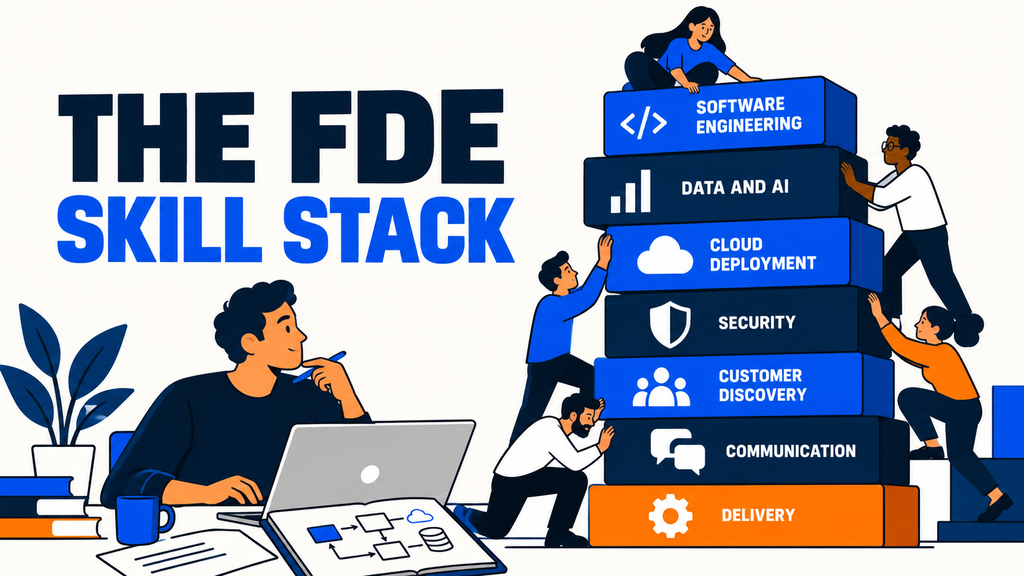
FDEs need breadth, but they do not need to become experts in every tool. Build one dependable core and enough surrounding knowledge to make good decisions, ask for help, and move a project forward.
1. Programming and software design
Learn Python well. It appears frequently in AI, data, automation, and backend work. You should be able to structure a project, model data, handle errors, write asynchronous code when needed, test behaviour, profile a slow path, and read an unfamiliar codebase.
Add TypeScript or JavaScript if you want to build web interfaces and full-stack applications. You do not need equal mastery in both languages. A strong combination is Python for services and AI workflows, plus TypeScript for user-facing tools.
Know how to use Git, review changes, manage configuration, write migrations, package code, and work with continuous integration. These ordinary skills separate a production engineer from a demo builder.
2. APIs and integrations
Enterprise work is integration work. Learn HTTP, REST, webhooks, authentication, OAuth, rate limits, retries, idempotency, pagination, and API versioning. Practise with imperfect APIs that time out, return partial data, and enforce quotas.
Understand message queues and background jobs. A long AI task should not block a web request. A failed integration should retry safely without creating duplicate records. An action that changes money, permissions, or a customer record needs a clear audit trail.
3. Databases and data modelling
Learn SQL and a relational database such as PostgreSQL. You should be comfortable designing tables, writing joins, creating indexes, explaining transactions, and tracing a slow query. Learn when a document store, cache, warehouse, vector index, or object store makes sense.
Data quality matters more than fashionable storage. Know how to validate a schema, track lineage, handle missing values, protect personally identifiable information, and define which source is authoritative.
4. Cloud and deployment
Choose one cloud platform and learn its basic building blocks: compute, storage, networking, identity, secrets, logs, managed databases, and monitoring. AWS appears frequently in current FDE listings, but Azure and Google Cloud remain common in enterprise environments.
Learn Docker. Understand how an application moves from local development to a container, registry, runtime, and deployment pipeline. Learn Kubernetes concepts after you can operate a smaller deployment. Do not use a cluster merely to make a portfolio look advanced.
5. AI application engineering
For AI-focused roles, understand model APIs, token limits, structured output, tool use, retrieval, embeddings, reranking, prompt design, context construction, caching, latency, and cost. Learn when a normal deterministic function is safer than a model call.
Build evaluations before you add more framework code. Test representative inputs, expected facts, refusal behaviour, tool selection, and policy constraints. Store traces so you can reproduce a failure. The site’s explanation of harness engineering covers the surrounding controls that help agents behave reliably.
6. Security and privacy
Learn least-privilege access, secret management, encryption basics, threat modelling, input validation, dependency risk, logging rules, and data retention. For AI applications, include prompt injection, data leakage, unsafe tool use, and cross-user access in the threat model.
You do not need to become a security engineer. You need to recognise when a shortcut creates serious risk and involve the right specialist before the launch.
7. Observability and reliability
A system should tell you when it is unhealthy. Learn structured logs, metrics, traces, alerts, dashboards, error budgets, and runbooks. Measure application failures and AI quality failures separately.
Practise incident response. State the impact, reduce harm, gather evidence, fix the immediate issue, and write what should change. Avoid blaming a user for discovering a case the team failed to test.
8. Discovery and problem framing
Ask questions that expose the workflow. Who performs the task? What starts it? Which information is required? Where does the process wait? What is the cost of a wrong result? Which exceptions happen every week? Who owns the final decision?
Turn answers into a process map, user stories, constraints, and acceptance criteria. Confirm them in writing. A ten-line decision note can prevent weeks of building the wrong system.
9. Communication
Explain technical choices in terms of consequences. A customer rarely needs a lecture about vector databases. The customer needs to know why the current design may miss policy updates and what the team will do about it.
Write short updates that cover progress, evidence, risk, decision, and next step. In meetings, distinguish a confirmed fact from a hypothesis. Say “I do not know yet” when that is the truth, then explain how you will find out.
10. Delivery and adoption
Break a broad project into milestones that produce evidence. Keep a risk list. Demonstrate working software early. Decide who approves changes. Define the launch group, training, support path, and adoption measure.
The FDE does not have to act as the formal project manager. The engineer does need to understand dependencies and make blocked work visible before it becomes a surprise.
How deep should you go?
Aim for deep ability in one core area, working proficiency across the delivery stack, and enough domain awareness to ask good questions. A backend engineer may go deep in distributed services. An AI FDE may go deep in evaluation and retrieval. A data-focused FDE may specialise in pipelines and modelling.
Breadth without a strong core creates shallow solutions. Depth without breadth makes it hard to move a customer project through its full lifecycle. The job rewards a T-shaped profile because both problems appear in the same week.
How Do You Become an FDE in 12 Months?
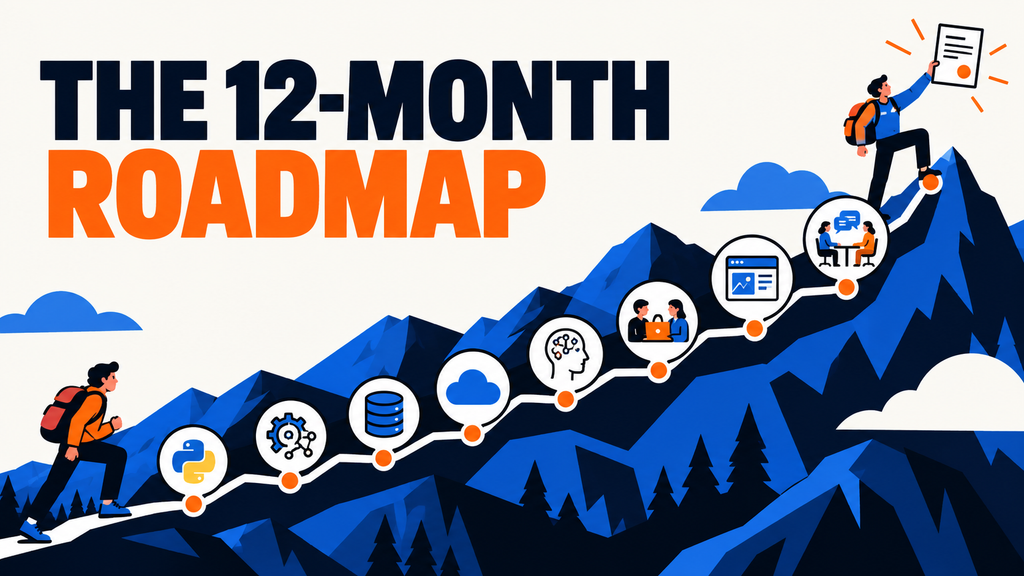
This plan assumes that you can study for roughly ten focused hours each week. It is a planning framework, not a promise about how long a career change takes. An experienced backend or data engineer can test out of the early stages. A complete beginner may need more than twelve months. Move forward when you can complete the checkpoint, not because a calendar page changed.
Month 1: Learn one programming language properly
Choose Python and stay with it. Learn variables, functions, collections, classes, exceptions, files, modules, virtual environments, type hints, and testing. Write small command-line programs that accept input, validate it, store a result, and report an error clearly.
Do not spend the month watching syntax videos. Build a case-intake tool. A user should be able to submit a request, choose a priority, attach a note, and list open cases. Store the data in a local SQLite database. Add tests for missing fields, invalid priorities, and duplicate identifiers.
Checkpoint: You can start a Python project from an empty folder, organise it into modules, write tests, debug a failure, and explain the code without reading a script.
Month 2: Build APIs and use a real database
Learn HTTP methods, status codes, JSON, headers, authentication, and REST conventions. Build an API with FastAPI or a similar framework. Replace SQLite with PostgreSQL. Add migrations, indexes, and an audit log.
Extend the case-intake tool into a service. Add endpoints to create, update, assign, and search cases. Protect write actions with a simple role model. Return useful errors. Document the API and call it from a small client.
Practise using an external API as well. Handle pagination, timeouts, retries, and rate limits. Record enough information to tell whether a failure came from your code or the provider.
Checkpoint: Another developer can clone the repository, run one setup command, read the API documentation, and complete the main workflow.
Month 3: Add a useful interface and deployment pipeline
Build a plain web interface with React and TypeScript, or use a lighter interface if frontend work is not your focus. Users should be able to see cases, filter them, open details, make an allowed change, and understand when an action fails.
Containerise the application. Deploy it to a cloud service. Put secrets outside the code. Add a continuous integration workflow that runs tests on every change. Record structured logs and create a basic uptime check.
Do not chase visual polish. Make the interface clear, accessible, and fast enough. FDE work often starts with internal tools where workflow quality matters more than animation.
Checkpoint: A reviewer can open a live URL, sign in to a test account, use the main flow, and see the deployment history.
Month 4: Learn data movement and integration
Add two realistic integrations. One can be a ticketing, messaging, CRM, or document API. The other should use a webhook or background job. Store external identifiers and design for retries without duplicate actions.
Create a small data pipeline that imports records, validates a schema, quarantines bad rows, and reports what changed. Add a reconciliation job that finds missing or conflicting records. Write down which system is authoritative for each field.
This month teaches a central FDE lesson: most failures occur at boundaries. An API changes, a field is empty, a user loses access, a webhook arrives twice, or a background task stops. Make those conditions visible.
Checkpoint: You can draw the data flow, explain the failure paths, replay a failed job safely, and prove that the integration does not create duplicates.
Month 5: Build your first AI workflow
Add an AI feature that improves a real step rather than decorating the interface. For the case tool, the model might classify a request, extract structured fields, propose a routing decision, or draft a response from approved material.
Use structured output and validate it. Keep the original input, model version, relevant context, output, latency, and cost in a trace. Add a fallback when the model is unavailable or returns invalid data.
Collect at least fifty representative examples. Label the expected category, facts, or action. Split the examples into development and test sets. Compare a simple deterministic baseline with the model workflow. The model should earn its place.
Checkpoint: You can show a repeatable evaluation, name the common failure types, and explain why the chosen design performs better than the baseline.
Month 6: Learn retrieval, context, and permissions
Build a document-grounded assistant for one narrow knowledge base. Parse documents, preserve source metadata, split content sensibly, retrieve candidates, rerank when useful, and cite the supporting passage.
Add document-level permissions. A user should never receive content from a source that the user cannot open. Test prompt injection inside a document, stale policy versions, contradictory sources, and questions with no supported answer.
Measure retrieval and answer quality separately. If the correct passage never reaches the model, rewriting the prompt will not solve the problem. If retrieval is good but the answer ignores evidence, then the generation layer needs work.
Checkpoint: Your system returns citations, respects access rules, declines unsupported questions, and produces an evaluation report that separates retrieval from response quality.
Month 7: Add tool use and controlled action
Let the AI workflow call a small set of tools. It might look up a customer record, calculate an eligibility rule, create a draft ticket, or schedule a review. Give each tool a narrow contract and validate every argument.
Keep high-impact actions behind human approval. Add idempotency keys, spending or volume limits, timeouts, and a record of who approved what. Show the proposed action and its evidence before execution.
Test adversarial requests and indirect instructions found in retrieved content. A document should not be able to convince the agent to reveal a secret or call an unrelated tool. Limit permissions at the tool layer instead of relying on a prompt to behave.
Checkpoint: You can replay every action, stop the workflow safely, and demonstrate that an untrusted input cannot bypass the permission boundary.
Month 8: Operate the system like production software
Add dashboards for request volume, error rate, latency, model cost, evaluation score, user approval rate, and external API failures. Set alerts for conditions that need action. Write a runbook for the three most likely incidents.
Run a failure exercise. Disable an integration, return malformed model output, expire a credential, fill a queue, or slow the database. Observe what users see and what the on-call engineer receives. Improve the system until the failure is controlled and understandable.
Write a short incident report after the exercise. Include impact, timeline, cause, contributing factors, recovery, and prevention. Keep the tone factual. The goal is learning, not blame.
Checkpoint: A second person can use your dashboard and runbook to identify a failure and restore the main workflow.
Month 9: Practise customer discovery and scoping
Find a real user. The user can be a small business owner, operations manager, nonprofit volunteer, university group, or professional in your network. Ask about a repeated workflow that wastes time or creates mistakes.
Conduct two discovery conversations before proposing technology. Map the current process, people, systems, delays, exceptions, and consequences. Write a one-page scope with the first release, excluded work, assumptions, risks, and success measure.
Present the plan in plain language. Ask the user to correct it. If the user wants ten features, explain which single path will create the earliest useful evidence.
Checkpoint: The user agrees that your written scope reflects the real problem and accepts a measurable first release.
Month 10: Deliver a customer-shaped project
Build the agreed release with weekly demonstrations. Keep a decision log. When the scope changes, record what changed, why, and what moves out. Test with the user’s real examples, but protect private information and obtain permission before storing anything.
Launch to a small group. Observe use. Compare the agreed measure before and after. The result may be modest or negative. Report it honestly. A project that disproves an assumption can still demonstrate mature engineering.
Ask the user for a short statement about the problem, collaboration, and result. Do not ask for praise. A specific reference carries more weight than a generic testimonial.
Checkpoint: You have one project with a real user, production deployment, measured result, and documented lessons.
Month 11: Turn your work into an FDE portfolio
Choose the strongest three projects. Each case study should answer six questions:
- What workflow was broken or expensive?
- Who used the system and under which constraints?
- What did you build, and why did you choose that design?
- How did you evaluate quality and manage risk?
- What happened after launch?
- What would you change with another month?
Include an architecture diagram, short demonstration, repository, evaluation summary, deployment notes, and known limitations. Remove secrets and private customer data. Make setup possible without access to your personal cloud account.
Write for a busy engineering manager. Put the problem and result near the top. Keep framework names in the architecture section. The project should look like a delivery story, not a pile of screenshots.
Checkpoint: A reviewer can understand the problem, inspect the proof, run the main path, and find your contact information in under ten minutes.
Month 12: Prepare for interviews and apply deliberately
Practise coding, system design, debugging, and customer discovery. Prepare five stories about ambiguity, disagreement, failure, speed, and measurable impact. Each story should explain the situation, your decision, the evidence, and the result.
Build a list of forty target companies, including direct FDE employers and companies using adjacent titles. Match your resume to the actual responsibilities. Ask engineers for context, not for an immediate referral. Show a relevant project when you reach out.
Apply in focused batches. Track role, date, contact, stage, feedback, and next action. If ten applications produce no screens, fix the positioning. If screens do not reach technical rounds, improve the resume story. If technical rounds fail at the same stage, practise that skill with evidence.
Checkpoint: You can complete a timed coding task, design a deployment, run a discovery conversation, explain one project deeply, and state why the specific company’s FDE model fits you.
A faster route for experienced engineers
If you already build production services, begin with the Month 5 evaluation checkpoint. Spend four weeks on AI application patterns, four weeks on a customer-shaped deployment, and four weeks on portfolio and interview practice. Do not skip discovery because your coding is strong. That is often the missing evidence.
A safer route for complete beginners
If Month 1 feels rushed, spend three to four months on programming, APIs, databases, and deployment before starting AI work. A slower foundation saves time later. Companies can teach a framework. They cannot easily compensate for an engineer who cannot trace a request, test a function, or reason about stored data.
Which Portfolio Projects Prove FDE Ability?
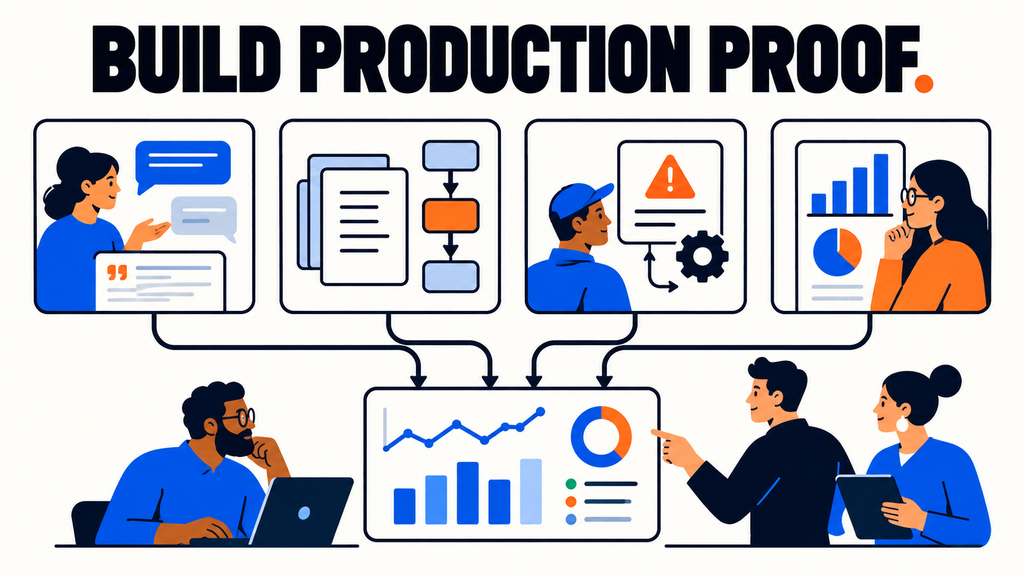
A good FDE portfolio does not need twelve projects. It needs a few complete projects that show technical depth, customer thinking, and production judgment. Use the following briefs as starting points. Change the domain and data so the result reflects your interests.
Project 1: Evidence-based support copilot
Build a support assistant for a fictional or open-source product. It should retrieve approved documentation, cite the exact source, draft an answer, and require an agent to approve or edit the response.
Add role-based document access, feedback capture, a queue for unsupported questions, and an evaluation set drawn from realistic support cases. Measure citation correctness, supported-answer rate, draft acceptance, latency, and cost.
The strongest version includes a discovery note explaining why full automation would be unsafe at the start. Show how human review creates labelled feedback for later improvement.
Project 2: Contract or policy review workflow
Build a system that extracts defined fields from documents, checks them against a ruleset, highlights uncertain items, and creates a review task. Use public sample contracts or policies. Do not upload confidential documents that you lack permission to use.
Separate deterministic checks from model judgment. For example, code can confirm whether a required date exists, while a model may classify a clause. Store the source page and text span for every extracted answer.
Test changed templates, scanned pages, missing sections, contradictory language, and prompt injection. Include a reviewer interface and an audit log. Measure field accuracy, unsupported extraction rate, review time, and failure by document type.
Project 3: Operations exception agent
Create an operations system that watches incoming records, identifies exceptions, gathers relevant information, proposes a resolution, and executes a limited action after approval. The domain can be inventory, invoices, delivery, claims, or account onboarding.
Use a queue and idempotent jobs. Simulate an unreliable external API. Add retry limits, dead-letter handling, duplicate protection, and a manual recovery path. The AI component should explain why a record looks unusual and choose from a small set of tools.
Measure detection precision, missed exceptions, average resolution time, tool-call success, and human override rate. Show a failure exercise and the runbook used to recover.
Project 4: Executive analytics assistant
Build a question-answering layer over a small warehouse with business definitions. The assistant should translate a question into a safe query, show the generated logic, return a chart or result, and link each metric to its definition.
Prevent unrestricted queries. Use a semantic layer or approved query templates. Add row-level permissions and a limit on scanned data. Test ambiguous terms such as “active customer” or “revenue” and require clarification when definitions conflict.
Measure correct metric selection, query accuracy, response time, and clarification quality. Add a page that shows data freshness and lineage. This project demonstrates that you understand why analytics errors often begin with definitions rather than SQL.
What every project should include
- A one-page problem and scope document
- An architecture diagram with data and trust boundaries
- A working deployment or recorded end-to-end demonstration
- Automated tests for deterministic code
- An evaluation set for AI behaviour
- Logs, metrics, and a small operations dashboard
- A threat model and access-control explanation
- A launch plan with staged permissions
- A runbook for common failures
- A result, limitation, and next-step section
Avoid copying a tutorial and changing the colours. The portfolio becomes credible when you make decisions that the tutorial did not make for you.
Best Courses and Books for an FDE Career

Courses can give you sequence, vocabulary, and enough guided practice to stop feeling lost. They cannot make decisions for you when a customer has an unclear request, inconsistent data, an old authentication system, and a fixed launch date. Choose a course that closes one visible skill gap, finish the parts that matter, and use the material in a project before buying another course. A complete deployed service will help your FDE application more than a profile filled with unfinished certificates.
Affiliate disclosure: Some course and book links below are affiliate links. If you buy through one of these links, ZeroToAIMastery.com may earn a commission at no extra cost to you. The recommendations are included because the material fits the forward deployed engineer skill stack, and you should still compare the syllabus, prerequisites, update date, and price before paying.
How to choose from these ten courses
You do not need to take all ten courses. A complete beginner can start with the Meta backend program, then learn FastAPI, Docker, and one cloud platform. A software engineer who already ships web applications can skip those foundations and concentrate on production machine learning, LLM applications, requirements gathering, and system design. If you already work in AI, the best use of this list is to fill the customer discovery, cloud operations, or architecture gap that your current role has allowed you to avoid.
1. Meta Back-End Developer Professional Certificate on Coursera
The Meta Back-End Developer Professional Certificate is the broadest starting point on this list. It teaches Python, Git, Linux commands, SQL, APIs, JSON, Django, and cloud hosting, which are the everyday foundations behind many customer deployments. It is a sensible choice if you can write small scripts but cannot yet design and deploy a complete web service. While studying, turn the course exercises into one small business workflow with authentication, a database, tests, and a public deployment.
2. Machine Learning Specialization on Coursera
The Machine Learning Specialization from Stanford Online and DeepLearning.AI explains how common models learn, how to evaluate them, and where methods such as classification, clustering, anomaly detection, and recommendation fit. An FDE does not train a new model for every customer, but you still need enough machine learning knowledge to question a weak metric or recognise when the data does not support the proposed solution. Take this program if terms such as validation set, precision, recall, and overfitting still feel vague. Apply the material by building a small prediction service with an error analysis, not only a notebook that reports one accuracy score.
3. Machine Learning in Production on Coursera
Andrew Ng’s Machine Learning in Production is one of the most directly relevant courses for a forward deployed engineer. It covers project scoping, baselines, changing data, deployment patterns, monitoring, error analysis, and continuous improvement after launch. Those subjects match the point where a promising model becomes a dependable product. Use the course to improve an existing portfolio project by adding data checks, deployment notes, failure metrics, and a plan for what happens when real inputs change.
4. Generative AI with Large Language Models on Coursera
The Generative AI with Large Language Models course from DeepLearning.AI and AWS gives you a structured explanation of the LLM application lifecycle. It covers model selection, transformer foundations, fine-tuning, evaluation, inference constraints, and deployment decisions. This is a better fit after you are comfortable with Python and basic machine learning, because it moves quickly through concepts that beginners often need time to absorb. Use it to explain why you selected a model for a project, how you tested it, and what cost or latency limit shaped the final design.
5. Requirements Gathering in Business Analysis on Coursera
Microsoft’s Requirements Gathering in Business Analysis covers the part of FDE work that technical courses often skip. You learn how to interview people, map the current process, separate functional requirements from quality requirements, write user stories, and document what success means. A technically impressive deployment can still fail when it solves the wrong problem or ignores the way people work. Use the final project to produce a discovery brief, process map, acceptance criteria, and phased launch plan for one of your portfolio systems.
6. FastAPI with GenAI and AgenticAI Project on Udemy
FastAPI with GenAI and AgenticAI Project: From Basic to AI is a practical bridge between Python code and a production-shaped AI backend. Its projects cover REST APIs, databases, validation, authentication, WebSockets, server-sent events, AI integration, and RAG. The course is useful if your work still lives inside notebooks or one-file demonstrations. Pick one project, add tests and observability, deploy it, and document the operational choices that the lessons leave to you.
7. Docker and Kubernetes: The Practical Guide on Udemy
Docker and Kubernetes: The Practical Guide teaches containers, images, volumes, networking, Docker Compose, deployment, and Kubernetes. You do not need Kubernetes for every FDE project, and using it for a tiny service can add work without solving a real problem. Learn Docker first so your application behaves consistently across machines, then study Kubernetes when you understand why several services need scheduling, scaling, or controlled rollouts. A useful portfolio result is a multi-container application that another person can start from one documented command.
8. Ultimate AWS Certified Solutions Architect Associate 2026 on Udemy
The Ultimate AWS Certified Solutions Architect Associate 2026 course gives you a wide view of AWS services and the decisions that connect them. It covers computing, networking, storage, databases, identity, serverless systems, security, reliability, and disaster recovery. The certification is optional, but the architecture knowledge is valuable when a customer asks where data should live, how access should work, or what happens when one component fails. Build one small architecture from the course and record the monthly cost, permissions, backup plan, and failure recovery steps.
9. AI Engineer Core Track on Udemy
The AI Engineer Core Track: LLM Engineering, RAG, QLoRA, Agents is a project-heavy route through current AI application patterns. It covers commercial and open models, retrieval, fine-tuning, agents, multimodal applications, and deployment. It suits developers who learn faster by building several systems and comparing approaches, but the number of projects can tempt you to rush. Choose two projects that match your target FDE roles, strengthen their tests and evaluation, and write down why the simpler design was or was not enough.
10. Mastering the System Design Interview on Udemy
Mastering the System Design Interview teaches scaling, caching, databases, distributed storage, failure handling, cloud resources, and structured interview communication. The course also includes generative AI, RAG, and agent system examples, which makes it more relevant to current FDE interviews than a generic architecture review. Do not memorise finished diagrams. Practise asking clarifying questions, stating assumptions, comparing two designs, and changing the architecture when the interviewer introduces a new constraint.
Free resources worth keeping beside the paid courses
LangChain Academy has free material on LangChain, LangGraph, LangSmith, agents, tracing, and evaluation. Start with LangChain Essentials in Python, then use LangSmith Essentials after you have an application that produces traces worth inspecting. The AWS Certified Generative AI Developer Professional exam guide is another useful production checklist even if you never take the exam. ZeroToAIMastery.com’s comparison of online courses for AI agents can help if you need a narrower agent course instead of the longer options above.
Ten books that build FDE judgment
Books work best when you read them against a system you are building. Copy one useful diagram in your own words, turn each chapter into a design question, and record where your project lacks a control or clear decision. Passive highlighting creates little evidence for an interview, while a project decision log shows how you think.
- The Harness Engineering Blueprint: This book focuses on the system around an AI agent, including context, tools, memory, evaluation, observability, security, and operational control. It fits FDE work because a customer needs a workflow that behaves predictably under real conditions, not a clever prompt by itself.
- Designing Data-Intensive Applications, Second Edition: Martin Kleppmann and Chris Riccomini explain the tradeoffs behind databases, distributed systems, batch processing, streams, reliability, and consistency. Read it when you need to understand why a data architecture behaves well in a diagram but fails under load or partial failure.
- AI Engineering: Chip Huyen covers model selection, evaluation, RAG, agents, dataset work, inference cost, latency, observability, and user feedback. It provides a strong technical frame for building applications with foundation models instead of training every model from scratch.
- Designing Machine Learning Systems: This book connects machine learning with data pipelines, deployment, monitoring, distribution shifts, testing, and continual learning. It is especially helpful when your project has moved beyond a demonstration and must keep working as its inputs change.
- Software Architecture: The Hard Parts: Neal Ford, Mark Richards, Pramod Sadalage, and Zhamak Dehghani examine coupling, service boundaries, distributed transactions, data ownership, workflows, and architectural tradeoffs. The value comes from learning how to compare imperfect options and explain the cost of each choice.
- Accelerate: Nicole Forsgren, Jez Humble, and Gene Kim connect engineering practices with delivery performance through research on technology organisations. Use its ideas to examine deployment frequency, recovery time, change risk, and the working conditions around reliable delivery.
- The Pragmatic Programmer, 20th Anniversary Edition: David Thomas and Andrew Hunt cover maintainable code, testing, debugging, requirements, adaptability, and professional responsibility. It is a useful foundation for the daily engineering habits that remain important after a particular framework becomes old.
- The Staff Engineer’s Path: Tanya Reilly explains technical leadership, broad project ownership, communication, strategy, and influence without formal authority. Those skills matter when an FDE must align customer teams, product engineers, security reviewers, and senior leaders around one delivery plan.
- Continuous Discovery Habits: Teresa Torres gives product teams a repeatable way to interview customers, map opportunities, test assumptions, and connect discovery with delivery. It helps you keep a deployment tied to a real user problem instead of letting the technology decide the roadmap.
- The Mom Test: Rob Fitzpatrick explains how to ask about real behaviour and past problems instead of collecting compliments about an idea. The book is short, direct, and useful before your next discovery call or portfolio user interview.
A sensible learning order
- Learn Python, SQL, HTTP, Git, testing, and basic backend development.
- Build and deploy one API with a database and authentication.
- Learn Docker and one cloud platform well enough to operate that service.
- Study model APIs, structured output, retrieval, and evaluation.
- Add permissions, approval steps, tracing, monitoring, and a runbook.
- Practise discovery interviews, requirements writing, and project scoping.
- Work through system design questions and defend your tradeoffs aloud.
- Deliver one customer-shaped project to a real user and measure adoption.
Do not collect five certificates before building one complete service. For an FDE interview, a well-defended project usually gives the interviewer more useful evidence than a long course list.
Across your projects, an employer should be able to see the same working habit: you understand the workflow before coding, reduce the first release to a useful size, build the complete path, test the risky cases, launch with controls, and check whether people use what you made.
How Much Does a Forward Deployed Engineer Earn?

FDE compensation varies sharply by company, level, location, travel, equity, and whether the role belongs to engineering, professional services, or sales. Public salary samples remain small in some countries, and self-reported figures can mix junior and senior roles. Treat the numbers below as reference points, not promises. I checked the cited pages on October 3, 2026, but you should still verify the employer’s current range before an interview.
United States
According to Glassdoor’s United States salary page, the estimated total-pay range was $125,000 to $198,000, with a median of $156,000. That page combined 50 reported salaries across employers and experience levels, so it is more useful as a broad reference than as a prediction for one offer.
OpenAI lists a base range of **$185,000 to $300,000** for its San Francisco FDE role, plus equity and eligible bonuses. The same page asks for at least five years of engineering or technical deployment experience, production Python or JavaScript, experience with generative AI systems, customer-facing work, and travel up to 50 percent. That is a senior, high-cost-market role, not a starting salary for every FDE.
Canada
Two current employer listings give a more useful Canadian comparison than one national average. Decoda Health lists **CA$120,000 to CA$160,000** for an on-site Toronto FDE role, while Spellbook lists an estimated base salary of **CA$170,000 to CA$213,000** for a remote Canadian role and offers equity. The gap reflects different employers, levels, and products. Compare base pay, bonus or commission, stock, benefits, on-call expectations, and travel reimbursement before comparing the headline numbers.
United Kingdom
According to Glassdoor’s Palantir London page, estimated base pay was £7,000 to £9,000 per month, with an average of £8,000 per month. Estimated additional pay averaged £2,000 per month. The page labelled the data “very high confidence” and showed 158 submissions when checked. Annualised base pay works out to roughly £84,000 to £108,000 before additional pay.
Germany
According to Glassdoor’s Germany data, estimated base pay ranged from €81,500 to €130,000, with an average base of €94,500. Estimated additional pay averaged €15,000. The page contained 16 salary reports, and the individual entries varied widely. Location, employer, seniority, and stock structure can move an offer far from the average.
India
According to Glassdoor’s India page, estimated base pay ranged from ₹9 lakh to ₹17.9 lakh, with an average of ₹12.2 lakh. Estimated additional pay averaged ₹2 lakh, with a reported range of ₹88,000 to ₹4 lakh. High-paying global product companies can exceed that broad-market figure, while implementation-heavy roles may sit below it.
What changes the offer
- Engineering depth: Candidates who can own architecture and production incidents command more than candidates limited to configuration.
- AI and data experience: Proven evaluation, retrieval, data, and LLMOps skills matter for AI FDE roles.
- Customer scope: Executive-facing discovery, large deployments, regulated industries, and international travel can raise expectations and pay.
- Revenue connection: Some organisations place customer engineers near sales and include variable compensation.
- Equity: Stock can form a significant part of total compensation at venture-backed and public technology companies.
- Location and level: A senior role in San Francisco cannot be compared directly with an early-career role in another market.
Ask the recruiter for the level, base range, target bonus, equity schedule, travel policy, on-call expectations, and the part of pay tied to sales or customer outcomes. A high total-compensation estimate can hide a demanding variable component.
How to Prepare for the FDE Interview Process
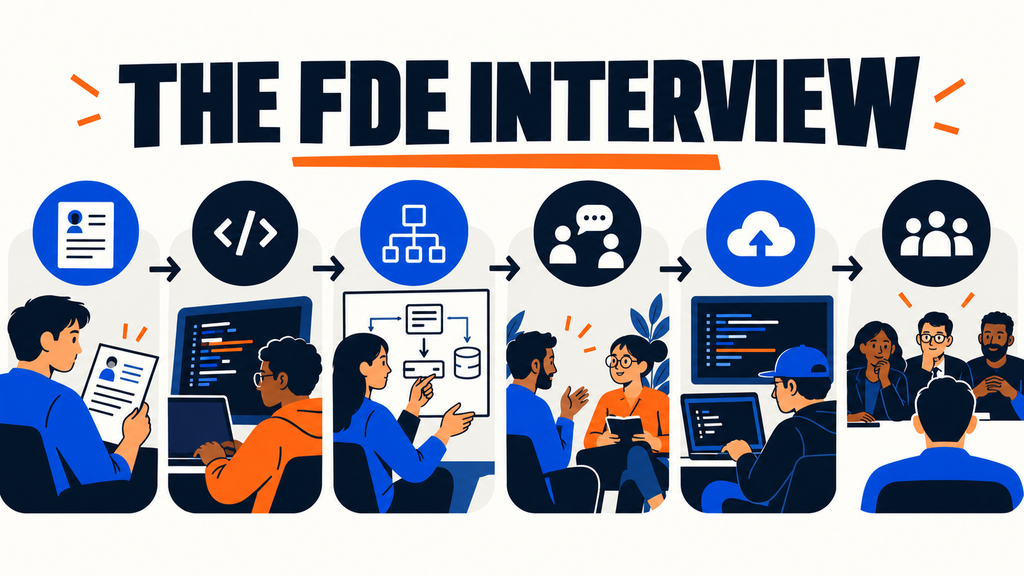
FDE interviews vary, but they usually test four areas: software engineering, system design, problem discovery, and communication under pressure. AI-focused teams add model-system design, evaluation, and safety. Prepare for the combination instead of treating the role like a normal coding interview with a customer chat added at the end.
Resume and recruiter screen
The first screen looks for credible building experience and a reason for choosing customer-facing engineering. Lead with outcomes and ownership. “Built a retrieval assistant” is weak. “Designed and deployed a cited policy assistant for 18 test users, created a 120-case evaluation set, and reduced median lookup time in the pilot” gives the recruiter something to inspect.
Be ready to explain travel preferences, location, work authorisation, and why the company’s deployment model interests you. Do not pretend to enjoy constant travel if you do not. A mismatch will appear later.
Coding interview
Expect normal software problems, practical data transformations, API tasks, or debugging. Write clear code, name assumptions, test edge cases, and communicate your reasoning. FDE teams care about speed, but careless code under time pressure creates the wrong signal.
Practise arrays, maps, strings, trees, graphs, parsing, queues, and basic complexity. Add practical exercises: consume a paginated API, deduplicate events, retry a failed job, validate a schema, or design an idempotent endpoint.
System design interview
You may be asked to design a document assistant, operational workflow, data platform, or customer integration. Begin with users, scale, latency, security, data sensitivity, and failure cost. Draw the main path, then address permissions, monitoring, rollout, and recovery.
For AI systems, discuss evaluation data, model choice, retrieval, prompt and tool versioning, traces, human approval, cost, and failure containment. Do not place “LLM” in the middle of a diagram and call the design complete.
Discovery or customer scenario
The interviewer may play a customer who asks for a broad solution. Your task is not to agree quickly. Ask what outcome matters, who uses the workflow, what happens today, which systems hold the data, what can go wrong, and how the team will measure success.
Summarise what you heard. Propose a narrow first release and name what remains outside scope. Explain one tradeoff in plain language. A good performance feels like a useful working session, not a sales pitch.
Technical presentation or deployment exercise
Some companies ask candidates to build or present a small system. Treat it like a miniature engagement. Include assumptions, architecture, working path, tests, evaluation, risks, deployment instructions, and next steps.
Use the simplest stack that proves the idea. A large collection of services can make a small exercise harder to review. Spend time on error behaviour and documentation because many candidates only polish the happy path.
Behavioural and values interviews
Prepare specific stories for:
- A vague project that you helped define
- A customer or stakeholder disagreement
- A production failure and your response
- A time you reduced scope to meet a deadline
- A technical decision you later changed
- A user who did not adopt the system
- A security or data risk you escalated
- A reusable improvement that came from customer work
Avoid stories where everyone else was foolish and you rescued the project. Strong engineers show judgment, ownership, and learning without turning colleagues into villains.
Questions worth asking the interviewers
- How does this team divide discovery, coding, deployment, and support?
- What was the hardest deployment in the last year?
- Which part of an engagement most often causes delay?
- How does customer work influence the core product?
- What happens when a project lacks adoption after launch?
- Who reviews security and architecture decisions?
- How are FDEs evaluated when outcomes depend on the customer?
- What do strong engineers learn in their first six months?
The interview is also your due diligence. You are choosing a delivery model, not only a company name.
How Do You Find an FDE Job in 90 Days?

Job searches become noisy when every application uses the same resume and no feedback changes the plan. Use a short operating cycle with clear evidence.
Days 1 to 30: Position the profile
Choose the type of FDE work you want: enterprise AI, data platform, security, infrastructure, industry software, or general deployment. Write a one-sentence positioning statement that connects your strongest engineering evidence with the customer problems you can handle.
Finish one flagship case study. Update your resume so the first half shows production ownership, integrations, customer or user contact, and measurable results. Make LinkedIn and GitHub descriptions agree with the resume.
Build a target list of forty companies. Include exact FDE titles and adjacent roles. For each company, record product, customers, likely deployment problem, location, travel, role level, and one relevant person to learn from.
Days 31 to 60: Create conversations and apply
Contact engineers, hiring managers, and technical recruiters with a brief, specific note. Mention the company’s deployment model and one relevant project. Ask a focused question about the work. Do not send a biography or ask a stranger to “guide” your entire career.
Apply in batches of five to eight roles, then inspect the response. Adapt the resume to the responsibilities without stuffing keywords. If a role emphasises data platforms, lead with pipelines and integration. If it emphasises AI agents, lead with evaluation, permissions, and production control.
Publish one useful technical case study during this period. Explain a failure, evaluation method, or deployment tradeoff. A clear article can give contacts a reason to remember you.
Days 61 to 90: Improve the weak stage
Review the funnel every week. Track applications, recruiter screens, technical screens, final rounds, rejections, and stated feedback. The weakest conversion points to the next action.
No recruiter screens suggests a positioning, level, location, or resume problem. Failed coding rounds require timed coding and debugging practice. Failed system design rounds require clearer requirements, architecture, and tradeoffs. Failed customer scenarios often mean the candidate proposed a solution before understanding the workflow.
Continue building while you interview. A second customer conversation, evaluation improvement, or production incident report gives you fresh material and keeps the search from becoming passive.
Common routes into the first role
- Move internally from software, data, solutions, or implementation work.
- Join a smaller company under an adjacent customer-engineering title.
- Take a product-engineering role that includes early customer deployments.
- Use domain knowledge to join an industry-focused AI company.
- Contribute to an open-source platform and help real users deploy it.
- Complete a contract project with clear production ownership and references.
Choose experience that improves both halves of the profile. Pure pre-sales work may not deepen production ability. Isolated backend work may not prove customer judgment.
Career progression
An individual contributor may progress from associate or new-graduate FDE to FDE, senior FDE, staff or principal FDE, and technical lead. Senior engineers handle larger ambiguity, more difficult customer relationships, higher-risk architecture, and wider reuse across deployments.
Management paths include FDE team lead, deployment manager, head of forward-deployed engineering, professional services engineering leader, or customer engineering leader. Product paths include product engineer, platform engineer, or product manager for capabilities discovered through deployments.
Some FDEs move into solutions architecture, sales engineering, technical account leadership, or implementation strategy. Others become founders because they have seen expensive problems at close range. The best next step depends on whether you want deeper engineering, larger customer ownership, people leadership, or product leverage.
How to keep the career healthy
Protect time to improve reusable engineering. Record patterns across customers. Push repeated fixes into the platform. Teach other teams through runbooks and reviews. Keep your coding ability current even as meetings increase.
Set boundaries around travel and incident work. A role can be demanding without becoming permanently chaotic. Ask for clear ownership and escalation. Sustainable FDE teams treat recovery time and documentation as engineering needs, not personal preferences.
What Should You Do Next?
A long roadmap is useful only when it leads to work you can begin. Choose the next step from your current position, not from the version of the career that looks most impressive online.
- Build the engineering base. Learn Python, APIs, SQL, testing, cloud deployment, and observability until you can deploy a small service and diagnose it when it fails. If you already do this at work, write down the proof instead of repeating beginner lessons.
- Deliver one complete workflow. Find a real user, understand a repeated problem, agree on a narrow first release, and build the full path. Add permissions, evaluation, monitoring, and a runbook. Measure whether the user adopts it.
- Turn the work into evidence. Write a case study that explains the problem, design, tradeoffs, failures, result, and next decision. Use that story to target FDE and adjacent customer-engineering roles that match your level.
You do not need to match every line of every job description. You do need a dependable technical core and honest evidence that you can carry a messy problem into production.
FAQs
1. What does a forward deployed engineer do?
A forward deployed engineer works with customers to understand a valuable workflow, design a solution, write and integrate software, launch it, and improve adoption. The role often includes production coding, APIs, data, cloud systems, AI components, customer meetings, evaluation, and operational support.
2. Is a forward deployed engineer a software engineer?
Yes. Strong FDE roles require real software engineering. The difference is proximity to a customer and responsibility for a specific deployment. Some jobs use the title for lighter implementation work, so check how much production code the team writes.
3. Can I become a forward deployed engineer without a degree?
Yes. You need stronger alternative evidence, such as deployed projects, clean repositories, tests, architecture decisions, evaluation reports, user feedback, and references. Some companies hire new graduates, while senior FDE roles may require several years of engineering or deployment experience.
4. Which programming language should an FDE learn?
Python is the best first choice for many AI, data, automation, and backend roles. TypeScript or JavaScript helps with full-stack applications and web interfaces. Learn one language deeply before spreading across several.
5. Does an FDE need machine learning knowledge?
It depends on the company. AI-focused FDEs need model APIs, retrieval, evaluation, tool use, safety, and LLMOps. Infrastructure or data-platform FDEs may need less model knowledge and more depth in distributed systems, networking, security, or data engineering.
6. How long does it take to become an FDE?
The timeline depends on your starting point. An experienced software engineer may close customer-delivery and AI gaps in a few focused months. A complete beginner should expect a longer path through programming, databases, APIs, deployment, projects, and interviews. Use skill checkpoints rather than a promised number of weeks.
7. Is forward deployed engineering a sales role?
Usually not, although FDEs can support important customer conversations and some teams sit close to revenue. Sales engineers often focus on technical evaluation before purchase. FDEs usually own more building, integration, rollout, and post-launch results.
8. How much travel does an FDE do?
Travel varies by company and customer. Some roles are mostly remote with planned site visits. Others require frequent work at customer locations. According to OpenAI’s current San Francisco FDE listing, travel can reach 50 percent. Ask the team what travel looked like during the previous quarter.
9. What should an FDE portfolio include?
Include two to four complete projects with a problem statement, scope, architecture, working deployment, tests, AI evaluation where relevant, access controls, monitoring, runbook, result, and limitations. At least one project should involve a real user or stakeholder.
10. What is the difference between an FDE and a solutions engineer?
Solutions engineers often help a customer evaluate and design a solution before purchase. FDEs usually spend more time building and operating the production deployment. Company definitions vary, so compare responsibilities, coding time, and post-launch ownership.
11. Are FDE jobs only available at Palantir?
No. Palantir made the title widely known, but OpenAI, Databricks, C3 AI, Decoda Health, Spellbook, and many other companies advertise forward-deployed or adjacent customer-engineering roles. Search several titles because employers describe similar work differently.
12. What are the hardest parts of forward deployed engineering?
The hardest parts are unclear requirements, old systems, data quality, changing scope, customer pressure, production failures, and adoption. The engineer must make progress without hiding risk or building an unmaintainable one-off system.
13. Do FDEs earn more than software engineers?
Some FDE roles pay at or above strong software-engineering bands because they combine technical depth, customer responsibility, travel, and business impact. Other implementation-heavy roles pay less. Compare level, base pay, bonus, equity, travel, and on-call work rather than titles alone.
14. How do I get FDE experience before my first FDE job?
Take integration-heavy work, join customer calls, build an internal tool for a real team, help users deploy an open-source project, or complete a small contract engagement. Document discovery, decisions, failures, rollout, and result so the experience becomes visible evidence.
15. Will AI agents replace forward deployed engineers?
AI tools can speed up coding, analysis, documentation, and support. They do not remove the need to understand a customer’s workflow, negotiate scope, protect sensitive systems, decide which errors matter, and earn adoption. FDEs will use better agents, while the standard for production judgment will rise.
Is Forward Deployed Engineering the Right Career for You?
The attractive version of this career is easy to describe: hard problems, serious customers, modern technology, and broad ownership. The useful version includes the less glamorous work too. You will inspect permissions, clean data, handle retries, rewrite a scope, sit through a tense incident, and explain why a demo should not launch yet.
That is also why the role can be satisfying. You see the whole path from a vague need to a system that changes a real workflow. Start with one complete project. Make it reliable. Put it in front of a user. Listen carefully when the user does something you did not expect. That loop is the beginning of forward deployed engineering.