

A lot of people are using AI right now. But there is a big difference between using AI and actually building with it.
Using AI means typing into ChatGPT and getting an answer. Building with AI means creating systems that can work on their own. Systems that can plan a task, use the right tools, make decisions, and get things done without someone guiding every single step. That is what AI agents are. And learning to build them is one of the most valuable skills you can develop in 2026.
The numbers show exactly how fast this is moving. The global agentic AI market was worth about USD 7 billion in 2025 and is projected to reach USD 93 billion by 2032, growing at a rate of 44.6% every year (source: MarketsandMarkets). Gartner predicts that 40% of enterprise software applications will have AI agents built into them by the end of 2026 (source: Gartner via onereach.ai). LinkedIn ranked AI Engineer as the number one fastest-growing job role in the United States in 2025 (source: LinkedIn Jobs on the Rise 2025).
This is not a future trend. It is already here. And the best online courses to learn AI agents are your fastest, most structured way in.
This article covers 10 courses that actually teach you how to build AI agents, not just talk about them. Every course here has been selected for clear teaching, practical project work, and content that is up to date with how the field actually looks right now. Whether you are starting fresh or you already know Python, there is something on this list that fits exactly where you are.
Why AI Agents Are the Skill Worth Learning Right Now
Before jumping into the courses, it helps to understand what makes an AI agent different from a regular AI chatbot.
When you ask ChatGPT a question, it answers. That is it. An AI agent does something much bigger. You give it a goal, and it figures out the steps, picks the right tools, takes action, checks the result, and keeps going until the job is done. It works like a smart, capable employee, not a search engine.
Think of it this way: a chatbot tells you how to book a flight. An AI agent actually goes and books it for you.
This is why companies are moving so fast on this. Around 51% of companies have already deployed AI agents in some form (source: Bayelsa Watch). Autonomous workflows using AI agents have been shown to save 40 to 60% of operational time (source: Javarevisited). The engineers who know how to build these systems are the ones getting hired and earning premium salaries.
The good news is that learning this has never been more accessible. There are free courses taught by the actual people who built the tools. There are beginner-friendly options that start from zero. There are project-based courses where you build 8 real agents before you even finish. Here are the best ones available right now.
If you are completely new to this space and feel like AI agents are too advanced, you can take a step back and first understand the broader picture of artificial intelligence. A structured path like How to Learn AI From Scratch in 2026: A Complete Expert Guide will give you clarity on fundamentals, tools, and how everything connects. Once you understand that foundation, learning AI agents becomes much easier because you are no longer just following tutorials, you actually understand what you are building.
The 10 Best Online Courses to Learn AI Agents in 2026
1. AI Agents and Agentic AI with Python — Vanderbilt University (Coursera)
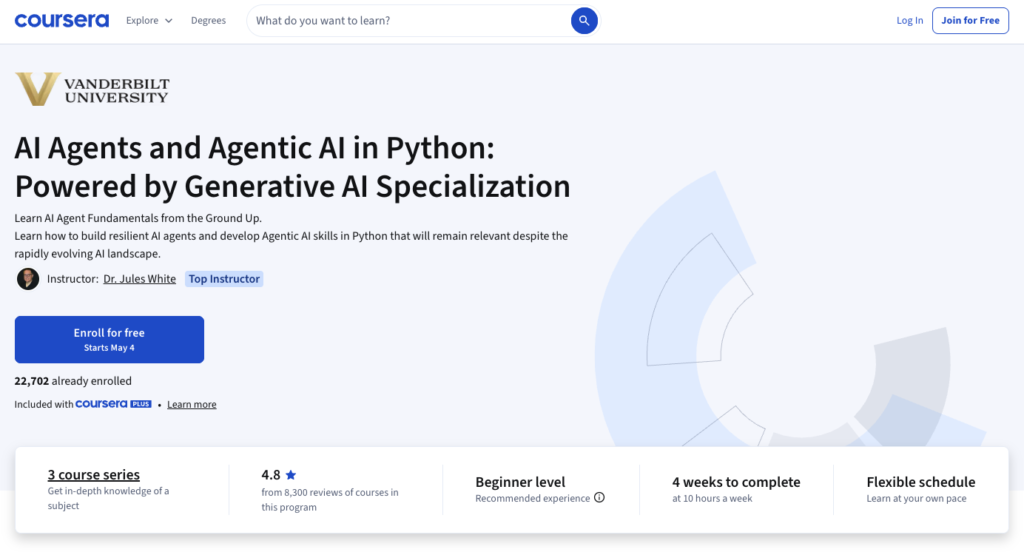
AI Agents and Agentic AI with Python by Vanderbilt University (Coursera) is the course to start with if you want to actually understand how AI agents work, not just copy someone else’s code.
Dr. Jules White from Vanderbilt University built this course around one important idea: if you build an agent completely from scratch yourself, you understand it in a way that lasts. You will not be lost when something breaks. You will not be stuck when a framework changes. You will know what is actually happening underneath the surface.
The course teaches you the GAME structure, which is the foundation every AI agent is built on. GAME stands for Goals, Actions, Memory, and Environment. You learn each component step by step and put them together yourself in Python, without relying on any big framework to do the work for you. You build practical agents that explore files, generate documentation, and assist with coding tasks. You can audit the full course free on Coursera, or pay for a certificate if you want the credential.
What you will learn in this course:
- The GAME framework (Goals, Actions, Memory, Environment) and how every AI agent uses it
- How to build a complete AI agent from scratch in Python without using pre-built frameworks
- How function calling works, which is how your agent uses tools to take real action
- How to build tool discovery systems so your agent knows which tool to reach for and when
- How to create agents for real tasks like file exploration, documentation generation, and coding assistance
2. The Complete Agentic AI Engineering Course — Ed Donner (Udemy)
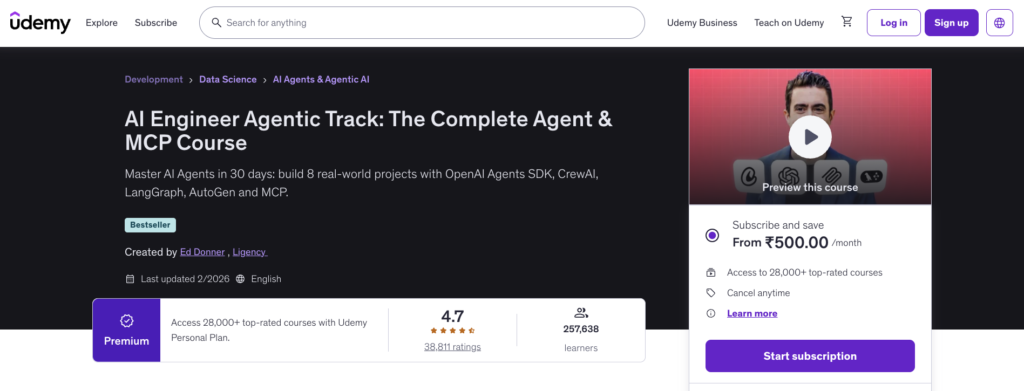
If you want one course that covers everything from beginner to advanced, across all major AI agent tools in one place, The Complete Agentic AI Engineering Course by Ed Donner (Udemy) is it.
Ed Donner spent years as a Managing Director at JPMorgan Chase leading a team of over 300 software engineers. He now co-founds an AI company called Nebula. He built this course the way someone who has shipped AI at enterprise scale would build a training program. It is structured, practical, and focuses on what actually works in real projects.
In about 6 weeks of focused study, you go through five major frameworks: OpenAI Agents SDK, CrewAI, LangGraph, AutoGen, and MCP. You do not just watch videos about them. You build 8 real-world projects using each of them. The course has over 83,000 students enrolled with a Udemy Bestseller badge, which reflects genuine value from a large developer community (source: Javarevisited on Medium). The final project is a Trading Floor with 4 autonomous agents that use 44 different tools. It is the most comprehensive single course available for agentic AI right now.
What you will learn in this course:
- How five major frameworks work: OpenAI Agents SDK, CrewAI, LangGraph, AutoGen, and MCP
- How to build 8 complete AI agent projects from scratch that you can add to your portfolio
- How to create agents that write emails, analyze stocks, manage code, and operate autonomously
- How to connect agents to external tools and services using the Model Context Protocol (MCP)
- How to design multi-agent systems where several agents collaborate toward a shared goal
If you are serious about turning these skills into a real career, this is exactly the kind of course that bridges the gap between learning and professional work. Many of the concepts covered here are directly aligned with what companies expect from AI engineers today. If your goal is to go beyond just learning and actually build a career in this space, How to Become an AI Engineer in 2026 (Without a Degree) breaks down the full roadmap, from skills to projects to landing opportunities without needing a traditional background.
3. Multi AI Agent Systems with crewAI — DeepLearning.AI
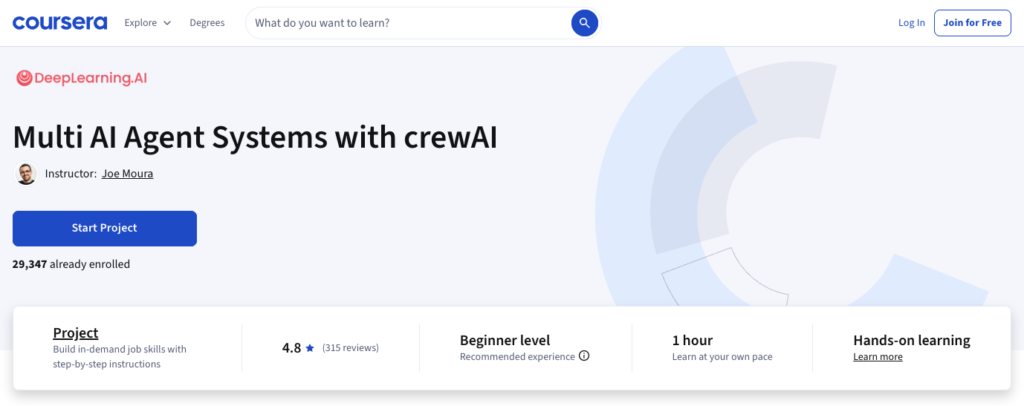
Multi AI Agent Systems with crewAI by DeepLearning.AI course is free, takes about 2 hours, and is taught by João Moura, the person who actually created CrewAI. That combination is genuinely hard to beat.
When you learn a tool from the person who built it, you get explanations that no third-party course can match. You understand not just how to use it but why it was designed the way it was. That depth changes how confidently you work with it.
The course focuses on multi-agent systems. You are not building one single agent. You are building teams of agents that collaborate together, each with a specific role, working toward a shared outcome. This is how most real enterprise AI systems are actually built. The tasks you build for are practical ones: customer support, research writing, financial analysis, and event planning.
What you will learn in this course:
- The six core building blocks of multi-agent systems: role-playing, tool use, memory, guardrails, focus, and cooperation
- How to organize agents to work in series, in parallel, or in a hierarchy depending on what your task needs
- How to assign specific roles to agents so your system stays organized and each agent stays focused
- How to build agent teams for real business tasks like customer support, research, and financial workflows
- How to make multiple agents work together without running into conflicts or getting stuck
4. AI Agents in LangGraph — DeepLearning.AI
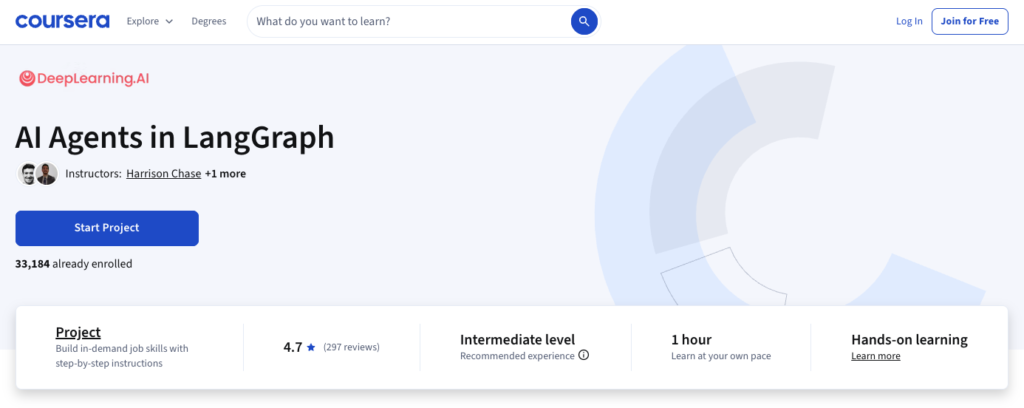
AI Agents in LangGraph by DeepLearning.AI is another free DeepLearning.AI course, and it takes about 2 hours. Short in time, but dense in what it teaches.
Harrison Chase, who created LangChain, co-teaches this with Rotem Weiss, founder of Tavily. What makes this course stand out is the structure. You first build an agent completely from scratch. Then you rebuild the same agent using LangGraph. Seeing it both ways gives you a clear picture of what the framework actually does for you and what you still have to manage yourself. That clarity is hard to find in most AI agent courses.
The most valuable section covers how to keep agents running reliably over time. You learn how to save an agent’s state so a conversation can be paused and picked back up later. You learn how to add human decision points mid-task, where a person reviews the agent’s plan before it continues. These are the features that separate a cool demo from a system real people use every day.
What you will learn in this course:
- How to build an AI agent from scratch before touching any framework, so you truly understand what is happening under the hood
- How LangGraph works and why it gives you more precise control over your agent’s execution flow
- How to do agentic search that returns structured, predictable answers instead of raw links
- How to save and reload agent state so tasks can be paused, resumed, and switched between users
- How to build human-in-the-loop steps where a person reviews and approves key decisions before the agent moves forward
5. LangChain: Develop AI Agents with LangChain and LangGraph — Eden Marco (Udemy)
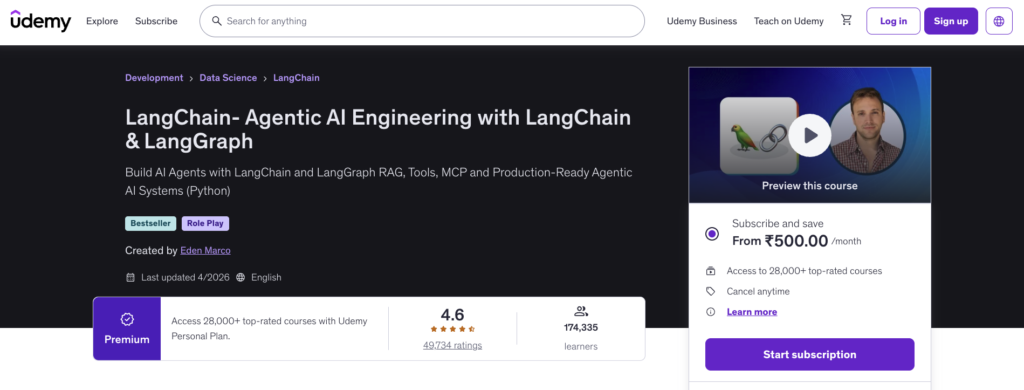
LangChain: Develop AI Agents with LangChain and LangGraph by Eden Marco (Udemy) course is built for people who already know Python and want to go deep into the LangChain ecosystem fast.
Eden Marco is a LangChain Ambassador and a GenAI Architect at Google Cloud. With over 142,000 students enrolled and a 4.6 rating, this has been tested by a large community of real developers who found it worth finishing. It skips over beginner introductions and gets straight into building.
The main project you build is called the Ice Breaker Agent. You give it a person’s name, and it searches Google, finds their LinkedIn and Twitter profiles, pulls public information from those pages, and generates a personalized summary and conversation starter. It is a real, complete agent doing a genuinely useful task. Building it teaches you the entire agent loop without leaning on a simplified toy example. The course has also been updated to support the current versions of LangChain and LangGraph, which matters a lot in a field that moves this fast.
What you will learn in this course:
- How to build a full production-style AI agent using LangChain and LangGraph from start to finish
- How to connect your agent to live data from Google Search, LinkedIn, and Twitter
- How to scrape and process public web data and use it inside your agent’s reasoning process
- How to structure a proper agent loop that takes input, reasons through it, acts, and delivers output
- How to work with the latest versions of LangChain V.1 and LangGraph in real applied projects
6. Hugging Face AI Agents Course
Hugging Face AI Agents Course is the best free, certified option for anyone who wants to learn agentic AI through an open-source and community-driven approach.
Hugging Face is one of the most respected names in the AI space, and their free courses are taken seriously by developers worldwide. This course covers three different frameworks: smolagents, LlamaIndex, and LangGraph. Seeing how different tools approach the same problem gives you a broader perspective than sticking to just one framework from the beginning.
The course has a built-in certification path. Complete Unit 1 and earn a Fundamentals Certificate. Complete the use-case assignment and final challenge on top of that and earn the full Certificate of Completion. There is also a public leaderboard where your agents are scored against other learners’ agents, which is a surprisingly effective way to see how much your skills have actually grown. Plan to invest 3 to 4 hours per week over several weeks to work through everything properly.
What you will learn in this course:
- How three different open-source frameworks approach agent development: smolagents, LlamaIndex, and LangGraph
- How to build agents that can perceive their environment, reason about what to do, and take action
- How to compare frameworks and understand the tradeoffs each one makes so you can choose the right one for any project
- How to compete on a real public leaderboard by submitting agents that are evaluated against benchmarks
- How to earn a recognized Hugging Face certificate to add to your resume or LinkedIn profile
7. Design, Develop, and Deploy Multi-Agent Systems with CrewAI — DeepLearning.AI
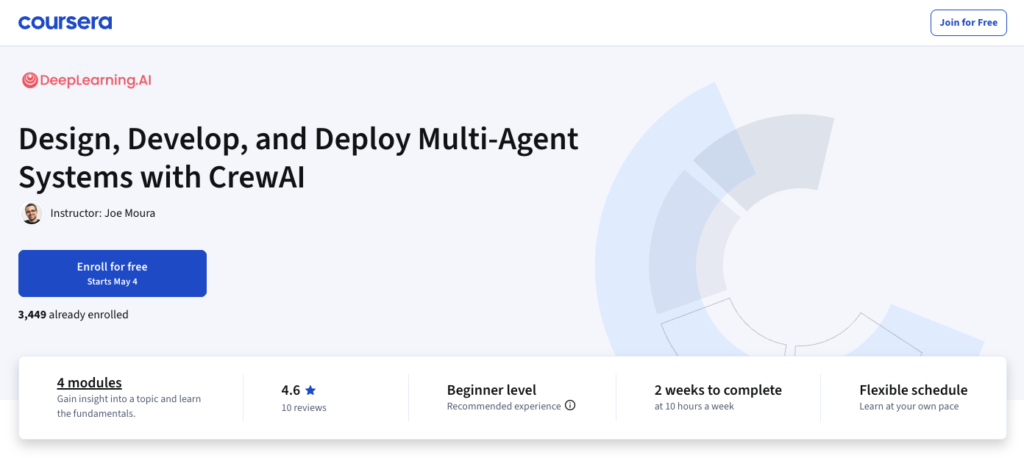
Most people can get a working AI agent running in a few days. Design, Develop, and Deploy Multi-Agent Systems with CrewAI by DeepLearning.AI course teaches everything that comes after that, which is where the real challenge lives.
Getting an agent to run once is one thing. Getting it to run reliably, safely, and consistently for real users at scale is a completely different problem. This course was built specifically to close that gap. It takes you from a working prototype to a system that is ready for production.
You go through memory management, advanced tool use including MCP servers, guardrails that prevent agents from doing things they should not, and execution hooks for precise control over agent behavior. The section on observability is especially practical. You learn how to trace exactly what your agent did and why, how to judge whether its decisions were good, and how to collect human feedback and use it to improve performance over time. Real company case studies from Exa, Snyk, Weaviate, and AB InBev are included to show how this works in actual business settings.
What you will learn in this course:
- How to add long-term and short-term memory to agents so they retain relevant context across complex tasks
- How to connect agents to MCP servers and advanced external tools for much broader real-world capabilities
- How to add guardrails that prevent agents from taking actions outside their intended boundaries
- How to trace and observe your agent’s full decision history so you can debug problems in production
- How to evaluate agent quality using LLM-as-a-Judge methods and real human feedback loops
8. Agentic AI with LangChain and LangGraph — IBM (Coursera)
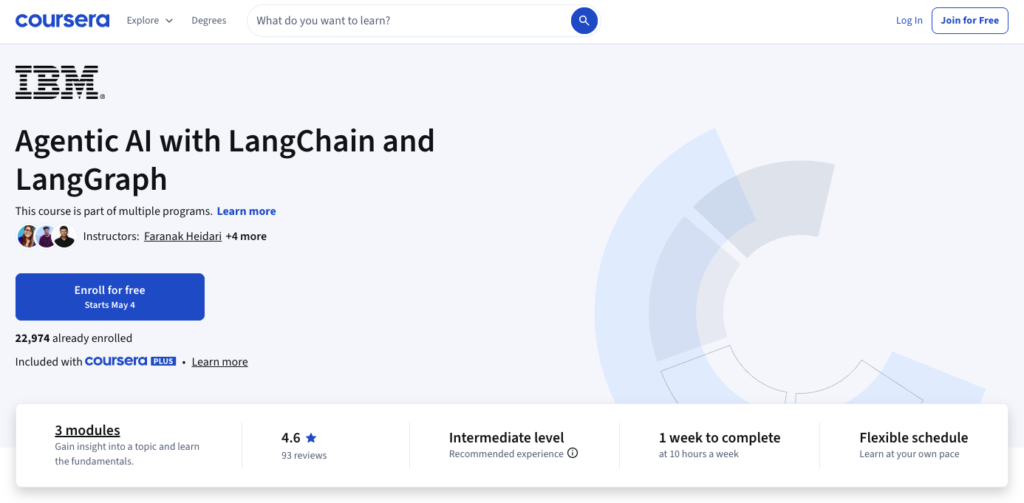
Agentic AI with LangChain and LangGraph by IBM (Coursera), available on Coursera, goes deeper than most into how agents actually think and improve themselves.
Most courses teach you to build an agent that acts. This one teaches you to build an agent that reflects on what it did and gets better before it delivers a result. That is a meaningful upgrade in capability. You learn three cognitive architectures that give agents this ability: Reflection, Reflexion, and ReAct. Each one is a different method for making your agent evaluate its own reasoning mid-process and course-correct when something is off.
You also build agentic RAG systems. These are agents that can search through large amounts of information, decide what is relevant, and synthesize it into a clear, useful answer. This is one of the most in-demand skills in enterprise AI right now. IBM’s certificate carries real recognition in corporate hiring, and the course itself is free to audit with a paid certificate option available.
What you will learn in this course:
- How the Reflection, Reflexion, and ReAct cognitive architectures work and when to apply each one
- How to build agents that review and improve their own outputs before delivering a final result
- How to design agentic RAG pipelines that search, filter, and reason across large information sources
- How to apply self-improving reasoning patterns to practical enterprise use cases
- How to combine LangChain and LangGraph in a production-ready workflow that goes beyond basic demos
9. Microsoft AI Agents: From Foundations to Applications — Professional Certificate (Coursera)
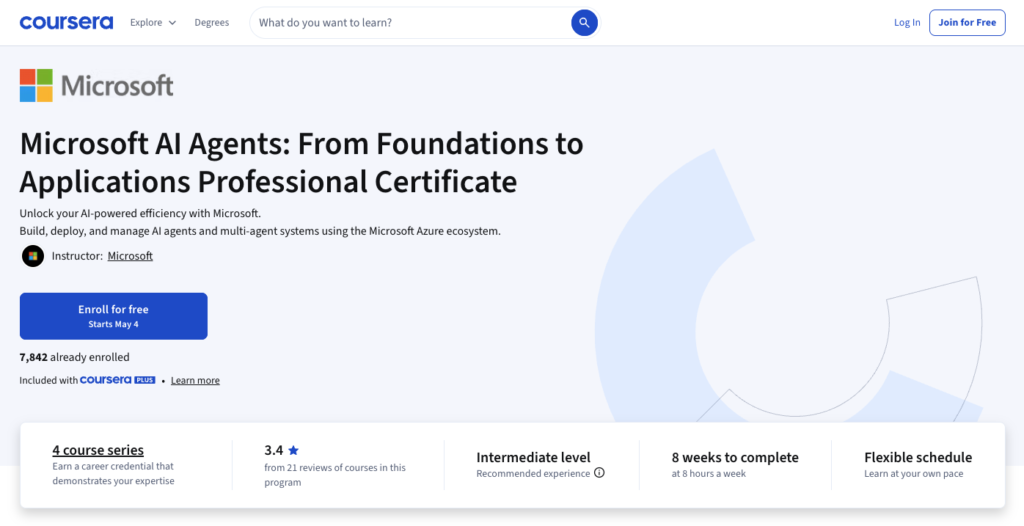
Microsoft AI Agents: From Foundations to Applications by Professional Certificate (Coursera) is the right course if you work in a corporate or enterprise environment and need a credential that HR teams, managers, and recruiters will immediately recognize.
The certificate is issued directly by Microsoft and covers agent development end-to-end on Microsoft’s cloud platform. You build three real agents during the program: a hotel information agent, a medical information agent, and a full multi-agent system. You also learn enterprise security through Azure Entra ID and SharePoint integration, which is the kind of real-world context most online courses skip entirely.
Docker deployment, basic Kubernetes setup, and Microsoft’s Responsible AI guidelines are all part of the curriculum. If your organization runs on Azure or Microsoft tools, this course teaches you the exact stack you will actually deploy on. The Microsoft name on the certificate is one that hiring managers in enterprise organizations already understand and trust.
What you will learn in this course:
- How to build production-ready AI agents on Microsoft’s Azure platform from design through deployment
- How to implement enterprise security using Azure Entra ID and connect agents to SharePoint data
- How to deploy your agents using Docker containers and understand the basics of Kubernetes
- How to apply Microsoft’s Responsible AI framework to ensure your systems are safe and accountable
- How to build multi-agent systems designed to operate inside real corporate IT infrastructure
10. Building AI Agents and Agentic AI Systems via Microsoft AutoGen (Udemy)
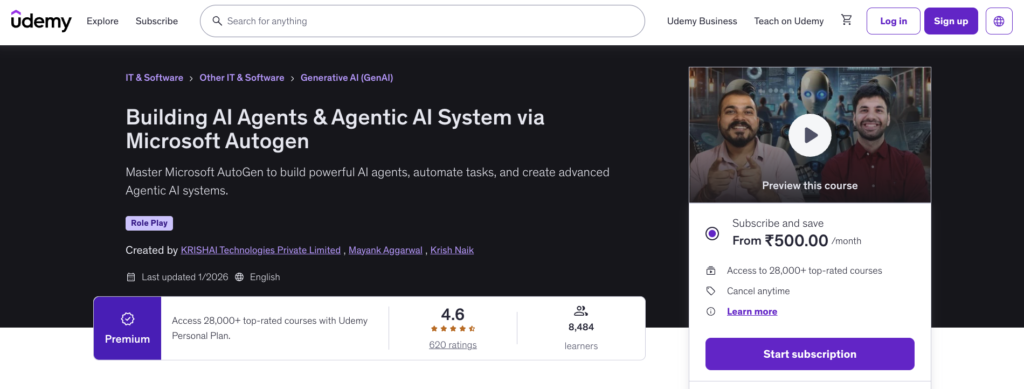
Building AI Agents and Agentic AI Systems via Microsoft AutoGen (Udemy) course is for developers who work in Microsoft-centric environments and want to go deep on AutoGen specifically.
Microsoft’s AutoGen is a framework designed for building teams of AI agents that coordinate like a real human team. It has matured significantly by 2026 and this course covers the current version in full. You learn how to assign roles to each agent, how to make them communicate with each other efficiently, and how to keep the whole system working even when a task changes partway through.
One of the most useful features of this course is a direct comparison between AutoGen, LangChain, and CrewAI. That comparison helps you understand which framework fits which situation, rather than assuming one is always the right choice. The AutoGen Studio section adds a visual interface for building and monitoring agents, which complements the code-based learning in a practical way.
What you will learn in this course:
- How Microsoft’s AutoGen framework works and how it compares directly to LangChain and CrewAI
- How to build autonomous AI teams where each agent has a clear, defined role and responsibility
- How to design agent communication so multiple agents share context and adapt when tasks shift mid-run
- How to use AutoGen Studio as a visual interface for building and monitoring agent systems
- How to decide confidently when AutoGen is the right choice over other agentic AI tools
How to Build Your Own AI Agent Learning Path
With 10 courses in front of you, the real question is: where do you start, and how do you move through them without losing time or momentum?
The answer is to build in phases. Do not try to take everything at once. Each phase lays the groundwork for the next one, and doing it in the right order makes everything easier.
- Weeks 1 to 2: Build your foundation. Start with the Vanderbilt course on Coursera. Build an agent from scratch in Python. This step teaches you how agents actually work underneath every framework you will use later. Most people skip this and then spend months confused about why things break. Do not skip it.
- Weeks 3 to 4: Go deep into one framework. Pick the one that fits your situation. Choose CrewAI if you want the most straightforward path to building multi-agent systems. Choose LangGraph if you want precise control over every step your agent takes. Choose AutoGen if your organization is already in the Microsoft ecosystem. Then take the matching DeepLearning.AI or Udemy course for that framework.
- Weeks 5 to 8: Get breadth and build your portfolio. Take Ed Donner’s Complete Agentic AI Engineering Course on Udemy. You cover all five major frameworks and build 8 real projects. By the end of this phase, you have a portfolio of actual, working agents to show to anyone.
- Ongoing: Go deeper and get production-ready. Add the DeepLearning.AI production-focused CrewAI course to learn how to take agents from prototype to reliable deployment. Add IBM’s course to understand how agents can reason and self-improve. Add the Hugging Face course for open-source exposure and a free, recognized certificate.
You do not need all 10 courses to get started. The first three phases alone take you from knowing nothing to having a real skill set in 8 weeks. The fourth phase is where you go from capable to genuinely expert.
At this stage, it is also worth understanding how this skill connects to real career outcomes. If you look at roles that are growing right now, many of them are directly tied to AI systems like agents. A guide like 7 AI Skills That Lead to High-Paying Jobs in 2026 helps you see where this skill fits in the job market and how you can turn it into income, not just knowledge.
How to Pick the Right AI Agents Course for You
There are a lot of AI agent courses available right now, and the quality varies significantly. Before enrolling in anything, it is worth asking three simple questions: Does this course match where I am right now? Does the instructor have real experience building AI systems? Will I have built something real by the time I finish?
Here is a simple breakdown of which course fits which type of person:
- Complete beginners with basic Python knowledge: Start with the Vanderbilt course on Coursera or either of the free DeepLearning.AI courses. Both are designed for people who are new to this space.
- People who want everything in one place: Ed Donner’s Complete Agentic AI Engineering Course on Udemy is the most comprehensive single option available, covering five frameworks and eight projects.
- People who prefer free options with real certification: The Hugging Face AI Agents Course gives you a real certificate at no cost. The DeepLearning.AI courses are also free and taught by the people who built the frameworks.
- Developers in Microsoft or enterprise environments: The Microsoft Professional Certificate on Coursera or the AutoGen course on Udemy will teach you on the exact tools your workplace uses.
- People who want to understand the deeper architecture: IBM’s Coursera course and the LangGraph course by Harrison Chase go further into how agents reason, plan, and self-improve.
One practical thing to always check before enrolling is when the course was last updated. AI agent frameworks change quickly. Content from 2024 may already teach you outdated code. Look for courses that have been recently updated and that specifically mention the Model Context Protocol, or MCP. MCP is the standard way agents connect to external tools in 2026, and any course that does not cover it is missing a critical piece of how modern agents are actually built.
Also look for courses that end with you having built something real and usable. A working agent is worth more than any certificate on its own. The best courses on this list give you both.
If your goal is not just learning but eventually building something of your own, then you should also start thinking beyond skills into ideas. Many AI agent projects can turn into real businesses if executed well. You can explore concepts like this in 21 Billion Dollar AI Startup Ideas 2026, which breaks down scalable ideas where systems like AI agents play a central role in automation and growth.
Conclusion
Learning to build AI agents is one of the most practical investments you can make in your technical skills right now. The market is growing fast, companies are actively hiring for this skill, and the gap between engineers who can build agents and those who just use them is getting wider every month.
The 10 courses in this article give you everything you need to close that gap. You can start today for free with the Vanderbilt course or any of the DeepLearning.AI options. You can get the most comprehensive training available with Ed Donner’s course. You can earn certificates recognized by IBM, Microsoft, or Hugging Face. All of it is right here.
The only step left is picking one and starting. Eight focused weeks of learning will take you from knowing nothing about AI agents to having real projects in your portfolio and a skill that the job market genuinely wants.
Along with building real skills, having the right certifications can help you stand out, especially if you are entering the field without a traditional background. Certifications are not everything, but the right ones can act as proof of your capability when you are just getting started. If you want to explore options that are actually valued in the current market, you can look into 7 New AI Certifications That Could Land You a $100,000 Job, which breaks down certifications that align with real hiring demand.
FAQs
- Do I need coding experience before I can learn to build AI agents? For most courses on this list, basic Python is all you need. You do not need a computer science degree, a machine learning background, or any previous AI experience. The Vanderbilt course is specifically designed for people who know Python basics but have never touched AI before. If you are completely new to coding, spending two to three weeks on a free Python fundamentals course will prepare you to start learning AI agents. After that foundation, you are ready.
- Which AI agent framework should I start with as a beginner? For most beginners, CrewAI is the most approachable starting point. It has a clean structure and is designed specifically for building multi-agent systems without needing to manage every low-level detail yourself. LangGraph is worth learning as your second framework because it gives you more control and handles more complex workflows. If your workplace uses Microsoft tools, start with AutoGen instead since it will fit directly into what you are already using. And regardless of which framework you pick, take the Vanderbilt course first. It teaches you concepts that apply across all of them.
- How long does it actually take to learn AI agents well enough to use them professionally? Following the phase-by-phase path in this article, 8 to 12 weeks of consistent effort is enough to go from beginner to having a real portfolio of working agents. For full production-level confidence, learning guides suggest 6 to 9 months is a realistic timeline (source: Data Science Collective). The key in either case is to build something with every course, not just watch videos. A working agent you built yourself teaches you more than any amount of passive viewing.
- Are the free AI agent courses genuinely good, or is it worth paying for a course? Some of the best courses on this list are completely free. The DeepLearning.AI courses on CrewAI and LangGraph are taught by the people who designed those frameworks and they cost nothing. The Hugging Face course is free and comes with a real certificate. Free does not mean low quality here. The paid courses like Ed Donner’s on Udemy are worth the money because of the project depth and the breadth across five frameworks in a single course, not because the free options are lacking.
- Will learning AI agents help me get a job, or is this just a trend? The job market data points clearly in one direction. Job postings for AI Agent Engineers grew by 300% between 2024 and 2026 (source: AI International News). LinkedIn ranked AI Engineer as the number one fastest-growing US role in 2025. Companies are not experimenting with agents anymore. They are deploying them, and they need engineers who can build and maintain them. This is not a short-term trend. Gartner expects 40% of enterprise apps to include agents by end of 2026, and that adoption will require skilled people for years to come.
Final Thoughts
The shift from using AI to building with AI is the most important skill transition happening in the tech world right now. AI agents are not complicated once you understand the building blocks. They are systems that take a goal, use tools, and get things done. And you can learn to build them with the courses in this article.
Every experience level is covered here. Every major framework is represented. Free options exist alongside paid ones. Beginner courses exist alongside advanced ones. The only thing this article cannot do for you is make the decision to start.
The engineers who will stand out in the next few years are not the ones who used AI the most. They are the ones who understood how to build it. That is the skill worth going after, and 2026 is exactly the right time to start.