
Ever wondered how platforms like Netflix seem to know exactly what you want to watch next, or how Siri understands your voice almost instantly? That is not magic, it is AI engineering in action. And the interesting part is that you no longer need a computer science degree to get into this field. In 2026, learning resources, open source tools, and real opportunities are easily available online. If you are consistent, you can start from scratch and build real skills directly from your laptop. This guide will help you understand how to become an ai engineer in 2026 without a degree, even if you are a complete beginner.
You will learn what AI engineering actually is, the skills you need, how much you can earn, and how to go from learning to getting your first job or freelance client. We will also follow a clear AI engineer roadmap 2026 so you are not wasting time jumping between random tutorials. If you want a career that is future-proof, high-paying, and lets you build powerful real-world solutions, this is one of the smartest paths you can choose right now.
What is AI Engineering?
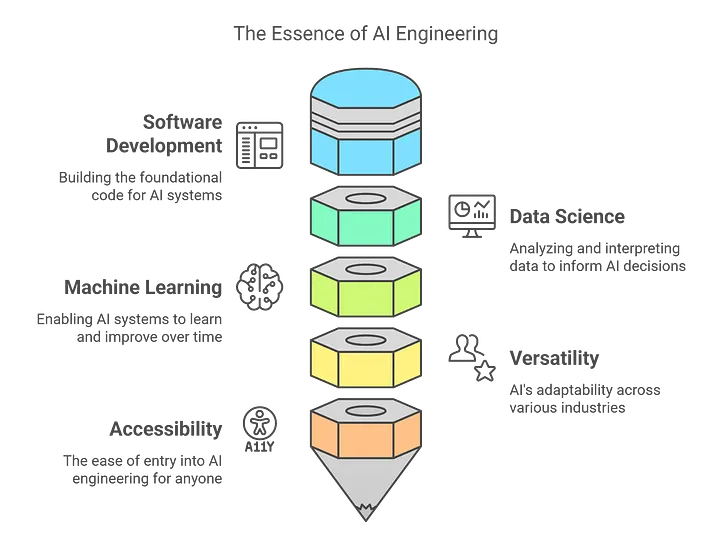
Imagine building something like a smart assistant that can schedule meetings, answer questions, and even respond in a natural, human-like way. That is the core idea behind AI engineering. Tools like ChatGPT and Google Assistant are perfect examples of what AI engineers create. It is not just about writing code. It is about designing systems that can learn from data, adapt over time, and make decisions based on patterns. This is exactly what you will be working on when you follow the path of how to become an ai engineer in 2026 without a degree.
AI engineering sits at the intersection of software development, data science, and machine learning. You are not just building apps, you are teaching machines how to understand information, predict outcomes, and improve with experience. This is why the demand for strong AI engineer skills is growing rapidly across industries. From healthcare and finance to entertainment and education, AI is transforming how things work. The best part is that you do not need a traditional degree to get started. With the right mindset, consistent effort, and access to modern tools, you can enter this field and start building real, intelligent systems on your own.
Who is an AI Engineer?
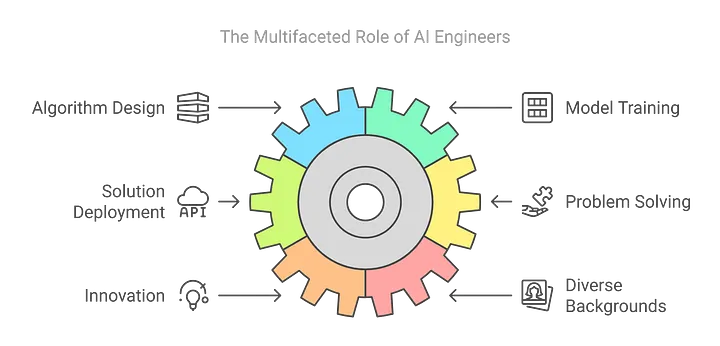
Think of an AI engineer as someone who turns raw data into intelligent systems that can see, hear, and understand the world. They are the people behind technologies like Tesla Autopilot and Google Translate. But they are not just technical experts. They are problem solvers who use AI to build real-world solutions. If you are exploring how to become an ai engineer in 2026 without a degree, this is the role you are aiming for. You are not just coding features, you are building systems that learn and improve over time.
An AI engineer works across multiple areas. They design algorithms, train machine learning models, and deploy systems that can handle real users at scale. This is why having the right AI engineer skills matters so much. You are essentially the bridge between theory and real-world impact. The most interesting part is that many AI engineers do not come from traditional tech backgrounds. People switch from completely different fields because they are curious and willing to learn. With today’s online resources, tools, and communities, this career is more accessible than ever if you stay consistent and focused.
If you are completely new to AI and want an even broader beginner-friendly starting point before going deeper into AI engineering, you can also read How to Learn AI From Scratch in 2026: A Complete Expert Guide. It will help you understand the basics first, so this AI engineer roadmap becomes much easier to follow.
What Do AI Engineers Do and What Are Their Responsibilities?
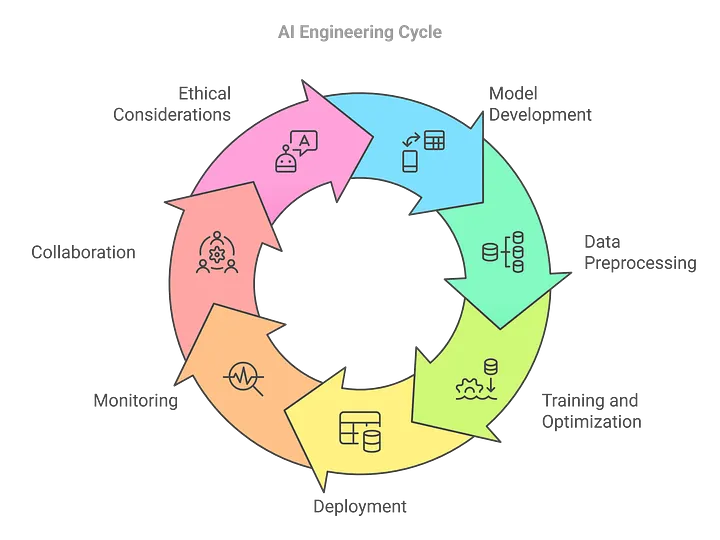
AI engineers are the people working behind the scenes to build the intelligent systems you use every day, whether it is recommendations on YouTube or personalized feeds on Instagram. If you are exploring how to become an ai engineer in 2026 without a degree, understanding what they actually do is a big step forward. Their role is not limited to just coding. They work across the full lifecycle of an AI system, from preparing data to deploying models that people can use in real-world applications.
To make it simple, here are the core responsibilities you will be handling as you follow this path, especially when building real AI engineer projects for beginners:
- Model Development: Creating algorithms that can learn from data and make predictions
- Data Preprocessing: Cleaning and organizing raw data so the model gets high-quality input
- Training and Optimization: Improving models step by step to get better accuracy and performance
- Deployment: Integrating the model into apps or systems so real users can interact with it
- Monitoring: Continuously checking performance and updating models when needed
- Collaboration: Working with developers, product teams, and stakeholders to build useful solutions
- Ethical Considerations: Making sure the system is fair, transparent, and free from bias
In simple terms, AI engineers are the backbone of modern AI products. They make sure these systems are not only powerful but also reliable and useful for real people.
What Skills Do AI Engineers Need?
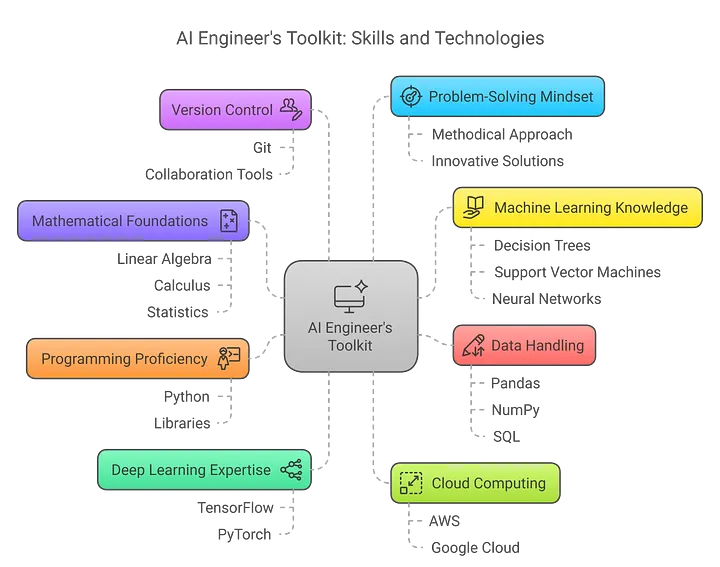
If you are serious about learning how to become an ai engineer in 2026 without a degree, the first thing you need to understand is the skill set. The good news is you do not need to learn everything at once. AI engineering is a mix of a few core areas that you can build step by step. Many tools you see today, like TensorFlow and PyTorch, are designed to make this journey easier for beginners as well.
Here are the essential skills you should focus on, especially if you are following a practical AI engineer roadmap 2026:
- Programming Proficiency: Learning Python is the most important starting point since it is widely used in AI development
- Mathematical Foundations: Basic understanding of linear algebra, statistics, and probability helps you understand how models work
- Machine Learning Knowledge: Knowing core algorithms like decision trees and neural networks is essential
- Deep Learning Skills: Using frameworks like TensorFlow or PyTorch to build more advanced models
- Data Handling: Working with tools like pandas, NumPy, and SQL to clean and manage data
- Cloud Computing: Understanding platforms like AWS or Google Cloud to deploy real-world applications
- Version Control: Using Git to manage code and collaborate with others
- Problem-Solving Mindset: Thinking logically and breaking down complex problems into simple steps
The key is to start small, build simple projects, and improve gradually. You do not need to master everything in the beginning. Consistency matters more than speed in this journey.
If you want to go deeper into the most valuable skills to focus on first, you can also read Top 7 AI Skills That Can Make You Rich in 2026. It will help you understand which AI skills are most useful for career growth, freelancing, and future income opportunities.
Key Responsibilities of an AI Engineer

AI engineers are the people who turn ideas into real, working intelligent systems. Whether it is improving recommendations on Amazon or powering smart assistants like Alexa, their work directly impacts how technology feels to users. If you are learning how to become an ai engineer in 2026 without a degree, this is where you start seeing how your skills translate into real-world impact.
Here are the key responsibilities you will handle as you grow in this field, especially when working on real AI engineer portfolio projects:
- Designing Intelligent Systems: Understanding real problems and building AI solutions to solve them
- Collaborating Across Teams: Working with developers, product managers, and business teams to align goals
- Managing Model Lifecycles: Handling everything from building and testing to deploying and maintaining models
- Ensuring Ethical AI: Making sure systems are fair, unbiased, and responsible
- Continuous Learning: Keeping up with new tools, frameworks, and trends in AI
In simple terms, AI engineers combine technical skills with real-world thinking. They are not just building models, they are building solutions that actually work and create value.
Why Become an AI Engineer?
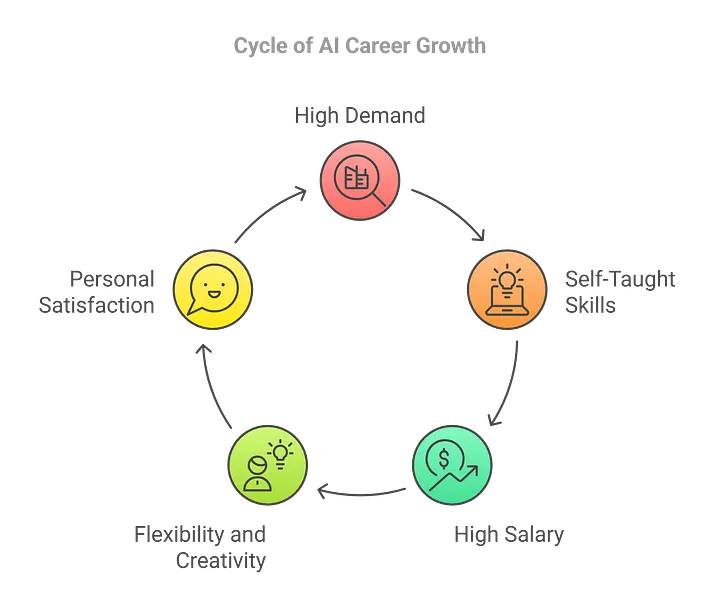
AI is no longer just a trend. It has become a core part of how modern technology works. From personalized recommendations on Amazon to navigation systems in Tesla, AI is everywhere. If you are thinking about how to become an ai engineer in 2026 without a degree, this is one of the most powerful and future-proof career choices you can make right now.
First, the demand is massive. Companies across industries are actively looking for people who can build intelligent systems. Whether it is startups or large tech companies, everyone wants AI solutions like recommendation engines, automation tools, and predictive systems. This means more job opportunities and faster career growth compared to many other fields.
Second, you do not need a traditional degree. This is one of the biggest advantages. Many successful AI engineers today are self-taught. They learned through online courses, built projects, and gained practical experience. If you are consistent and focused, you can follow the same path without going through a traditional college route.
Third, the earning potential is very high. AI engineers are among the highest-paid professionals in tech. Even beginner roles can offer strong salaries, and as you grow your skills, your income can increase significantly. This is especially true if you develop expertise in areas like machine learning, cloud, or natural language processing.
Fourth, you get flexibility and creative freedom. You can work remotely, freelance, or even build your own AI-based products. This is not just a job, it is a skill that allows you to create solutions, start businesses, and work on ideas that actually make an impact.
Finally, it is genuinely exciting work. Building systems that learn and improve over time feels incredibly rewarding. Following a clear AI engineer roadmap 2026 and seeing your projects come to life gives you a sense of progress that very few careers offer. You are not just using technology, you are shaping the future with it.
Why Become an AI Engineer?
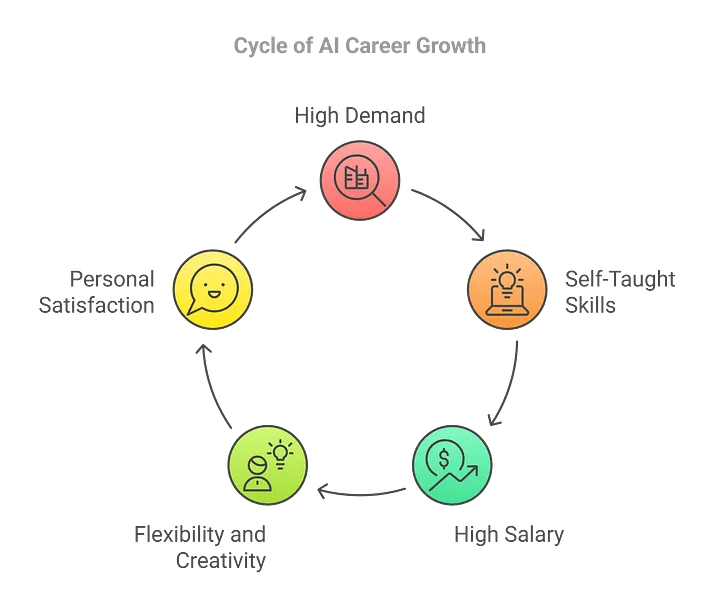
AI is no longer just a buzzword. It has become a core part of how modern technology works, powering everything from smartphone features to advanced systems in companies like Tesla and Google. If you are thinking about how to become an ai engineer in 2026 without a degree, this is one of the most future-proof and high-impact career paths you can choose today.
First, the demand is extremely high. Almost every company today wants to build intelligent systems, whether it is recommendation engines, automation tools, or predictive models. From startups to global tech companies, there is a constant need for people who can build and manage AI systems. This demand is only increasing, which means more opportunities for beginners who are willing to learn and build.
Second, you do not need a traditional degree. This is one of the biggest advantages of this field. Many AI engineers today are self-taught. They learned through online courses, built projects, and gained practical experience instead of following a conventional academic path. If you stay consistent and focus on building real skills, you can achieve the same results.
Third, the earning potential is very strong. AI engineers are among the highest-paid professionals in the tech industry. Even entry-level roles can start at six figures, and mid to senior-level roles can easily reach $200K or more, especially if you specialize in areas like cloud, natural language processing, or computer vision.
Fourth, there is flexibility and creative freedom. You can work remotely, freelance, or even build your own AI-powered products. This career is not limited to a fixed job role. You can explore different opportunities, experiment with ideas, and create solutions that solve real-world problems. Many people even use their skills to start their own businesses.
Finally, the work itself is exciting and rewarding. Building systems that can learn and improve over time feels powerful. Following a clear path like best projects to become an AI engineer portfolio helps you see real progress as you grow. You are not just using technology, you are creating intelligent systems that can impact how people live and work.
Do I Need a Degree to Become an AI Engineer?
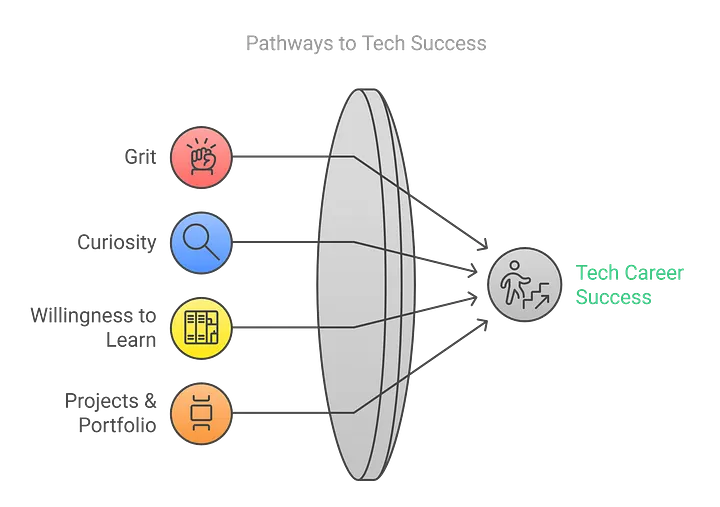
Short answer, no. Long answer, absolutely not. If you are thinking about how to become an ai engineer in 2026 without a degree, you should understand that a formal degree is no longer the deciding factor. What matters now is your ability to learn, build, and show real results. You do not need a computer science background or a tech degree. What you need is curiosity, consistency, and the willingness to learn by doing.
Many top companies like Google, Apple, and IBM have already removed strict degree requirements for several roles. Instead of focusing on qualifications, they look at your projects, your portfolio, and your proof of work. If you have built useful tools, shared them on platforms like GitHub, and can clearly explain how they work, you are already ahead of many graduates. This is why following a practical path like best free resources to learn AI engineering in 2026 can take you much further than traditional learning alone.
Still unsure? Think about this:
- Have you learned how to code in Python?
- Have you built a small project with scikit-learn or PyTorch?
- Have you written about what you’ve learned?
If your answer is yes, then you are already on the right path. You do not need a degree or approval from anyone. You just need skills, consistency, and the willingness to keep improving.
Life as an AI Engineer

Once you step into this field, life as an AI engineer is dynamic, creative, and constantly evolving. If you are working toward how to become an ai engineer in 2026 without a degree, it helps to understand what your daily life might actually look like. You are not stuck doing repetitive tasks. Instead, you are solving problems, experimenting, and building systems that improve over time.
First, your day-to-day work is a mix of experimentation and collaboration. You might start your day by adjusting a model, testing its performance, and analyzing results. Later, you could be discussing ideas with your team or improving how your system behaves in real-world conditions. It is a balance between technical work and creative thinking.
Second, your tools and workflow are very practical. You will often work with tools like Jupyter Notebook and Docker, along with cloud platforms and version control systems. A lot of your work will involve Python, data handling, and testing different approaches to improve your models. This is where strong AI engineer skills really come into play.
Third, the impact of your work is very real. You are not just writing code. You are building systems that can make decisions, understand inputs, and learn from data. Your work could help detect diseases, improve learning platforms, or prevent fraud. This makes the role both meaningful and rewarding.
Fourth, you get flexibility in how and where you work. Remote work is very common in this field. You can work from home, a café, or even while traveling. This flexibility allows you to design a work style that fits your lifestyle.
Finally, the learning never stops. One week you might be working on a chatbot, and the next you could be improving a recommendation system. The field evolves quickly, so staying curious and continuously learning is part of the job. That is what makes this career exciting and full of growth opportunities.
What is the Average AI Engineer’s Salary? (2026 Breakdown)
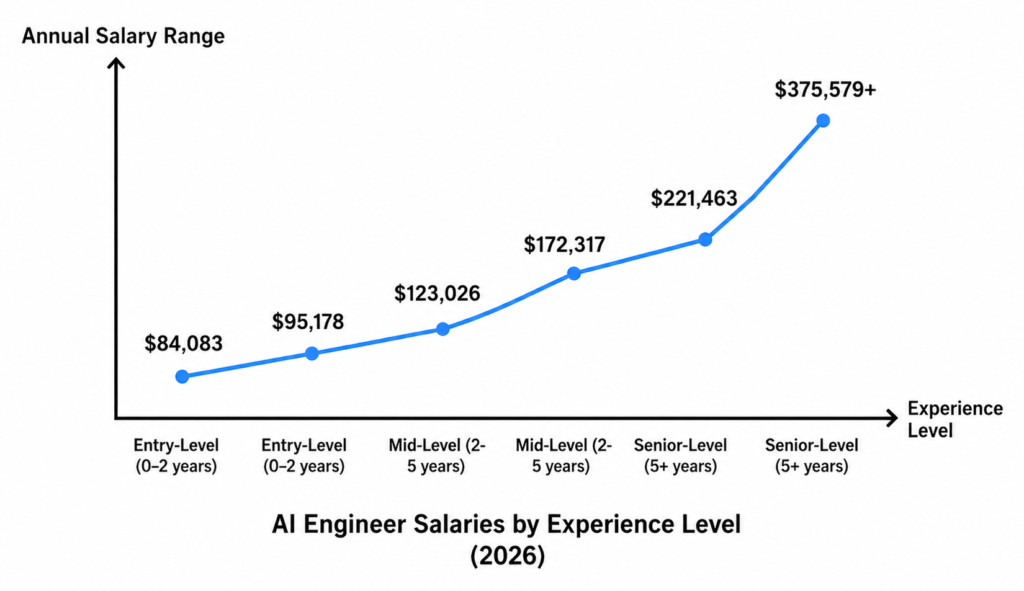
Let’s talk numbers, because AI engineering does not just pay well, it pays very well. If you are exploring how to become an ai engineer in 2026 without a degree, this is one of the biggest reasons people choose this path. Salaries are strong right from the beginning and grow quickly as you gain experience.
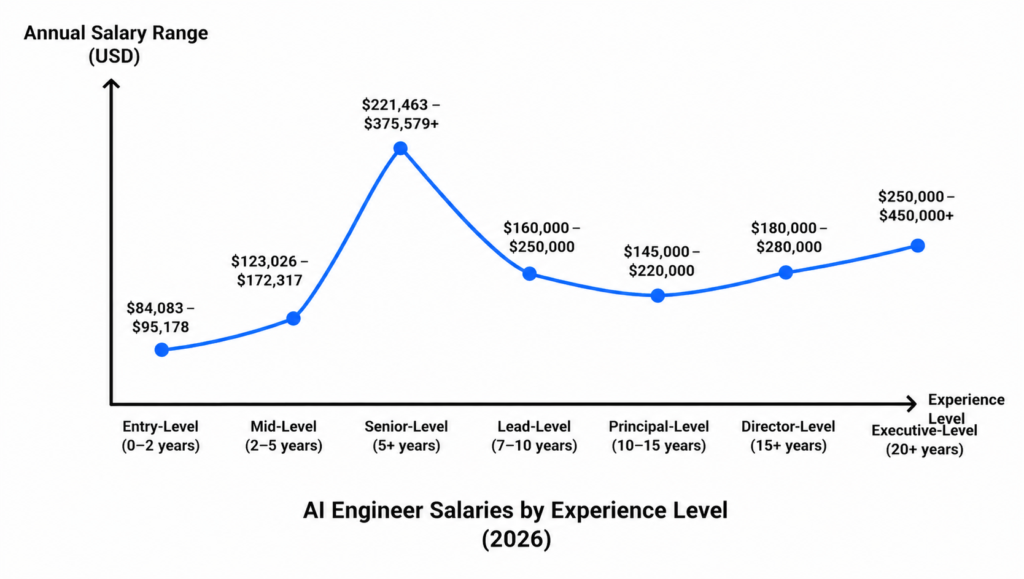
Here is how AI engineer salaries typically look based on experience level:
- Entry-Level (0–2 years): $84,083 to $95,178/year (Source: Salary.com)
You are just getting started, but you are already way above average compared to many other tech roles. - Mid-Level (2–5 years): $123,026 to $172,317/year (Source: Glassdoor)
By this stage, you have built a few systems, possibly deployed them on the cloud, and worked with real-world datasets. Employers value this experience highly. - Senior-Level (5+ years): $221,463 to $375,579+/year (Source: Glassdoor)
This is where the big earnings come in. If you are leading projects, optimizing deep learning models, or working on MLOps pipelines, your paycheck reflects your expertise.
Also, many companies offer bonuses, stock options, and perks like learning stipends, conference passes, and full remote flexibility. Freelancers in AI are charging anywhere from $25 to well over $100/hour depending on the project. (Source: Upwork)
So yes, AI engineering is not just future-proof, it is financially solid. It is not unusual for experienced engineers to reach a $200K+ compensation within five years, especially if they specialize in NLP, computer vision, or cloud ML. (Source: Coursera) That is why understanding AI engineer salary in 2026 can help you plan your learning path and career goals more clearly.
What Factors Affect an AI Engineer’s Salary?

AI engineering already pays well, but your salary can go even higher depending on a few key factors. If you are working toward how to become an ai engineer in 2026 without a degree, understanding these factors will help you make smarter decisions and increase your earning potential faster.
Here are the main factors that influence how much you can earn, especially if you are following a strong AI engineer skills strategy:
- Industry: AI engineers working in finance, healthcare, or defense often earn more than those in education or nonprofit sectors. Higher risk and higher impact industries usually offer better pay.
- Location: Cities like San Francisco and New York still offer some of the highest salaries. However, remote work is changing this. Skilled engineers from countries like India or regions like Eastern Europe can now earn global-level salaries if they work with international companies.
- Experience: More experience usually means higher pay, but it is not just about years. What you have built matters more. A strong portfolio with real projects can help you grow faster than a traditional resume.
- Specialization: Fields like natural language processing, computer vision, and cloud deployment are in high demand. If you specialize in these areas, you can command higher salaries.
- Certifications: Certifications like AWS Certified Machine Learning, Google Professional ML Engineer, or TensorFlow Developer can help strengthen your profile and make you stand out.
- Portfolio Strength: A strong GitHub profile often matters more than a degree. If your work shows real-world impact, companies will notice.
- Negotiation Skills: This is often overlooked. Knowing how to negotiate your salary and understand your market value can increase your earnings by 10 to 20 percent or even more.
The bottom line is simple. The more valuable and in-demand your skills are, the higher your earning potential will be in this field.
How Do AI Engineer Salaries Compare Globally?
AI engineering is no longer limited to Silicon Valley. It has become a global opportunity, with companies across the world investing heavily in AI talent. If you are exploring how to become an ai engineer in 2026 without a degree, it is important to understand how salaries differ across regions. While demand is high everywhere, your location or your employer’s location can still influence how much you earn.
Here is a snapshot of AI engineer salaries across key regions:
- United States: $140,000–$185,000+ (source: KORE1)
This is still the highest-paying market, especially if you are working with companies like Google or Meta. Startups in this space also offer strong compensation. - Canada: CAD $80,303–$138,445+ (source: Glassdoor Canada)
Cities like Toronto and Vancouver are growing AI hubs. Salaries are competitive, and the overall work-life balance is often considered better. - United Kingdom: £33,863–£69,195+ (source: Glassdoor UK)
London’s fintech industry is expanding rapidly, increasing demand for AI engineers. Other cities like Manchester and Edinburgh are also emerging. - India: ₹4.37L–₹31.40L per annum (source: Glassdoor India)
Cities like Bengaluru, Pune, and Hyderabad are full of AI startups and tech companies. With remote opportunities, many engineers are now earning global-level salaries. - Australia: AUD $90,000–$250,000+ (source: AI Talent On Demand)
Sydney and Melbourne are key locations where AI is growing in sectors like logistics, government, and services. - Germany: €55,000–€100,000+ (source: Turing College)
Strong engineering industries and automotive companies are heavily investing in AI. Technical skills matter more than language in many cases. - Netherlands: €58,166–€112,889+ (source: Glassdoor)
Amsterdam is quickly becoming a tech hub, with increasing demand for AI engineers. - France: €51,514–€83,071+ (source: SalaryExpert)
Cities like Paris, Grenoble, and Toulouse are actively investing in AI research and development.
The most interesting shift is happening because of remote work. Companies are starting to offer global salary ranges based on skills rather than location. This means if you build strong expertise and follow a solid AI engineer salary in 2026 strategy, you can earn at a global level no matter where you live.
Is AI Engineering a High-Paying Career?

Yes, without any doubt. AI engineering is one of the highest-paying careers in tech today, and the demand is only increasing. If you are exploring how to become an ai engineer in 2026 without a degree, this is one of the biggest reasons people are choosing this path. Companies are actively investing in AI, and they are willing to pay premium salaries for people who can build real, working systems.
Why is the pay so high? Here are the key reasons:
- It is hard to find skilled talent: Almost every company wants AI solutions, but there are not enough engineers who can actually build and deploy them. This shortage increases the value of skilled professionals.
- It directly impacts business results: A strong AI model can save companies millions, improve efficiency, and even create new revenue streams. Because of this direct impact, companies are willing to pay top salaries.
- It requires a complex skill set: AI engineering combines programming, mathematics, data handling, and cloud technologies. This mix of skills is not easy to master, which makes experienced engineers even more valuable.
Even at the beginner level, AI engineers start with strong salaries. As you gain experience and specialize in areas like NLP, recommendation systems, or MLOps, your income can grow significantly. This is why understanding AI engineer career path early can help you plan your growth and maximize your earning potential.
On top of that, you also get benefits like stock options, remote work flexibility, and freelancing opportunities. Whether you are working a job or building your own AI-based business, the financial upside in this field is very real.
Top Skills to Learn for an AI Engineer
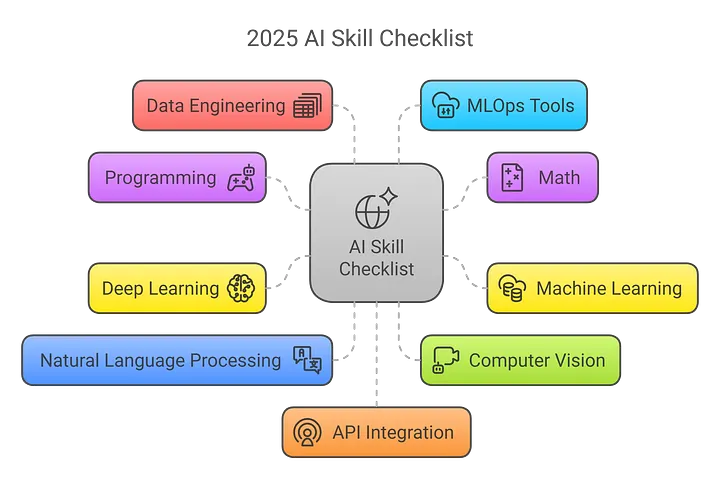
If you are wondering what to actually study to break into this field, here is a practical and no-fluff skill checklist for 2026. If your goal is how to become an ai engineer in 2026 without a degree, these are the real-world skills that companies expect and projects demand. You do not need to master everything at once. Focus on learning step by step and building along the way.
- Programming (Python + SQL)
Python is your main tool. It is simple, flexible, and has libraries for almost everything in AI. From data cleaning to model training, Python handles most of the work. SQL helps you access and manage data stored in databases. Together, they form a strong foundation. - Mathematics (Linear Algebra, Probability, Calculus)
You do not need advanced theory, but understanding how models work is important. Basic concepts in linear algebra, probability, and statistics help you understand why models behave the way they do. - Machine Learning Algorithms
Before going into advanced topics, you need to understand the basics. Models like decision trees, logistic regression, and random forests are widely used. You will learn how to train, test, and improve these models. - Deep Learning
This is where neural networks come in. Deep learning powers things like image recognition and speech systems. Tools like PyTorch and TensorFlow are commonly used to build and train these models. - Natural Language Processing (NLP)
NLP allows machines to understand and work with text data. This is useful for building chatbots, summarizers, and search systems. It is one of the most in-demand areas in AI today. - Computer Vision
This focuses on helping machines understand images and videos. Applications include facial recognition and autonomous systems. Tools like OpenCV and deep learning models are commonly used here. - Data Engineering Basics
AI systems depend on data. You need to know how to clean, process, and manage data efficiently. Building pipelines and handling large datasets is a key part of this. - MLOps Tools
This is where you move from building models to deploying them. Tools like Docker and MLflow help you manage and run models in real-world environments. - API Integration
A model becomes useful only when people can interact with it. APIs help connect your model to apps and websites. Frameworks like Flask or FastAPI are commonly used. - Cloud Platforms (AWS, GCP, Azure)
Most AI systems run on the cloud today. Platforms like AWS and Google Cloud help you deploy and scale your models for real users. - Ethics and AI Fairness
AI systems should be fair and responsible. Understanding bias, transparency, and ethical practices is important for building trustworthy systems.
If you want to stand out, focus on one skill at a time and build projects around it. This is the most effective way to develop strong AI engineer skills and move closer to becoming job-ready.
Step-by-Step Process to Start from Scratch to Becoming an AI Engineer (2026 Edition)
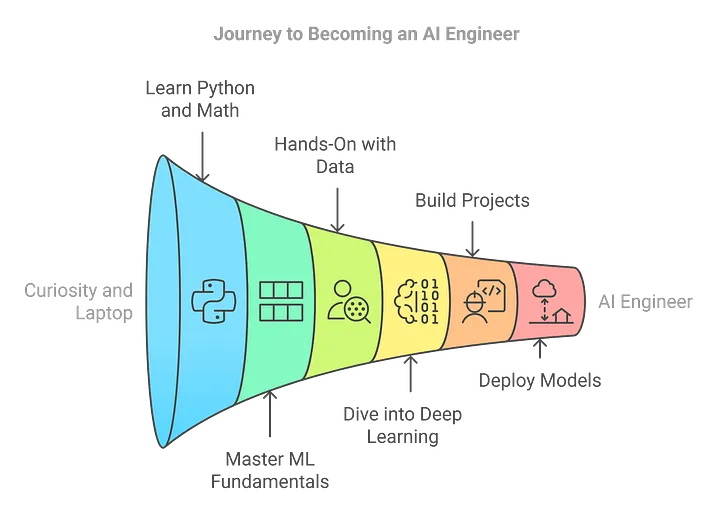
No degree? No problem. In 2026, the path is wide open. If you are serious about how to become an ai engineer in 2026 without a degree, all you really need is a laptop, internet, and the willingness to learn by building. You do not need to wait for a university or follow a traditional route anymore. People are learning online, creating real projects, and getting hired based on their work.
This guide will walk you through a clear AI engineer roadmap 2026, helping you go from complete beginner to someone who can build and deploy real AI models. Whether you are starting from zero or switching careers, the process is simple. Learn the fundamentals, practice consistently, build projects, and improve step by step.
Let’s break it down.
Step 1: Learn Python & Basic Math
Your first step is simple. Start with Python. It is beginner-friendly, easy to read, and the most widely used language in AI and data science. If you are serious about how to become an ai engineer in 2026 without a degree, this is where your journey begins. A great starting point is the “Python for Everybody” course by Dr. Chuck on Coursera. It is slow-paced, practical, and perfect if you are starting from zero.
While learning Python, begin building a basic understanding of math. You do not need advanced theory, just the fundamentals that help you understand how AI models work:
- Linear algebra: Helps you understand vectors and matrices used in neural networks
- Statistics: Helps you understand data patterns and model outputs
- Basic calculus: Helps you understand how models learn and improve over time
To learn these concepts effectively, you can explore:
- 3Blue1Brown for visual explanations like “Essence of Linear Algebra” and “Statistical Thinking”
- Khan Academy for simple and practical math lessons
Along with this, start practicing Python regularly. Install Jupyter Notebook, experiment with variables and functions, and solve beginner-level problems on platforms like HackerRank or LeetCode. This hands-on practice is essential if you want to learn Python for AI beginners step by step and build a strong foundation.
Step 2: Master Machine Learning Fundamentals
Once you are comfortable with Python and basic math, the next step is to learn machine learning. This is the core of AI, where you understand how systems learn from data and make decisions. If you are following how to become an ai engineer in 2026 without a degree, this is where things start to feel real. You move from writing simple code to building models that can actually predict and classify.
To get started, focus on a few beginner-friendly resources that explain concepts clearly and help you practice at the same time:
- Andrew Ng’s Machine Learning course on Coursera
It is slightly math-focused, but the explanations are clear and structured, making it one of the best foundations available. - Machine Learning Crash Course by Google
This course is more interactive, with hands-on exercises and visual explanations that make concepts easier to understand. - Practical Deep Learning course by fast.ai
This approach focuses on building first and understanding theory later, which is great for practical learners.
At the same time, start working with tools like scikit-learn. It allows you to train models like decision trees, linear regression, and k-nearest neighbors with very little code. Build simple projects like predicting housing prices or classifying spam emails. This hands-on practice is the best way to understand how to learn machine learning for beginners step by step and gain real confidence.
Step 3: Get Hands-On with Data
Theory will only take you so far. Real progress starts when you actually work with data. If you are serious about how to become an ai engineer in 2026 without a degree, this step is where your learning becomes practical. You do not need to build complex systems yet. Start small, but make sure you start.
Here is what you should focus on:
- Use real-world datasets:
Go to platforms like Kaggle and pick beginner-friendly datasets such as Titanic survival or housing prices. These datasets are perfect for learning how real data looks and behaves. - Learn data handling and visualization:
Use tools like pandas to clean and organize data, and libraries like matplotlib and seaborn to visualize patterns. Try to understand the data instead of just running models on it. - Work in Jupyter Notebooks:
Use notebooks to write and organize your code clearly. It helps you combine code, explanations, and results in one place, which is very useful for learning and showcasing your work. - Upload your work to GitHub:
Share your projects on GitHub. This becomes your portfolio and proof of work, which is extremely important when applying for jobs or freelance opportunities.
At this stage, your goal is not to build perfect models. Focus on understanding the full process, from loading data to cleaning it, building a model, and sharing your results. This is the foundation of real-world AI work and a key part of how to practice data science projects for beginners at home.
Step 4: Dive into Deep Learning
Now you are ready to move into deep learning, which is where AI starts to feel powerful. This is the stage where you build neural networks that can recognize images, understand text, and even generate content. If you are following how to become an ai engineer in 2026 without a degree, this step takes you from basic models to more advanced, real-world applications.
To get started, focus on learning through structured resources and hands-on practice:
- Learn from advanced courses:
Start with the Deep Learning Specialization by DeepLearning.AI. It builds on machine learning concepts and goes deeper into neural networks and real applications. - Use popular frameworks:
Begin working with TensorFlow or PyTorch. These are the most widely used tools for building and training deep learning models. - Build simple neural network projects:
Try creating models for tasks like digit recognition using the MNIST dataset or basic image classification. These projects help you understand how neural networks actually work. - Explore modern AI tools:
Use Hugging Face Transformers to work with advanced models like BERT, GPT, and RoBERTa. You can build projects like sentiment analysis on tweets or a simple chatbot.
At this stage, your projects will start to feel much more powerful and practical. This is also where you begin to understand how to learn deep learning from scratch with projects, which is essential for moving toward real AI engineering roles.
Step 5: Build and Showcase Projects
At this stage, your focus should shift to visibility. Learning is important, but showing your work is what actually gets you opportunities. If you are serious about how to become an ai engineer in 2026 without a degree, this is where you start standing out. Real projects prove your skills far better than any certificate.
Here are some project ideas you can build to strengthen your portfolio:
- Movie recommendation system:
Build a system that suggests movies using collaborative filtering, similar to what platforms like Netflix use. - Image classification model:
Create a model that can identify things like plant diseases or different dog breeds using computer vision. - Chatbot application:
Develop a chatbot that can answer common customer questions or provide basic assistance. - Fraud detection system:
Use anomaly detection techniques to identify unusual patterns in transactions.
Once you build these projects, present them properly. Upload everything to GitHub with a clear README, sample outputs, and if possible, a short demo video. You can also create a simple portfolio using tools like Notion, Framer, or GitHub Pages to showcase your work in a clean way.
This is exactly how you demonstrate best AI projects for portfolio to get a job. When hiring managers review your profile, they are not just looking for knowledge. They want to see if you can actually build something useful and real.
Step 6: Learn APIs, Deployment and MLOps
Building a model is a great start, but the real value comes when people can actually use it. If you are serious about how to become an ai engineer in 2026 without a degree, you need to learn how to take your models out of notebooks and turn them into real, usable systems. This is where you move from learning to engineering.
Here are the key things you should focus on:
- Build APIs for your models:
Use frameworks like Flask or FastAPI to create APIs that allow applications to interact with your models. - Deploy your projects online:
Host your models on platforms like Heroku, Render, Vercel, or cloud services such as Amazon Web Services so they can be accessed by real users. - Learn containerization:
Use Docker to package your application so it can run smoothly in different environments. - Automate and track your workflow:
Use GitHub Actions to automate deployments and tools like MLflow to track experiments and monitor model performance.
This step is crucial because it teaches you how to deploy machine learning models in production step by step. It shows that you are not just building models for practice, but you can actually deliver working solutions that people can use.
Step 7: Collaborate and Contribute
AI is not something you build in isolation. It is a field where collaboration plays a huge role in growth. If you are working toward how to become an ai engineer in 2026 without a degree, getting involved with the community can speed up your learning and open new opportunities. You start learning from others, getting feedback, and understanding how real-world projects are built.
Here is how you can get started:
- Join AI communities:
Be part of Discord groups and communities like FlowGPT where people discuss projects, tools, and ideas. - Contribute to open-source projects:
Explore repositories on GitHub and look at issues in projects like scikit-learn, LangChain, or Transformers. Even small contributions help you learn and build credibility. - Share your work publicly:
Post your projects, learnings, and progress on platforms like LinkedIn, X, or Medium. This helps you build your personal brand.
This step is important because it teaches you how to contribute to open source AI projects as a beginner. When you consistently share and contribute, people start noticing your work. You get feedback, improve faster, and eventually attract opportunities like internships, freelance projects, or job offers.
Step 8: Apply for Jobs Early
Do not wait until you feel completely ready. That moment rarely comes. If you are serious about how to become an ai engineer in 2026 without a degree, start applying as soon as you have a few solid projects. Every application teaches you something and helps you improve faster.
Make sure you:
- Update your LinkedIn profile to say “Aspiring AI Engineer,” with a clean summary and links to your projects
- Apply on the right platforms: Wellfound (startups), AIJobs.ai (AI-focused), Otta (modern tech firms), and RemoteOK (remote gigs)
- Stay consistent even with rejections: You will face rejections, but you will also gain feedback, build connections, and grow your confidence
This step is important because it teaches you how to apply for AI jobs as a beginner with no experience. The more you apply, the better you understand what companies are looking for and how to position yourself effectively.
Step 9: Stay Updated
AI moves fast, and that is something you need to accept early. What is trending today can become outdated in a few months. If you are working toward how to become an ai engineer in 2026 without a degree, staying updated is not optional, it is part of the job. The more aware you are of new tools and trends, the stronger your advantage becomes.
Here is how you can stay updated effectively:
- Follow AI newsletters:
Subscribe to newsletters like Ben’s Bites, TLDR AI, and The Batch by DeepLearning.AI to stay informed about the latest updates. - Track active GitHub projects:
Explore repositories on GitHub such as LangChain, Hugging Face, and OpenAI Cookbook to see what developers are building in real time. - Experiment with new tools:
Try out tools and models like Claude, Gemini, LlamaIndex, and Whisper. Hands-on experience helps you understand trends better than just reading about them. - Engage with the community:
Join webinars, read blog posts, and participate in virtual hackathons to stay connected with the industry.
This step is important because it teaches you how to stay updated with latest AI tools and trends in 2026. Your biggest advantage as an AI engineer is your ability to adapt, stay curious, and keep building consistently.
This roadmap is not about getting everything perfect on your first try. It is about staying consistent, learning by doing, and building real projects that show your skills.
In AI, your work speaks louder than any degree ever could.
Best Online Courses for AI Engineers (Sorted by Experience Level)

Let’s be honest, searching for AI courses online can get overwhelming very quickly. There are thousands of options, and it is easy to fall into endless research without actually starting. If you are serious about how to become an ai engineer in 2026 without a degree, the goal is simple. Pick the right courses and start learning, instead of overthinking.
That is why this list is carefully curated based on real value. These are not just popular courses, they are practical, beginner-friendly, and focused on building real skills. Whether you are just starting or already learning, this guide will help you choose the right path based on your level. If you are looking for the best online courses to become an AI engineer in 2026, these are the ones that professionals recommend, hiring managers respect, and learners actually benefit from.
Beginner-Level Courses (Ideal for Complete Newcomers)
If you are just starting out with no coding background and no AI experience, this is where you should begin. These courses are simple, beginner-friendly, and designed to help you ease into the field without feeling overwhelmed. If your goal is how to become an ai engineer in 2026 without a degree, starting with the right foundation is the most important step.
Here are some of the best beginner-level courses to get you started:
- AI for Everyone — Andrew Ng (Coursera)
This is a perfect starting point if you want to understand AI without writing code. It explains what AI can and cannot do, how it is used in business, and how to think about AI systems. - Python for Everybody — Charles Severance (Coursera)
One of the most recommended courses for beginners. It teaches Python in a simple and practical way, helping you write code, work with data, and build a strong base. - Google Machine Learning Crash Course
A free and interactive course created by Google. It covers key concepts like loss functions, overfitting, and feature engineering while allowing you to experiment with TensorFlow directly. - Introduction to Data Science — IBM (Coursera)
A great course if you want a broader understanding of data. It covers data collection, cleaning, visualization, and basic machine learning concepts. - Programming for Data Science — Udacity
This course gives you a strong foundation by combining Python, SQL, and Git, which are essential tools for anyone entering AI.
If you are looking for the best AI courses for beginners with no coding experience, these options will help you build a solid foundation and move forward with confidence.
Intermediate-Level Courses (For Learners with Basic Python and ML Exposure)
Once you have completed a few beginner courses or built small projects, it is time to go deeper. This is where you start working with real machine learning concepts and tools in a more structured way. If you are following how to become an ai engineer in 2026 without a degree, this stage helps you move from basic understanding to practical skill-building.
Here are some of the best intermediate-level courses to level up your knowledge:
- Machine Learning — Andrew Ng (Coursera)
This is one of the most well-known courses in AI. It covers algorithms like logistic regression, support vector machines, and neural networks. The math can feel challenging at times, but the explanations are clear and give you a strong foundation. - CS50’s Introduction to AI with Python — HarvardX
A more structured course that focuses on core AI concepts like search algorithms, probabilistic models, and neural networks. It also includes hands-on projects such as building a Sudoku solver or an AI-based game. - Intro to TensorFlow for Deep Learning — Udacity
Created in collaboration with Google, this course focuses on building neural networks using TensorFlow. It is practical and helps you move into deep learning step by step. - Practical Deep Learning for Coders — fast.ai
This course focuses on building real models from the beginning. You start by training powerful models and then gradually understand the theory behind them. It is highly respected for its real-world approach. - IBM Applied AI Specialization — Coursera
A practical series that walks you through building applications like chatbots, computer vision tools, and visual recognition systems with minimal focus on complex math.
If you are looking for the best intermediate AI courses for machine learning and deep learning, these options will help you build real skills and prepare you for advanced topics and real-world projects.
Advanced-Level Courses (For Those Aiming to Build and Deploy at Scale)
If you are already comfortable training models and want to move toward a professional level, this is your stage. Here, you focus on building complete systems, scaling models, and working on real production environments. If your goal is how to become an ai engineer in 2026 without a degree, this level helps you transition from learning to becoming industry-ready.
Here are some of the best advanced-level courses to take your skills further:
- Deep Learning Specialization — DeepLearning.AI (Coursera)
This series covers neural networks, convolutional and recurrent networks, sequence models, and more. It includes coding assignments and practical insights for building production-ready systems. - Full Stack Deep Learning — Berkeley
This course focuses on building and launching real AI products. You will learn about dataset management, training pipelines, monitoring systems, and deploying models at scale. - MLOps Zoomcamp — DataTalksClub
A free and highly practical course that teaches how to turn machine learning models into scalable systems. You will work with tools like Docker, Prefect, and MLflow, and deploy models on cloud platforms. - Advanced Machine Learning Specialization — HSE University (Coursera)
This course dives deeper into advanced topics like reinforcement learning, Bayesian methods, and natural language understanding. - Generative AI with LLMs — DeepLearning.AI (Coursera)
A modern course focused on working with large language models like GPT. You will learn how to fine-tune models and build real-world applications using generative AI.
If you are aiming to master advanced AI engineering skills for real-world deployment, these courses will help you build, scale, and deliver complete AI solutions at a professional level.
Tips for Getting the Most Out of These Courses
Taking courses is important, but how you use them matters even more. If you are serious about how to become an ai engineer in 2026 without a degree, you need to focus on applying what you learn, not just completing lessons.
- Pair theory with application
Do not rely only on watching lectures. If you are learning from a course, apply it at the same time by working on small projects using real datasets from platforms like Kaggle. - Do not just watch, build
The real value comes from creating projects. Upload your work on GitHub and treat it like your portfolio. This matters much more than collecting certificates. - Use extra resources when needed
If you get stuck, do not stop. Use YouTube tutorials, blog guides, or open-source repositories to understand concepts better and keep moving forward. - Focus on outcomes, not completion
Finishing a course is not the goal. Building a working project, writing about what you learned, or creating a demo that others can see is far more valuable. This is how you actually develop AI engineer skills that companies look for.
The key is simple. Learn, apply, and show your work consistently.
Learning AI is a long-term journey, not something you rush. Focus on building a solid foundation, practicing consistently, and improving step by step at your own pace. The people who succeed in this field are the ones who stay curious, keep experimenting, and continue building over time.
Career Path of an AI Engineer
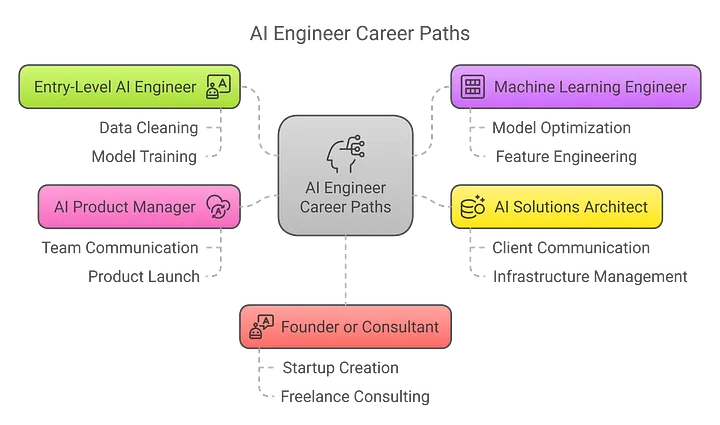
Once you step into this field, your journey does not follow a single straight line. AI engineering offers multiple directions you can grow into, depending on your interests and strengths. If you are working toward how to become an ai engineer in 2026 without a degree, it is important to know that your career path is flexible. You can choose where you want to go based on what you enjoy building and solving.
Here is how your career path can typically evolve, especially if you are following a clear AI engineer career path roadmap:
- Entry-Level AI Engineer
At this stage, you focus on building and training models, cleaning data, and understanding how deployment works. You will collaborate with different teams like data scientists and product managers while gaining hands-on experience. - Machine Learning Engineer
As you gain experience, you start working on larger and more complex projects. You will focus on optimizing models, improving features, and building systems that can scale in real-world environments. - AI Solutions Architect
This role combines technical skills with strategy. You design complete AI systems for businesses, making sure they solve the right problems efficiently. It involves planning, infrastructure, and working closely with stakeholders. - AI Product Manager
If you are interested in both business and technology, this role fits well. You manage AI products, coordinate between teams, and guide ideas from concept to launch. - Founder or Consultant
Many AI engineers eventually move into building their own products or working independently. You can start your own AI-based business or offer your expertise as a consultant or freelancer.
The best part is that all of these paths are open to you. What matters most is not your degree, but your skills, your projects, and your ability to turn ideas into real solutions.
If the founder path interests you, you can also check out Top 10 AI Startup Ideas to Launch in 2026. It will give you practical ideas for turning your AI skills into products, tools, or small businesses instead of only using them for jobs.
Future Scope of AI Engineers

AI is not just growing, it is expanding at a massive pace. If you are starting now and exploring how to become an ai engineer in 2026 without a degree, you are not late. In fact, you are still early in one of the biggest technological shifts happening right now. The opportunities are only going to increase as more industries adopt AI.
Here are some of the major trends shaping the future of AI:
- Multi-Modal AI
Models are now combining text, images, voice, and video into a single system. Tools like ChatGPT are already moving in this direction, where AI can understand and respond across different types of data. - Edge AI
AI is starting to run directly on devices like smartphones, cars, and smart home systems. This allows faster processing with lower latency, without depending completely on the cloud. - Custom LLMs and AutoML
Companies are building their own AI models similar to GPT. At the same time, tools that automate model creation are making it easier for beginners to build AI systems without deep expertise. - AI and Robotics
AI is being integrated with robotics, from drones to advanced machines. This combination is opening up new possibilities in industries like manufacturing, logistics, and automation. - AI Ethics, Safety, and Trust
As AI systems influence real decisions, fairness, transparency, and accountability are becoming critical. Engineers who understand ethical AI practices are in high demand.
In simple terms, AI is becoming a core part of almost every industry. If you build strong future scope of AI engineer career opportunities skills, you will have access to endless possibilities in the coming years.
Why Now is the Best Time to Become an AI Engineer
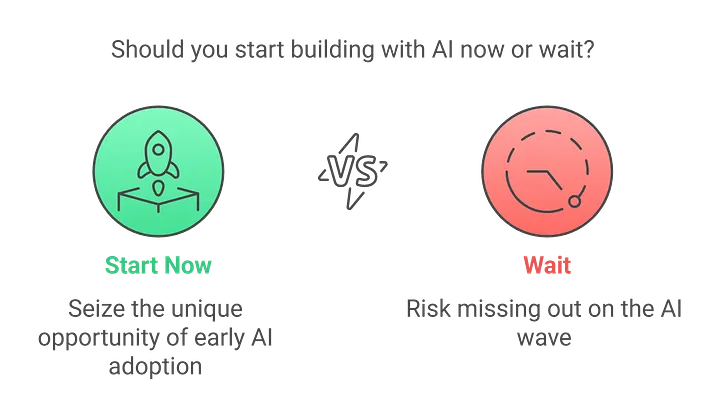
Why now? Because this moment is rare. AI is growing fast, but most people still do not fully understand it, and many businesses are still figuring out how to use it properly. If you are exploring how to become an ai engineer in 2026 without a degree, this gap creates a huge opportunity for anyone willing to learn and build.
Here is why starting today makes sense:
- It is still early
Technologies like large language models and deep learning are still evolving. You are not late, you are entering at the right time. - There are no gatekeepers
You do not need a degree or traditional background. Companies care more about what you can build than what you studied. - Access to tools and learning is easier than ever
Platforms like MIT share high-quality learning resources online, and powerful tools are available to anyone with a laptop. - High income and remote flexibility
You can work from anywhere, earn well, and build products that solve real problems. - It is genuinely exciting work
Building something that can learn and solve problems on its own is incredibly rewarding.
If you are thinking about entering this field, this is the right time. With the right mindset and consistent effort, you can follow a strong best time to start AI engineering career in 2026 path and take advantage of the opportunities ahead.
Conclusion
Let’s keep it simple. AI engineering is not just another job, it is a skill that gives you real leverage in the modern world. If you are exploring how to become an ai engineer in 2026 without a degree, you already have everything you need to get started. You do not need a traditional background or advanced math skills. What matters is your curiosity, consistency, and willingness to build.
The path is straightforward. Start with Python, learn the fundamentals, build real projects, join communities, deploy your models, and share your work. Keep improving step by step. That is how you grow. If you focus on building and stay consistent, you will naturally develop strong AI engineer skills that companies look for.
AI is not going anywhere. It is becoming a core part of industries like healthcare, finance, media, and technology. The people who understand how to build with AI will always be in demand. This gives you the freedom to choose your work, your income, and your direction.
So start now. The tools are available, the opportunities are real, and the future is wide open for you to build something meaningful.
FAQs
- Can I become an AI engineer without coding experience?
Yes, you can. If you are starting from zero, begin with Python because it is beginner-friendly and widely used in AI. There are plenty of free tutorials available online to help you get started with how to become an ai engineer in 2026 without a degree. - How long does it take to become job-ready?
With consistent effort and regular project building, it usually takes around 6 to 12 months to become ready for entry-level roles or freelance opportunities. The timeline depends on how much you practice and build. - Do I need a master’s or PhD to get hired?
No, you do not. In today’s market, your projects and practical skills matter much more than degrees. A strong portfolio can easily make you stand out. - Is AI engineering hard to learn?
It can feel challenging at first, but it is definitely manageable. With modern tools, structured courses, and community support, learning AI is much more accessible than it used to be. Following a clear path like AI engineer roadmap for beginners step by step makes the process much easier. - Can I work as a remote AI engineer?
Yes, absolutely. Many companies now offer remote roles, and freelance opportunities are growing quickly. You can work from anywhere if you have the right skills and a strong portfolio.
Final Thoughts
Here is the reality. AI is no longer something in the future, it is already part of everyday life. It powers the apps you use, the businesses you interact with, and even the conversations you have. Behind every smart feature, there is an engineer who built it. If you are exploring how to become an ai engineer in 2026 without a degree, that role can absolutely be yours.
You do not need permission or a traditional path. What matters is your curiosity, your consistency, and your willingness to learn by building. In today’s world, your skills matter more than your resume. If you can create real projects and show your work, you are already ahead. This is why focusing on how to build AI projects for beginners step by step can completely change your trajectory.
Start small, build consistently, and share what you create. Join communities, apply even if you feel unprepared, and keep improving. You are not just writing code, you are shaping how technology interacts with people.
The best time to start was earlier. The next best time is right now.