Finding an AI Product Management course is easy now. Choosing one that actually teaches AI Product Management is harder.
Some courses spend most of their time on traditional product management and add a few lessons about generative AI. Others assume you already know how products work and move quickly into machine learning, large language models, RAG, AI agents, evaluations, guardrails, and AI product strategy. The right choice depends on what you already know and what you want to learn next.
For this guide, I went through the current curricula to find the best AI product management courses you can take online in 2026. I looked for courses that teach skills you can use when working on an AI product, such as product discovery, AI product requirements, machine learning concepts, LLMs, model evaluation, AI UX, responsible AI, prototyping, and working with technical teams. I also paid attention to whether a course gives you something practical to build instead of stopping at theory.
If you are still trying to understand the career itself, I recommend reading my guide on how to become an AI Product Manager in 2026 first. It explains the role, skills, roadmap, portfolio, and career path in much more detail.
The 10 best AI product management courses in 2026
1. IBM AI Product Manager Professional Certificate
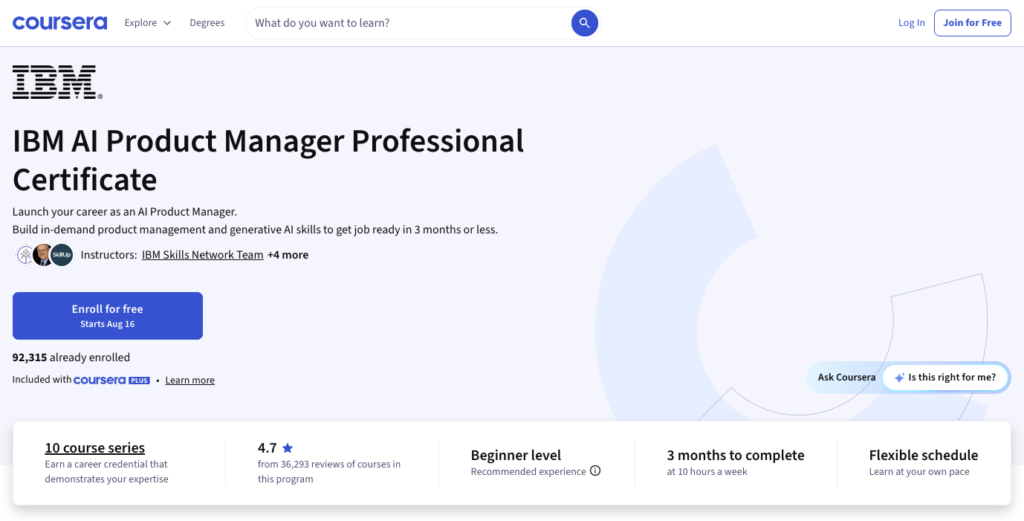
If you are starting from the beginning, the IBM AI Product Manager Professional Certificate is the course I would look at first.
The reason is simple: IBM does not assume that you already understand either side of the job. The current program teaches regular product management topics such as stakeholders, Agile methods, roadmaps, planning, product development, and lifecycle management, then connects them with AI topics such as machine learning methods, generative AI, prompt engineering, AI product strategy, responsible AI, generative model architectures, and AI agents. It is currently structured as a ten-course certificate.
That makes it particularly useful for someone who wants to become an AI Product Manager but has never worked as a traditional Product Manager.
What you will learn:
- Product management fundamentals and the product lifecycle
- Stakeholder and client management
- Agile and adaptive product development
- Product planning and roadmapping
- Artificial intelligence and machine learning fundamentals
- Generative AI and prompt engineering
- AI product strategy
- Responsible AI
- Generative AI agents and modern AI concepts
- Ways to apply generative AI throughout product work
The breadth is the main reason I put IBM at number one. You do not have to piece together a general PM course, an introductory AI course, and a separate generative AI course before things start making sense.
There is a trade-off. A broad beginner program cannot go as far into advanced AI evaluation, agent architectures, RAG systems, or rapid AI product building as some of the more specialized courses later in this list. If you already work as a Product Manager and understand AI fundamentals, I would probably skip ahead to Product School, Product Faculty, or one of the practitioner-led programs.
For a career switcher, however, IBM gives you one of the cleanest starting points among the AI product manager courses online right now.
2. Duke University AI Product Management Specialization
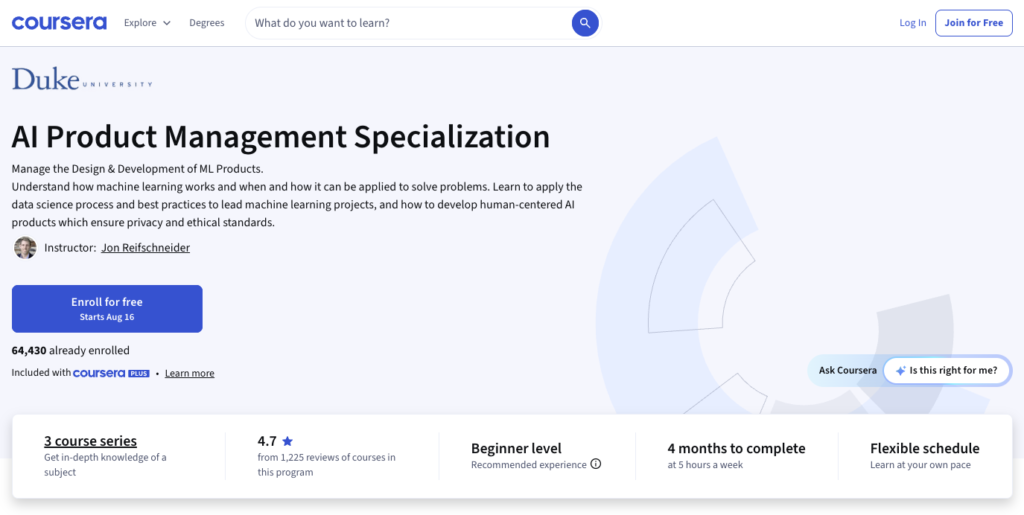
The AI Product Management Specialization from Duke University takes a different approach.
Instead of beginning with generative AI tools, Duke spends more time helping you understand machine learning as a Product Manager. You learn how to recognise problems that make sense for ML, how the data science process works, how models are trained and evaluated, and what happens as an ML product moves toward production.
You also work through human-centered AI, user experience, privacy, ethics, data quality, and model evaluation. The current specialization includes three applied projects, and Coursera explicitly states that programming is not required.
What you will learn:
- How machine learning works at a Product Manager level
- How to identify suitable ML problems
- How data affects an AI product
- Model training and evaluation concepts
- Data quality and data management
- How to manage a machine learning project
- Human-centered AI design
- AI user experience
- Privacy and data ethics
- Responsible AI product decisions
I would choose Duke over IBM if you already understand basic product management and want a stronger mental model of what happens behind an ML product.
This course is especially useful because AI Product Managers have to make decisions involving uncertainty. A normal software feature is usually deterministic. An ML model makes predictions. An LLM can return different answers to similar inputs. Data quality can affect the product itself. A model can perform well on one dataset and poorly after user behaviour changes.
Duke gives you a foundation for thinking about those problems without turning the course into an engineering program.
The curriculum is more ML-oriented than some newer courses that focus heavily on agents, RAG, context engineering, and LLM applications. I do not see that as a reason to dismiss it. If you understand machine learning fundamentals properly, many newer AI concepts become easier to reason about later.
3. Product School AI Product Management Certification
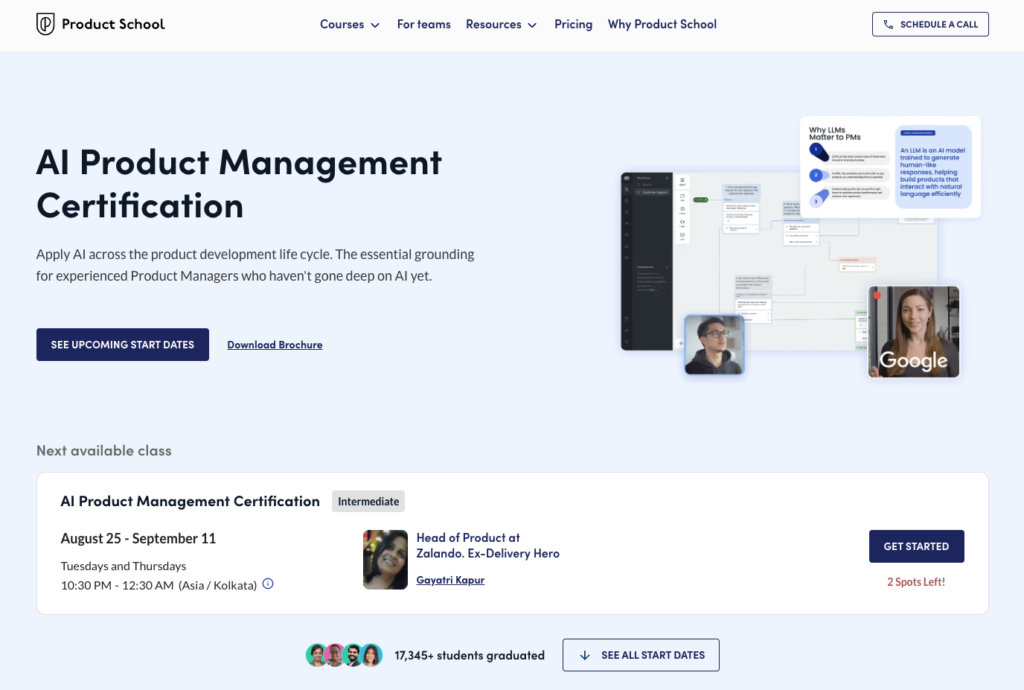
If you already understand regular product management and want a course focused on how AI changes the job, the AI Product Management Certification from Product School is one of the most relevant options I found.
Its current curriculum is much closer to the work Product Managers are doing with generative AI products in 2026. Product School covers AI-specific PRDs, RAG architecture, embeddings and vector stores at a PM level, prompting, AI user experiences, agentic systems, evaluation, guardrails, and the trade-offs that appear when building AI features.
The official curriculum also deals with questions such as cost versus latency and evaluating non-deterministic outputs, which are exactly the kinds of issues that make an AI PRD different from a normal software PRD.
What you will learn:
- How to evaluate AI product opportunities
- How to write an AI-specific PRD
- RAG concepts for Product Managers
- Embeddings, retrieval, and vector-store concepts
- Prompting for product work
- AI-native user experience patterns
- Agentic systems and multi-step workflows
- AI evaluations
- Guardrails and AI quality
- How to turn an AI idea into a more complete product specification
I would put this above many generic “AI for Product Managers” courses because the curriculum goes beyond teaching you how to use ChatGPT to write a user story faster.
There is an important distinction here. Using AI as a Product Manager and managing an AI product are related, but they are not the same skill.
A Product Manager can use an LLM to summarize research without understanding how to scope an AI feature. An AI Product Manager also needs to think about model behaviour, evaluation criteria, retrieval, latency, trust, failure cases, human intervention, and what happens when an AI response is wrong.
Product School now covers much more of that second category.
I would not make this my first PM course if I were completely new to product management. Product School itself says the certification is best suited to people who already understand product workflows. If you have that base, it becomes a much stronger choice.
4. Product Faculty AI Product Management Certification
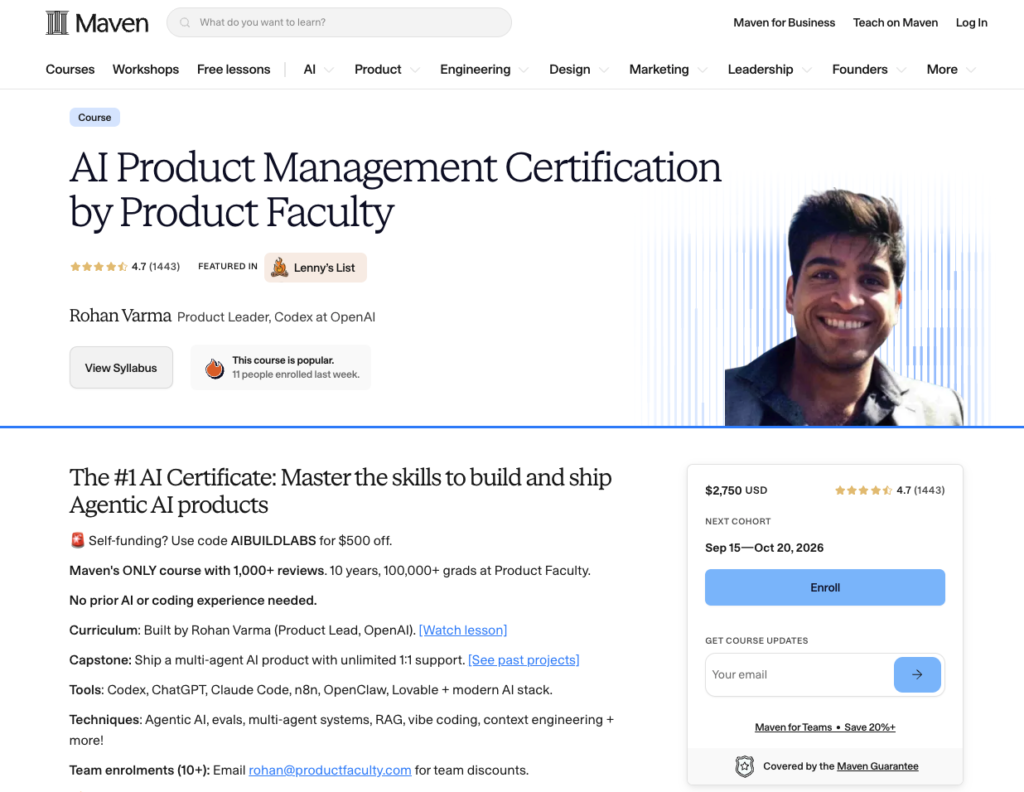
The AI Product Management Certification from Product Faculty is the course I would investigate if my main goal were to become much more comfortable building modern AI products.
Its 2026 curriculum has moved into areas that many older AI PM courses barely touch. The current course covers agentic AI, evaluations, multi-agent systems, RAG, context engineering, AI strategy, AI product metrics, modern AI building tools, and a capstone in which learners build an AI product.
The course is currently led by Rohan Varma, who is listed by Maven as a Product Leader for Codex at OpenAI. Maven also states that prior AI or coding experience is not required.
What you will learn:
- How modern AI products are structured
- RAG and retrieval-based product concepts
- Agentic AI
- Multi-agent systems
- AI evaluations
- Context engineering
- Rapid AI prototyping
- AI product strategy
- AI product metrics
- How to turn an idea into a working AI product
I would describe this as a builder-oriented AI PM program rather than a beginner introduction to product management.
That distinction matters.
You can understand what an AI agent is after reading an article. It is different to decide when an agent should have access to a tool, what context it receives, what happens after a failed action, how you evaluate whether the workflow succeeded, and where a human should remain in control.
Those questions become much easier to understand once you actually build something.
If you already know traditional PM work and want your next course to reflect where AI product development is in 2026, Product Faculty deserves serious consideration.
5. Udacity AI Product Manager Nanodegree
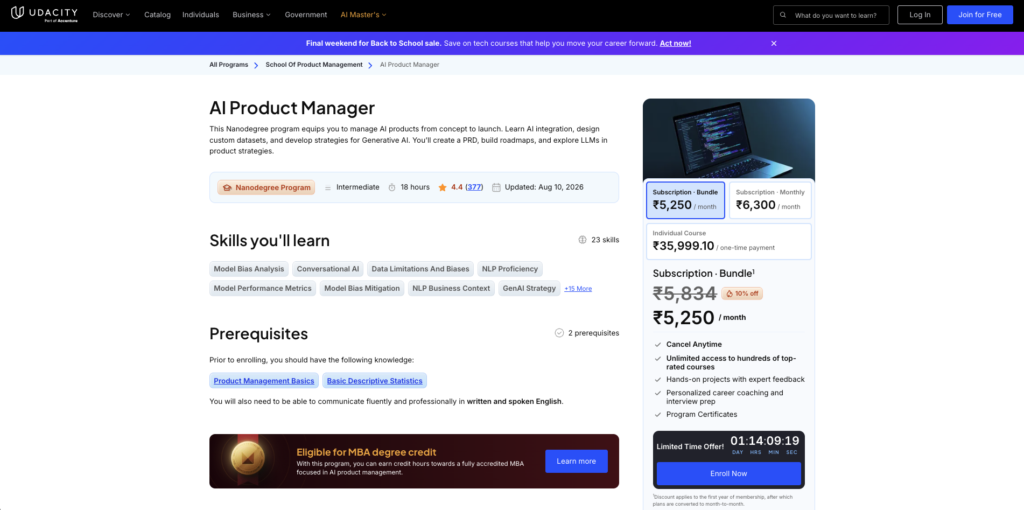
The Udacity AI Product Manager Nanodegree has been around for a while, but Udacity updated the program on January 27, 2026.
The current version covers AI integration, custom datasets, generative AI strategy, product requirements, roadmaps, LLM product strategy, model bias, conversational AI, data limitations, NLP concepts, and model performance metrics. Udacity also lists several projects within the program.
Unlike IBM and Duke, Udacity currently classifies the program as intermediate and expects learners to understand basic product management and descriptive statistics before starting.
What you will learn:
- How to scope an AI product
- AI product requirements
- Product roadmapping for AI projects
- Dataset design and data annotation concepts
- Model performance and evaluation
- Model bias
- Natural language processing concepts
- Conversational AI
- LLM product strategy
- How to work through practical AI product projects
The project component is what makes Udacity interesting to me.
There is an older Reddit discussion from a learner who completed the Nanodegree and specifically mentioned gaining experience through three separate projects involving ML model training, dataset annotation, and an AI product business proposal. The curriculum has since been updated, so I would use that comment as an example of why learners valued the project format rather than as a description of the exact 2026 syllabus.
That is also a useful lesson when choosing between AI product management certification courses. A certificate gives you evidence that you completed a program. A good project gives you something to discuss.
If an interviewer asks how you would evaluate an AI feature, define its dataset, handle poor model performance, or decide whether AI belongs in the product at all, a completed project gives you far more material for that conversation.
6. AI Product Management 101 by Dr. Marily Nika
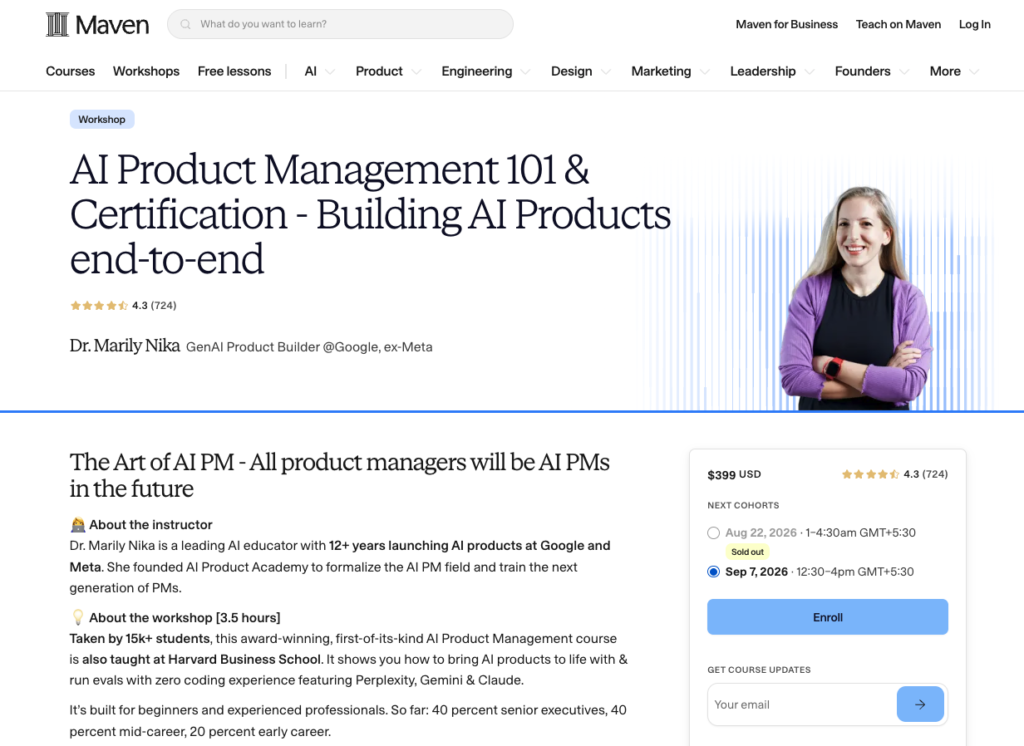
The AI Product Management 101 & Certification course by Dr. Marily Nika is one of the more practitioner-driven options on this list.
Maven currently lists Dr. Marily Nika as a GenAI Product Builder at Google and a former Meta product leader. The current workshop goes through LLMs and AI Product Management, user research, ideation using tools such as Perplexity and Gemini, artifact generation and prototyping with Claude, AI evaluations, and product demos.
That is a very different teaching style from sitting through a long sequence of recorded lessons.
What you will learn:
- AI Product Management fundamentals
- LLM concepts for Product Managers
- AI product discovery
- AI-assisted user research
- AI product ideation
- Creating product artifacts with AI
- Rapid AI prototyping
- Evaluations for AI products
- Presenting and explaining an AI product
- The development process behind AI-powered features
I would consider this course if you learn better by making something and discussing your decisions with other people.
It is also useful for people who already consume a lot of AI information but struggle to turn that information into a product process. Knowing what Claude, Gemini, or an LLM can do is one thing. Turning a user problem into a feature hypothesis, prototype, evaluation plan, and demo forces you to connect the pieces.
For someone moving from a traditional PM role into AI Product Management, that can be more useful than another broad introduction to artificial intelligence.
7. Pragmatic Institute AI Product Management Expert Certification
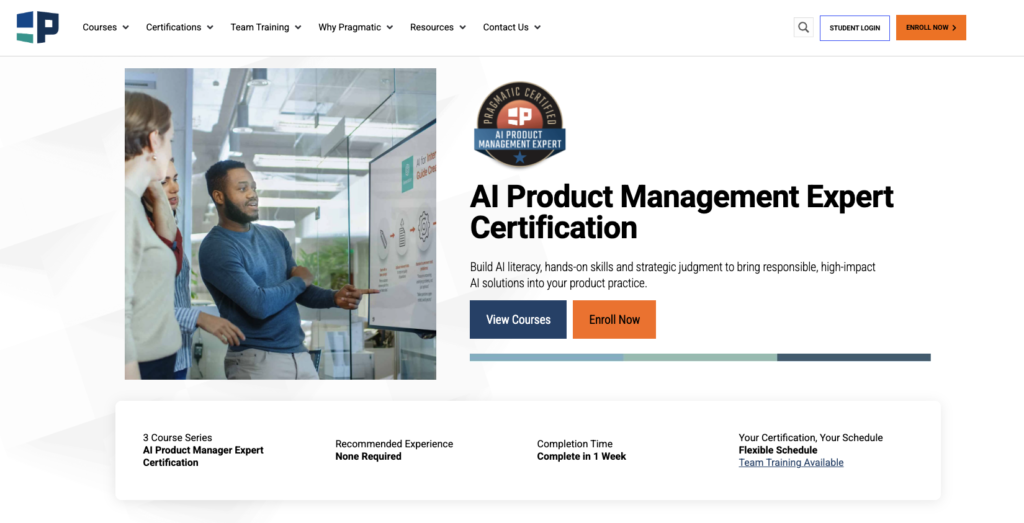
The AI Product Management Expert Certification from Pragmatic Institute combines three areas: general product foundations, using AI inside product management work, and deciding how AI should fit inside a product.
That structure makes sense for Product Managers who want both sides of AI adoption.
The current curriculum covers AI-assisted discovery, competitor research, interview preparation, hypothesis development, prioritization, product concepts, opportunity evaluation, organisational readiness, trust, transparency, autonomy, and responsible AI product decisions.
What you will learn:
- Product and market fundamentals
- AI-assisted product discovery
- Using AI agents for research and analysis
- AI-supported hypothesis development
- Product prioritization
- Faster prototyping with AI
- Finding sensible AI opportunities inside a product
- Assessing whether an organisation is ready for an AI feature
- Trust and transparency in AI experiences
- How much autonomy an AI system should have
What I like about this curriculum is the separation between “AI for Product Managers” and “AI in Your Product.”
Those are easy to mix together.
You may use an AI agent internally to organize customer research while managing a completely non-AI product. In another situation, your customers may interact directly with an AI feature, which creates a different set of questions around behaviour, trust, autonomy, privacy, failures, and measurement.
If you already work in product and want a structured way to think through both situations, Pragmatic is worth considering.
8. Microsoft AI Product Manager Professional Certificate
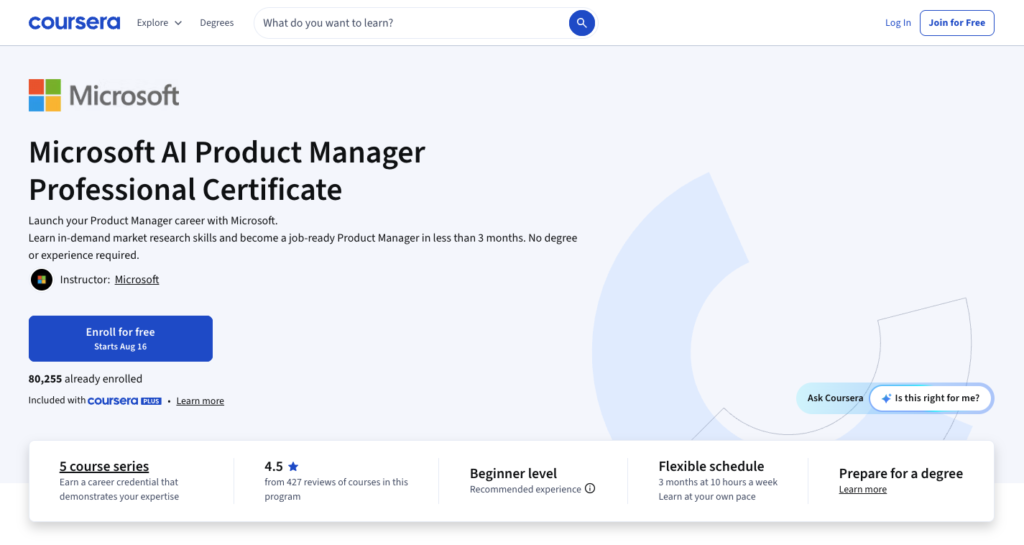
The Microsoft AI Product Manager Professional Certificate is another good option for beginners, although I would position it differently from IBM.
Based on its current five-course curriculum, Microsoft spends a large amount of the program on the broader Product Manager role. It covers product management principles, market research, competitive analysis, product strategy, roadmaps, UX/UI, product development, product launches, quality, and lifecycle management. AI product strategy and responsible AI are included as part of the skill set.
What you will learn:
- Product management fundamentals
- Market and customer research
- Competitive analysis
- Product strategy
- Product roadmaps
- UX and UI concepts
- Product lifecycle management
- Quality and release management
- AI product strategy
- Responsible AI concepts
I would choose Microsoft if your biggest knowledge gap is product management itself.
If you are already a working PM and your main goal is to understand RAG, AI agents, LLM evaluations, context engineering, and AI-native UX, I think Product School or Product Faculty gives you a closer match.
If you are entering product from another field, however, the broader curriculum can work in your favour. An AI Product Manager still has to do product management. You still need to understand users, markets, priorities, requirements, roadmaps, product decisions, and cross-functional execution.
Learning advanced AI terminology without those fundamentals does not solve that problem.
9. Mind the Product: Building AI Experiences in Your Product
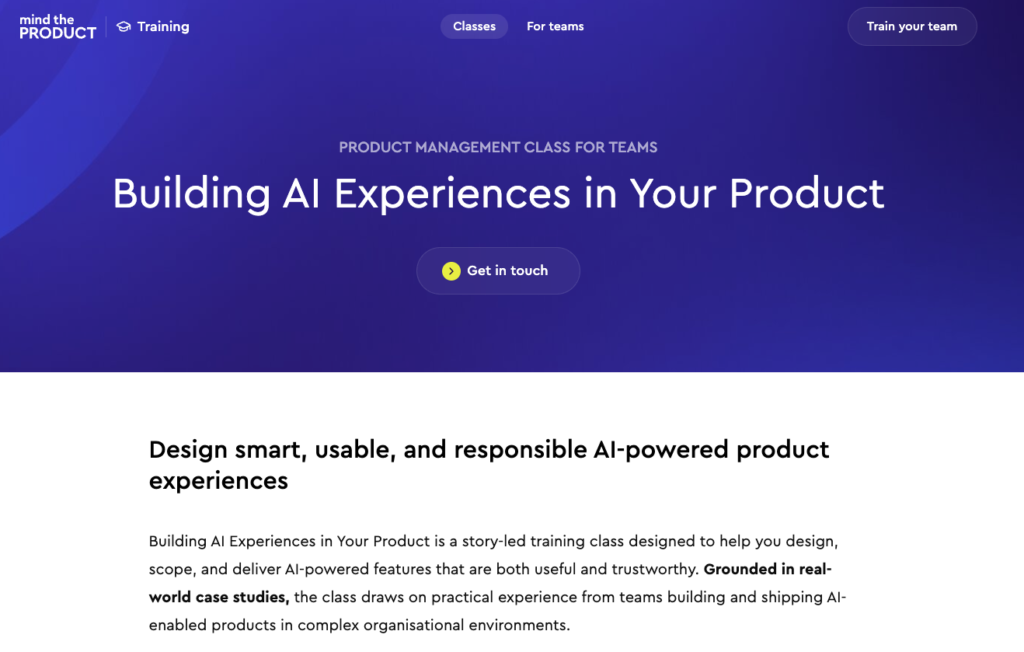
Building AI Experiences in Your Product from Mind the Product is more specialized than a general AI PM certification.
The class focuses on one important question: how do you design and deliver an AI-powered experience that people can actually use and trust?
Its current curriculum includes identifying AI opportunities, AI UX patterns, LLM behaviour and constraints, guardrails, cross-functional delivery, measurement, uncertainty, and user trust after launch.
What you will learn:
- How to identify useful AI opportunities
- AI-specific user experience patterns
- How LLM behaviour affects product design
- How to communicate uncertainty inside an AI experience
- Guardrails for AI features
- Responsible product scoping
- Working across product, design, engineering, and AI teams
- Metrics for AI experiences
- Measuring user trust
- Iterating on an AI feature after launch
I would recommend this more strongly to someone who already understands PM basics and is about to work on an actual AI feature.
AI UX deserves more attention than it normally gets.
Think about a traditional search feature. A user enters a query, receives results, and understands roughly what the system did. Now replace that with a generative answer. Should you show sources? Should users be able to inspect them? What happens when confidence is low? Can the AI take an action automatically? Should the user approve it first? What should the interface do when the model cannot answer?
Those are product questions, not just model questions.
If that is the part of AI Product Management you want to improve, this class has a much tighter focus than a general certificate.
10. Pendo AI for Product Management Course
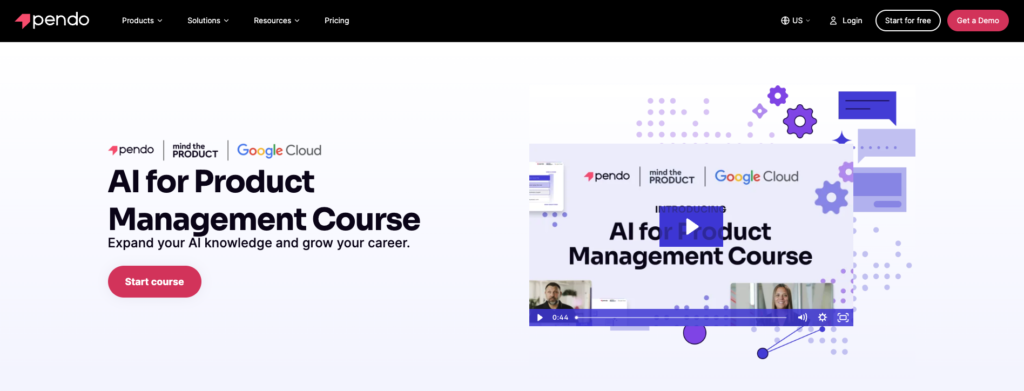
Pendo’s AI for Product Management Course is the option I would use as a compact introduction rather than as my complete AI Product Manager education.
Pendo developed the course with Google Cloud and Mind the Product. Its curriculum covers AI use cases, using AI during the product development lifecycle, and thinking about AI-powered features inside software products. The course page remains active in 2026.
What you will learn:
- Where AI fits into product management
- Common AI use cases for product teams
- Using AI during product development
- Data analysis and experimentation use cases
- AI-assisted product communication
- How AI can become part of a product
- Principles for thinking about AI-powered features
- AI product strategy at an introductory level
I would not choose Pendo instead of IBM, Duke, Product School, or Product Faculty if my goal were a full career transition.
I would use it when I wanted an accessible first exposure before choosing something deeper.
It can also make sense for an experienced Product Manager who has not yet worked with AI and wants enough context to decide which parts of the field require further study.
That is often a better use of an introductory course than expecting one certificate to teach every part of a multidisciplinary role.
The best book to pair with an AI Product Management course
Courses are useful because they give you an order to follow. They explain a concept, give you exercises, and move you to the next topic.
The problem appears later.
A few months after finishing the course, you may need to revisit how an AI PRD should work. Then you may need to prepare an interview answer about RAG. A week later, you may want ideas for an AI PM portfolio project. Later you might need to rewrite your resume, review model evaluation concepts, understand agents, or decide what to learn next.
That is one reason I think a course and a role-specific book work well together.
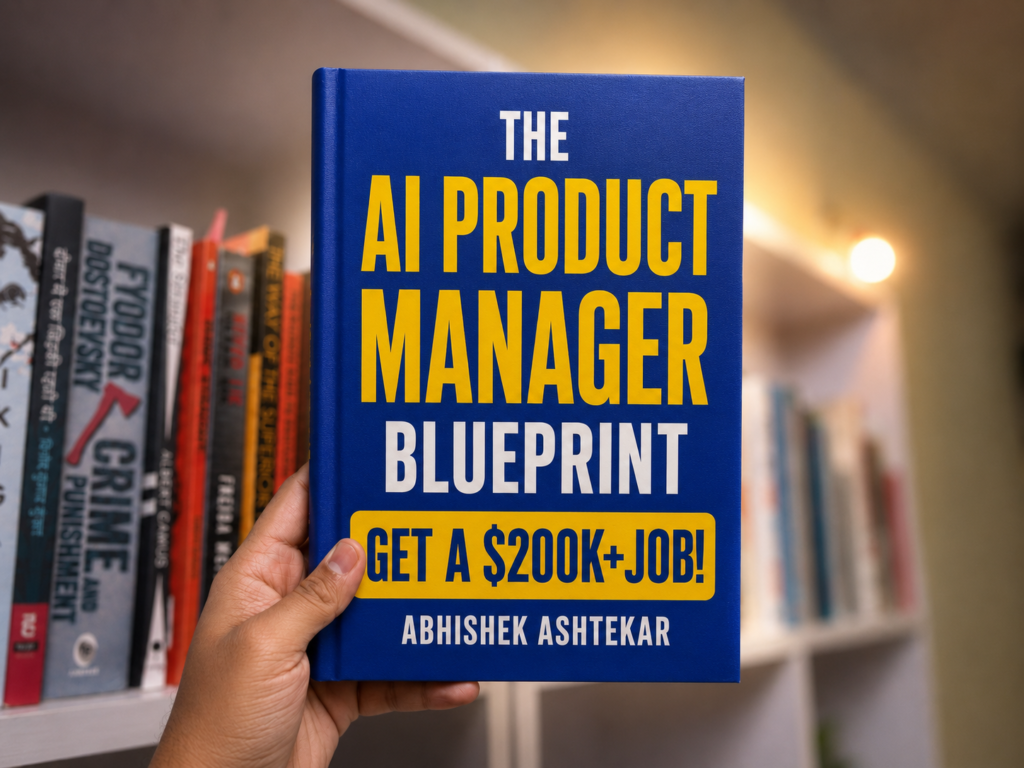
I wrote The AI Product Manager Blueprint for that purpose. It is built specifically around becoming an AI Product Manager rather than teaching artificial intelligence in isolation. The book covers the AI PM role, product thinking, discovery, user research, PRDs, roadmaps, metrics, AI and machine learning fundamentals, LLMs, prompt and context engineering, RAG, agents, model evaluation, responsible AI, portfolio projects, resumes, job search, and interview preparation. The current Amazon description lists 88 chapters and five portfolio-ready projects.
I would not use the book as an excuse to avoid taking a good course. I would use the two differently.
Take IBM if you need a structured beginner program. Use Duke when you want a better understanding of ML products. Take Product School or Product Faculty when you want to work more directly with current AI product concepts. Then keep the book beside that learning path as the broader reference that connects the technical learning with projects, portfolio work, job preparation, and the rest of the career.
If you still need stronger general AI foundations before focusing entirely on product, my complete guide to learning AI from scratch in 2026 covers the concepts and learning path in more detail.
Conclusion: How to choose among the best AI product management courses
If you asked me to choose only one course without knowing anything about your background, I would pick the IBM AI Product Manager Professional Certificate.
It is the easiest recommendation because it covers both sides of the role. You learn normal product management before moving further into AI, generative AI, strategy, responsible AI, and related concepts. That makes it useful for the widest range of beginners.
But I would change the recommendation depending on your starting point:
- If you are completely new to Product Management, start with IBM.
- If you already understand PM and want stronger machine learning knowledge, choose Duke.
- If you are a working PM who wants current AI product methods, look at Product School.
- If you want to build with agents, RAG, evals, and newer AI workflows, look closely at Product Faculty.
- If portfolio-style projects matter most to you, Udacity is worth considering.
- If you prefer live practitioner-led learning, look at Marily Nika’s course.
- If you want AI integrated into an established product framework, consider Pragmatic Institute.
- If you need broad PM fundamentals and prefer Microsoft’s learning ecosystem, consider Microsoft’s certificate.
- If you specifically want to improve AI UX, guardrails, and trust, Mind the Product has the clearest focus.
- If you want an introductory course before making a larger commitment, start with Pendo.
Do not choose an AI PM course because the certificate name sounds impressive. Open the curriculum.
Look for product discovery. Look for AI and ML fundamentals. Look for LLMs. Look for evaluation. Look for data. Look for AI UX. Look for responsible AI. Look for projects. If the course talks endlessly about prompt writing but never teaches you how to decide whether an AI feature works, it is missing an important part of the job.
You can also read my guide to 7 AI skills that lead to high-paying jobs in 2026 if you want to see how broader AI skills connect with career development.
And if you prefer learning through books alongside courses, my guide to the best AI Product Management books can help you choose what to read based on whether you are a beginner, an experienced PM, or someone who wants deeper technical knowledge.
Frequently asked questions about AI Product Manager courses online
1. What are the best AI product management courses in 2026?
My overall shortlist is IBM’s AI Product Manager Professional Certificate, Duke University’s AI Product Management Specialization, Product School’s AI Product Management Certification, Product Faculty’s AI Product Management Certification, Udacity’s AI Product Manager Nanodegree, Dr. Marily Nika’s AI Product Management course, Pragmatic Institute’s AI Product Management Expert Certification, Microsoft’s AI Product Manager Professional Certificate, Mind the Product’s Building AI Experiences in Your Product, and Pendo’s AI for Product Management Course.
They are not interchangeable. IBM is the strongest general starting point in this list, Duke is stronger for ML understanding, while Product School and Product Faculty move further into current generative AI product work.
2. Which AI Product Management course is best for beginners?
For a complete beginner, I would choose the IBM AI Product Manager Professional Certificate.
It teaches product management and AI instead of assuming you already know one of them. IBM currently covers stakeholders, Agile, product development, roadmaps, machine learning, generative AI, prompt engineering, responsible AI, AI strategy, and generative AI agents.
Microsoft is another beginner option if you want an even broader introduction to general product management, while Duke makes more sense if your main goal is understanding the machine learning side of AI products.
3. Do I need coding skills to become an AI Product Manager?
You do not need to become a software engineer to work in AI Product Management.
Duke’s AI Product Management Specialization explicitly teaches its ML material without requiring programming, and Product Faculty currently states that its AI PM certification does not require previous AI or coding experience.
You still need technical literacy.
You should eventually understand APIs, models, datasets, prompts, context windows, embeddings, RAG, agents, evaluation, latency, cost, privacy, and model limitations well enough to have productive conversations with engineers and data scientists.
Being able to prototype with AI tools can make you more effective, but that is different from training to become an ML engineer.
4. Are AI product management certification courses worth it?
They can be worth it when the course helps you produce evidence of skill.
I would care far more about the curriculum, assignments, projects, feedback, and what you can explain after the course than the digital badge by itself.
This is also why I pay attention to project-based programs when comparing certifications. Duke includes applied ML-product projects, Udacity includes project work, Product School builds AI product specifications, and Product Faculty currently includes an AI product capstone.
A certificate can support your resume. It should not be the only evidence that you understand the job.
5. Is an AI Product Management certificate enough to get an AI Product Manager job?
No. I would not plan a job search around a certificate alone.
A stronger combination is:
- One good AI Product Management course
- A working understanding of the AI concepts behind modern products
- Several AI product case studies or projects
- Clear PRDs and product thinking
- A portfolio that explains your decisions
- A resume tailored to AI Product Management
- Enough technical understanding to handle AI questions in an interview
- Product sense, metrics, prioritization, and strategy preparation
This is one reason the project discussion around courses matters. An older Reddit comment from an Udacity graduate focused on what the projects taught them rather than simply saying they had earned the Nanodegree.
The certificate gets a line on your resume. The work gives you something to talk about.
6. Which is better for AI Product Management: IBM or Duke?
Choose IBM if you are new to both Product Management and AI.
Choose Duke if you already have some product understanding and want a clearer mental model of machine learning products.
IBM currently has a broader curriculum across product management, Agile, roadmaps, generative AI, prompting, responsible AI, agents, and AI strategy. Duke goes deeper into ML foundations, data, model evaluation, the data science process, human-centered AI, privacy, and ethics.
If I were changing careers from a non-product background, I would start with IBM. If I were already a PM who kept getting lost during conversations with ML engineers and data scientists, I would choose Duke.
7. What should a good AI Product Manager course teach in 2026?
I would expect a serious AI PM course to cover more than prompts.
At minimum, look for a reasonable mix of:
- Product discovery and problem definition
- Product strategy and prioritization
- AI and machine learning fundamentals
- Data and data quality
- LLM fundamentals
- AI-specific requirements
- RAG
- AI agents
- Model or output evaluation
- AI UX
- Guardrails
- Responsible AI
- Metrics
- Cost and latency trade-offs
- Prototyping
- Projects or case studies
You will not necessarily find every topic in one program. The current Product School and Product Faculty curricula are good examples of how newer courses are now incorporating RAG, agents, evaluations, and other topics that have become much more relevant to generative AI products.
8. What is the best book for an AI Product Manager?
If your goal is specifically AI Product Management rather than general product management or general artificial intelligence, I would pair a course with The AI Product Manager Blueprint.
I wrote it as a complete role-specific roadmap, and the Amazon listing currently describes 88 chapters covering the AI PM role, product skills, AI and ML fundamentals, LLMs, prompt and context engineering, RAG, agents, model evaluation, responsible AI, portfolio projects, resumes, job search, interviews, and career progression.
The reason I would pair the book with a course rather than choose between them is that they solve different problems. A course gives you guided instruction. A book is easier to return to when you need one concept, one framework, one project idea, or one part of the career roadmap again.
9. Can I become an AI Product Manager without a technical background?
Yes, but you should not use “non-technical” as a reason to avoid learning how AI products work.
Several current programs are built for people without coding backgrounds. Duke requires no programming, while Product Faculty says no prior coding or AI experience is necessary.
You can start from marketing, design, operations, consulting, analytics, business, or traditional Product Management.
Your job is not necessarily to train the model yourself. Your job is to make sensible product decisions around the technology. That becomes difficult if terms such as hallucination, retrieval, embeddings, context, evals, model drift, precision, latency, or agent tools mean nothing to you.
Learn the technical concepts to the level required for product decisions, then keep building from there.
10. Should I take an AI course or build AI Product Management projects first?
If you are starting from zero, learn enough first that your project decisions have some reasoning behind them. Then start building as early as possible.
I would not spend months completing course after course before creating anything.
A useful progression is to learn one concept, apply it, document what happened, and then move on. For example, after learning RAG, design a small knowledge assistant. Define its users, sources, retrieval behaviour, success criteria, failure cases, and evaluation set. After learning AI agents, design a workflow where an agent can use tools and decide when human approval is required.
Your finished project should explain the product decisions, not just display a chatbot interface.
That is much closer to the work an AI Product Manager needs to understand.
Final thoughts
There are many more AI courses for Product Managers than there were a few years ago, but more choice does not automatically make the decision easier.
If you are starting completely from zero, I would keep it simple. Start with IBM. Learn product management and AI together. Build a small project while you learn. Then decide which gap you need to close next.
If you already work in product, do not automatically restart from beginner PM material. Duke can strengthen your ML understanding. Product School can move you into AI-specific requirements, RAG, agents, UX, evaluations, and guardrails. Product Faculty can push you further into hands-on modern AI building. Mind the Product can help if your biggest challenge is designing AI experiences people can understand and trust.
The best AI product management courses are the ones that close your actual skill gaps and leave you able to explain how an AI product should be discovered, scoped, built, evaluated, launched, and improved.
Pick one. Learn the material properly. Build something from it. Then move to the next gap instead of collecting certificates.